KAPDEC® | Elite STEM Learning Platform | https://kapdec.com
Unit: Number System
Chapter: Expanded Form & Order Relations
Reference: – Expanded Form of Numbers (Indian and International Systems), Writing Numbers in Expanded Notation, Place Value Expansion, Comparing Numbers (Same Number of Digits, Different Number of Digits), Order Relations (<, >, =), Ascending and Descending Order, Arranging Numbers in Order, Forming Numbers from Given Digits
After studying this chapter, you should be able to understand:
- Expanded Form of Numbers in Indian and International Systems
- Writing Numbers in Expanded Notation
- Place Value Expansion & Its Applications
- Comparing Numbers with Same Number of Digits
- Comparing Numbers with Different Number of Digits
- Order Relations: <, >, =
- Ascending and Descending Order
- Forming Numbers from Given Digits
The International Place Value System
In this system, we start grouping the number from right in group of 3 called period.
- Starting from the right, the first period is ones, consisting of three place values i.e. ones, tens and hundreds.
- The next period is thousands, consisting of three places i.e. thousands, ten-thousands and hundred-thousands.
- The third period is millions consisting of three places i.e. millions, ten-millions and hundred million and then billions, trillions and so on.
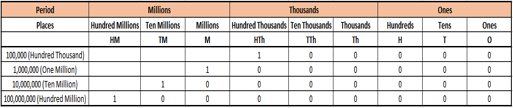
Source: Kapdec.com
Reading and writing a number
- While reading a number in the International system, all of the digits in the same period are read together and the name of the period (except the ones) is read along with them.
- While writing a number in the International system, we put a comma after every period to separate the period and making it easier to read.
Example 1: Write the following in words:
- 227,842
- 36,479,111
- 508,541,360
Solution: Let us arrange the digits in International place value chart as follows:

Source: Kapdec.com
- Two hundred twenty-seven thousand eight hundred forty two
- Thirty-six million four hundred seventy-nine thousand one hundred eleven
- Five hundred eight million five hundred forty-one thousand three hundred sixty
Example 2 : Write the following in figures :
- Three hundred five million thirty-seven thousand sixty three
- Eighty-nine million one hundred twenty-six thousand ninety
- Two million twenty
Solution: Let us make the International place value chart and write the digits in the respective places from the number name.

Source: Kapdec.com
The required number is-
- 305,037,063
- 89,126,090
- 2,000,020
Expanded Form
- A number when expressed with its place value denotes its expanded form.
- Suppose we write a number 619, here we actually mean that we have a total of 600 + 10 + 9. This expansion shows the value of each of its digit and hence represents the expanded form.
- The expanded form varies in the Indian and International structure as per their defined period.
International Place Value System
Examples:
Expand the following numbers as per International Place Value System:
- 81,664
- 1,697,832
We can expand any given number in three ways:
- 81,664
= 8 ten thousand + 1 thousand + 6 hundred + 6 ten +
4 one
Or = 8 x 10,000 + 1 x 1,000 + 6 x 100 + 6 x 10 + 4 x 1
Or = 80,000 + 1,000 + 600 + 60 + 4
- 1,697,832
= 1 million + 6 hundred thousand + 9 ten thousand +
7 thousand + 8 hundred + 3 ten + 2 one
Or = 1 x 1,000,000 + 6 x 100,000 + 9 x 10,000 + 7 x
1,000 + 8 x 100 + 3 x 10 + 2 x 1
Or = 1,000,000 + 600,000 + 90,000 + 7,000 + 800 + 30 +
2
Did you know??
- Zero was invented by Aryabhata. India invented the Number System.
- The place value system and the decimal system were developed in India in 100 BC.
- The largest numbers used by the Greeks and the Romans were 10^6 whereas Hindus used numbers as big as 10^53 with specific names as early as 5000 BC during the Vedic period.
