Unit (5): Heredity
Chapter: Chromosomal inheritance
Reference: chromosomal theory of inheritance, law of independent assortment, genetic disorders, mendelian disorders, chromosomal disorders
Learning objectives
- To study about chromosomal theory of inheritance
- To learn about genetic disorders
Chromosomal theory of inheritance
Proposed by Sutton and Boveri independently in 1902 and in 1933 T. H. Morgan confirmed these findings.
- According to this theory genes are located at specific loci on the chromosome and it is the chromosome which segregate and assort independently during meiosis and recombine at the time of fertilization in zygote.
Features of theory:
- Gamete constitute bridge between one generation and next generation.
- Both sperm and ova contribute equally in the heredity of the offspring.
- Chromosome which resides in the nucleus carry the heredity.
- Every chromosome has definite role in the development of an individual, loss of which produce structural and functional deficiency in the organism.
- Both chromosome and genes occur in the pair in the somatic or diploid cells.
- Homologous chromosome synapse during meiosis and then segregate independently into different cells.
- In many organisms, sex of an individual is determined by specific chromosome called sex chromosome.
Non-disjunction as a proof of chromosomal theory-ene for eye color was on the X chromosome of Drosophila by correlating the inheritance of that gene with the transmission of t
- Morgan showed that a ghe X chromosome during reproduction.
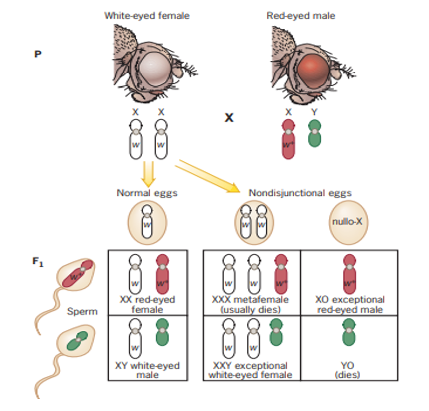
Fig.1. X chromosome nondisjunction is responsible for the exceptional progeny that appeared in Bridges’ experiment. Non-dysfunctional eggs that contain either two X chromosomes or no X chromosome unite with normal sperm that contain either an X chromosome or a Y chromosome to produce four types of zygotes. The XXY zygotes develop into white-eyed females, the XO zygotes develop into red-eyed, sterile males, and the YO zygote die. Some of the XXX zygote develop into sticky, red-eyed females, but most of them die.
- Bridges’ ability to explain the exceptional progeny that came from these crosses showed the power of the chromosome theory. Each of the exceptions was due to anomalous chromosome behaviour during meiosis. Bridges called the anomaly nondisjunction because it involved a failure of the chromosomes to disjoin during one of the meiotic divisions. This failure could result from faulty chromosome movement, imprecise or incomplete pairing, or centromere malfunction
The chromosomal basis of Mendel’s Principle–
- Principle of segregation-During the first meiotic division, homologous chromosomes pair. One of the homologues comes from the mother, the other from the father. If the mother was homozygous for an allele, A, of a gene on this chromosome, and the father was homozygous for a different allele, a, of the same gene, the offspring must be heterozygous, that is, Aa. In the anaphase of the first meiotic division, the paired chromosomes separate and move to opposite poles of the cell. One carries allele A and the other allele a. This physical separation of the two chromosomes segregates the alleles from each other; eventually, they will reside in different daughter cells. Mendel’s Principle of Segregation is therefore based on the separation of homologous chromosomes during the anaphase of the first meiotic division
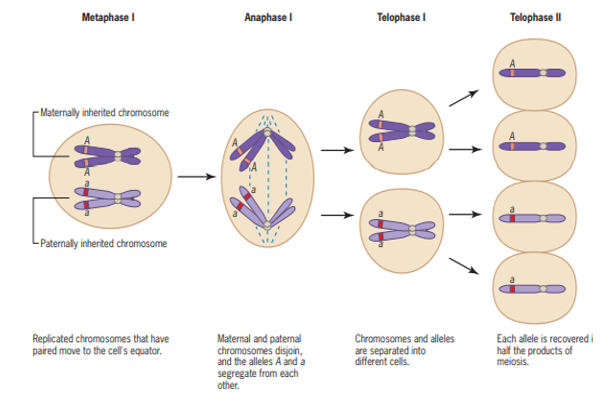
Fig.2. Mendel’s Principle of Segregation and meiotic chromosome behaviour. The segregation of alleles corresponds to the disjunction of paired chromosomes in the anaphase of the first meiotic division.
- Principle of Independent Assortment- Fig.3. shows detailed explanation of this.
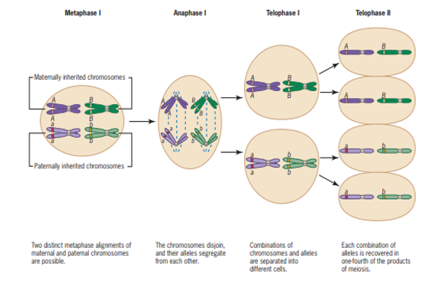
Fig.3. Mendel’s Principle of Independent Assortment and meiotic chromosome behavior. Alleles on different pairs of chromosomes assort independently in the anaphase of the first meiotic division because maternally and paternally inherited chromosomes have aligned randomly on the cell’s equator.
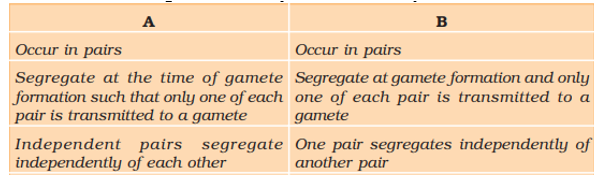
Fig.4. Comparison between the behaviour of chromosome and genes
- Drosophila melanogaster- T. H. Morgan used it as experimental material for genetics experiment.it has following advantages:
(a)Easily available
(b) can be easily reared inside bottles.
(c)a new generation can be raised within two weeks
(d) easy male and female distinction
(e)presence of polytene chromosome in salivary gland
(f)the organism has only 4 pair of chromosomes
(g) cost effective.
Genetic disorders
They are of two types-
- Mendelian disorders
- Chromosomal disorders
Mendelian disorders-These disorders are transmitted to the offspring on the same lines. The pattern of inheritance of such Mendelian disorders can be traced in a family by the pedigree analysis, they may be dominant or recessive.
Gene mutation in autosome-
(a)Recessive traits-
- Alkaptonuria- metabolic disorder due to the deficiency of oxidase enzyme required for the breakdown of tyrosine. The toxic by product produce is homogentisic acid. AA, Aa are normal but aa is alkaptonuric.
- Tay-Sach’s disease-a degenerated CNS is present in the homozygous children due to accumulation of fatty acid in nerve cells.
- Gaucher’s disease- characterized by the impaired break down of fatty acid substance cerebroside and have inhibited activity of enzyme glucocerebrosidase in lysosome.
- Sickle cell anaemia-in this disorder the erythrocytes become sickle shaped under oxygen deficiency. The defect is caused by the substitution of Glutamic acid (Glu) by Valine (Val) at the sixth position of the beta globin chain of the haemoglobin molecule. The substitution of amino acid in the globin protein results due to the single base substitution at the sixth codon of the beta globin gene from GAG to GUG.
- Pheynylkatponuria-This inborn error of metabolism is also inherited as the autosomal recessive trait. The affected individual lacks an enzyme that converts the amino acid phenylalanine into tyrosine. As a result of this phenylalanine is accumulated and converted into phenylpyruvic acid and other derivatives. Accumulation of these in brain results in mental retardation. These are also excreted through urine because of its poor absorption by kidney.
- Haemophilia-This sex-linked recessive disease, which shows its transmission from unaffected carrier female to some of the male progeny has been widely studied. In this disease, a single protein that is a part of the cascade of proteins involved in the clotting of blood is affected. Due to this, in an affected individual a simple cut will result in non-stop bleeding. The heterozygous female (carrier) for haemophilia may transmit the disease to sons. The possibility of a female becoming a haemophilic is extremely rare because mother of such a female has to be at least carrier and the father should be haemophilic (unviable in the later stage of life). The family pedigree of Queen Victoria shows a number of haemophilic descendents as she was a carrier of the disease
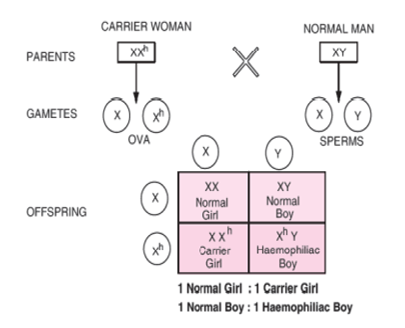
Fig.21. Inheritance of haemophilia
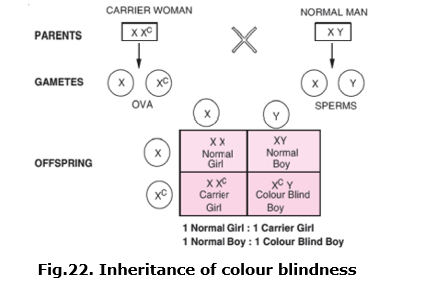
- Colour Blindness- It is a sex-linked recessive disorder due to defect in either red or green cone of eye resulting in failure to discriminate between red and green colour. This defect is due to mutation in certain genes present in the X chromosome. It occurs in about 8 per cent of males and only about 0.4 per cent of females. This is because the genes that lead to red-green colour blindness are on the X chromosome. Males have only one X chromosome and females have two. The son of a woman who carries the gene has a 50 per cent chance of being colour blind. The mother is not herself colour blind because the gene is recessive. That means that its effect is suppressed by her matching dominant normal gene. A daughter will not normally be colour blind, unless her mother is a carrier and her father is colour blind.
- Thalassemia-This is also an autosome-linked recessive blood disease transmitted from parents to the offspring when both the partners are unaffected carrier for the gene (or heterozygous). The defect could be due to either mutation or deletion which ultimately results in reduced rate of synthesis of one of the globin chains (α and β chains) that make up haemoglobin. This causes the formation of abnormal haemoglobin molecules resulting into anaemia which is characteristic of the disease. Thalassemia can be classified according to which chain of the haemoglobin molecule is affected. In α Thalassemia, production of α globin chain is affected while in β Thalassemia, production of β globin chain is affected. α Thalassemia is controlled by two closely linked genes HBA1 and HBA2 on chromosome 16 of each parent and it is observed due to mutation or deletion of one or more of the four genes. The more genes affected, the less alpha globin molecules produced. While β Thalassemia is controlled by a single gene HBB on chromosome 11 of each parent and occurs due to mutation of one or both the genes. Thalassemia differs from sickle-cell anaemia in that the former is a quantitative problem of synthesising too few globin molecules while the latter is a qualitative problem of synthesising an incorrectly functioning globin.
(b)Dominant trait-
- Huntington chorea-appears at the age of 45-50, defective gene is dominant autosomal located on the 4h chromosome, characterized by disorganized muscular movement.
- Achondroplasia-type of dwarfness, with abnormally short legs and hands and only 20% of such individual reach to adulthood.
- Polydactyly- person with extra finger and toes.
- Brachydactyly– the hands, toes or fingers of that person are short and thick.
Chromosomal disorders-The chromosomal disorders on the other hand are caused due to absence or excess or abnormal arrangement of one or more chromosomes. Failure of segregation of chromatids during cell division cycle results in the gain or loss of a chromosome(s), called aneuploidy. Failure of cytokinesis after telophase stage of cell division results in an increase in a whole set of chromosomes in an organism and, this phenomenon is known as polyploidy (common in plants).
- Autosomal trisomy (due to autosomal disjunction)-
- Patau syndrome- trisomy (increase in number of chromosomes in particular set of chromosome) of 13th chromosome
- Edward syndrome- trisomy of 18th chromosome
- Down syndrome- trisomy of 21st chromosome.
- Allosomal trisomy- (due to allosomal disjunction)
- Klinefelter syndrome- (XXY)- trisomy of sex chromosome, total number of chromosomes 47(44A+XXY), have mental retardation and individual is male due to presence of Y chromosome, and are sterile.
- Jacob’s syndrome or super male- (XYY)- duplication of Y chromosome, chromosome number is 47, can be fertile or sterile, robust body, aggressive and have criminal mindset.
- Allosomal monosomy (2n-1)-
Turner’s syndrome- total number of chromosomes is 45 (44A+X), individual is female, due to absence of Y chromosome, have webbed neck, broad shoulder, low-set pinna, ovulation, and menstrual cycle absent, secondary sexual character is also poorly developed.
Solved examples
Example 1. Chromosomal theory of Inheritance was proposed by—-
a) Morgan b) Sutton and Boveri c) Bateson d) Punnet
Solution 1: b. Chromosomal theory of Inheritance was proposed by Sutton and Boveri
Example 2. Walter Sutton worked with—–
- rabbits b) pea plants c) grasshoppers d) macaroni
Solution 2: c. Walter Sutton worked with grasshoppers
Summary
- After knowing that genes are located on chromosome, a good correlation was drawn between Mendel’s law – segregation and assortment of chromosome during meiosis.
- Mendel’s laws were extended in form of chromosomal theory of inheritance.
- Sickle-cell anaemia is caused due to change of one base in the gene coding for beta-chain of haemoglobin.
- Down’s syndrome is due to trisomy of chromosome 21, where there is an extra copy of chromosome 21 and consequently the total number of chromosomes becomes 47.
- In Turner’s syndrome, one X chromosome is missing and the sex chromosome is as XO, and in Klinefelter’s syndrome, the condition is XXY