Unit: Gene expression and regulation
Chapter: Replication
Reference: Replication, The Machinery, and the Enzymes
Process of replication, Difference between prokaryotic and eukaryotic DNA replication
Learning objectives
- To understand the process of DNA replication
- To differentiate prokaryotic and eukaryotic replication
Replication
- The process that facilitates the formation of newly formed DNA over the old strand of DNA is called replication and take place just prior to cell division.
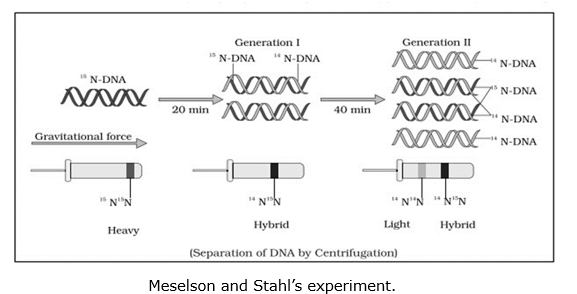
- The DNA replicate via semi conservative mode of replication, proved by Taylor (1957) in Vicia Fabia using triradiated thymidine.
- It is also experimentally proved by Meselson and Stahl by conducting following experiment:
(a) Culturing E. coli for many generations in N15 containing culture.
(b) N15 was incorporated as nitrogenous base in newly synthesized DNA.
(c) Heavy DNA separated from normal by centrifugation in CsCl (caesium chloride) density gradient.
(d) E.coli cells having N15 was transferred to N14 medium.
(e) Extraction of DNA from E. coli cells in step (d) and measured density of ds DNA in CsCl centrifugation.
- Results of experiment: After one generation, resultant DNA was hybrid with one strand having N15 isotope and other having N14.
- DNA extracted after recycling of procedure produced 2 types of DNA– hybrid and light
The Machinery and the Enzymes
The enzymes required for the replication are:
- DNA polymerase- polymerisation of deoxyribonucleotide triphosphate, discovered by Kornberg in 1957. In prokaryotes there are three types of DNA polymerase-
- DNA polymerase I-DNA repair after replication completes and 5' → 3' polymerisation activity.
- DNA polymerase II – catalyse 5' → 3' synthesis + 3' → 5' exonuclease activity.
- DNA polymerase III – DNA synthesis in 5' → 3' direction + 3' → 5' and 5' → 3' exonuclease activity.
Eukaryotes have five types of DNA polymerase-
- DNA polymerases α- for initiation of replication
- DNA polymerase β- involved in DNA repair.
- DNA polymerase γ- involved in the mitochondria DNA repair.
- DNA polymerase δ- involved in replication activity
- DNA polymerase ε- involved in polymerase activity of Hela cells.
- DNA ligase- helps in joining the newly synthesised strand of DNA.
- other enzymes- topoisomerase (corrects overwinding), helicase (unzip parental double helix) and primase (synthesize RNA primer), SSB-single stranded binding protein (stabilize single strand of DNA)
Process of replication:
- DNA replication occurs during S phase of cell cycle, which requires DNA template and DNA polymerase along with primer.
- DNA double helix is unwound by helicase enzyme and single stranded (ss) DNA is stabilized by SSB-single stranded binding protein.
- DNA topoisomerase allows the helix to unwind without causing extensive rotation of the chromosome
- DNA replication begins at a specific site called ori (origin) which has recognition site for DNA polymerase, which also provides site for attachment of RNA primer.
- RNA primer is essential for DNA replication because without the presence of RNA primer, DNA polymerases cannot add nucleotides. RNA primer is synthesized at 5' end of new DNA.
- The enzyme which forms RNA from DNA are called RNA polymerase. The synthesis of RNA primer is brought about by enzyme primase.
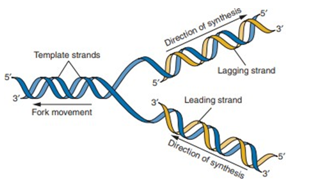
- In bacterial chromosome, replication starts at a single origin and both strands of a double helix serve as template for DNA synthesis which proceeds outwards in both directions from single origin (i.e., it is bidirectional).
- Region of DNA undergoing replication forms replication bubble/replication eye having replicating fork moving in opposite direction.
- dsDNA is antiparallel, one strand runs in 5'-3' direction and its complementary strand runs in 3'-5'. New DNA strand is made against each template strand. DNA polymerase polymerises DNA only in 5'- 3' direction. So, template strand with 3'-5' orientation, new DNA strand is form in continuous manner in 5'-3' direction. This DNA is called leading strand.
- Template strand which has 5' → 3' orientation, DNA polymerase synthesizes short stretches of new DNA (about 1000 nucleotides long) in 5'-3' direction and then joins these pieces together. These small fragments are called Okazaki fragments and new DNA strand made in this discontinuous manner is called lagging strand. Okazaki fragments are joined by DNA ligase.
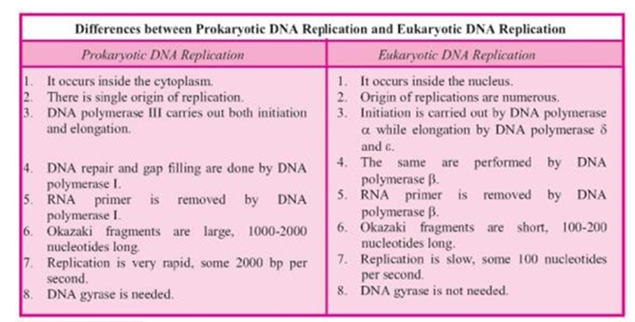
Difference between prokaryotic and eukaryotic DNA replication
Solved examples
Example 1. The enzyme that unzips the DNA to prepare for replication
a) helicase b) replicase c) polymerase d) synthase
Solution 1: a. The enzyme that unzips the DNA to prepare for replication is helicase.
Example 2. In what phase of the cell cycle does DNA replication take place?
a) G1 b) S c) G2 d) M
Solution 2: b. DNA replication occurs in S phase of cell cycle.
Summary
- DNA replication process follows a semiconservative pattern. Each double helix strand serves as a template for creating a new, complementary strand.
- DNA polymerases, which require a template and a primer (starter) synthesize DNA in the 5' to 3' orientation, creating a new DNA strand.
- One new strand (the leading strand) is created as a continuous piece during DNA replication. On the other hand, the lagging strand comprises little bits.
- In addition to DNA polymerase, other enzymes such as DNA primase, DNA helicase, DNA ligase, and topoisomerase are required for DNA replication