Unit: Gene expression and regulation
Chapter: Transcription and RNA processing
Reference: Transcription, Regions of transcription unit, The Gene, Types Of RNA, The Process of Transcription, Complexity in Eukaryotic Transcription, Post transcriptional modifications in eukaryotes
Learning objectives
- To understand about transcription in prokaryotes and eukaryotes
- To learn about post transcriptional modifications in eukaryotes
Transcription
DNA or genes give instructions for the synthesis of proteins, which constitute most of the substances in our body, such as enzymes, hormones, antibodies etc. Transcription is the first step in the synthesis of proteins from DNA. Transcription Unit
The central dogma of molecular biology is as follows:
DNA → RNA → protein
Transcription is the copying of genetic information from one DNA strand into RNA-by-RNA polymerase. Like replication, it is also governed by the principle of complementarity. However, unlike replication, only one DNA strand is copied to RNA in transcription.
Firstly, if both DNA strands act as templates, it will result in two different RNA sequences and in turn give rise to two different proteins. This complicates the transfer of genetic information. Secondly, the two RNA sequences produced will be complementary to each other and produce a double-stranded RNA. This will prevent RNA from being translated into protein.
Regions of transcription unit
1. Structural Gene
The two DNA strands within the structural gene has different names. Since RNA polymerase catalyses polymerization in only one direction 5′ → 3′, the strand with 3′ → 5′ polarity becomes the template strand. The other strand with 5′ → 3′ polarity is displaced during transcription and is called the coding strand even though it does not code for anything. In a transcription unit, the promoter and terminator regions lie on either side of the structural gene.
2. Promoter
It is a DNA sequence located towards the 5′ end (upstream) of the coding strand. It is the binding site for RNA polymerase and is the site that tells the polymerase to start transcription. Additionally, the presence of the promoter defines the template and coding strand in a transcription unit.
3. Terminator
It is a DNA sequence located towards the 3′ end (downstream) of the coding strand. It provides the stop signal and defines the end of transcription. Additional regulatory sequences may be present upstream or downstream of the promoter.
The Gene
The functional unit of inheritance is a gene. Although genes are located on DNA, it is difficult to define a gene in terms of DNA sequence. A DNA sequence that codes for tRNA (transfer RNA) or rRNA (ribosomal RNA) is also a gene.
A cistron is a segment of DNA that codes for a polypeptide (a polymer of amino acids). A cistron can be polycistronic (mostly in prokaryotes and bacteria), i.e., it can code for several proteins. It can also be monocistronic (mostly in eukaryotes) i.e., its codes for a single protein. The monocistronic genes in eukaryotes consist of coding sequences called exons and intervening sequences called introns. Exons appear in mature or processed RNA whereas introns do not.
Types Of RNA
There are three major types of RNAs in bacteria:
- Messenger RNA (mRNA) – It provides the template to make protein.
- Transfer RNA (tRNA) – It reads the genetic code and transfers amino acids for protein synthesis.
- Ribosomal RNA (rRNA) – It has a structural and catalytic role in protein synthesis.
The Process of Transcription
Transcription has the following steps:
Initiation: Here, RNA polymerase binds to the promoter region and transiently binds to the ‘initiation factor’ to initiate transcription.
Elongation: This is the step where the RNA strand starts getting longer. RNA polymerase “walks” along one strand of DNA. For every nucleotide recognized on the DNA template, it adds a complementary RNA nucleotide to the growing RNA transcript.
Termination: Transcription stops once the RNA polymerase reaches the terminator region. At this region, the RNA transcript, and the RNA polymerase, both fall off. RNA polymerase transiently associates with the ‘termination factor’ to stop transcription.
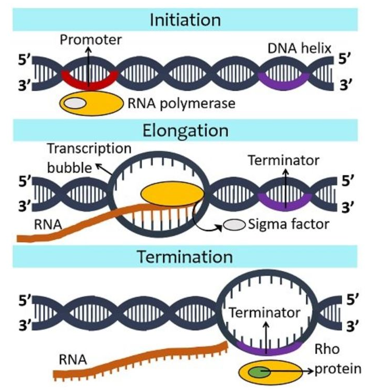
Transcription in bacteria
Complexity In Eukaryotic Transcription
In bacteria, since the mRNA does not need to be processed and since transcription and translation occur in the same cell compartment, the two processes can occur simultaneously. Also, the RNA Polymerase catalyses transcription of all kinds of RNA. Eukaryotes, however, differ and show two main complexities. There are 3 types of RNA polymerases –
- RNA Polymerase I that transcribes rRNA.
- Type II that transcribes a precursor of mRNA – heterogenous nuclear RNA (hnRNA).
- RNA Polymerase III that transcribes tRNA and small nuclear RNAs (snRNA).
Post transcriptional modifications in eukaryotes
Capping
This is the first processing event an mRNA undergoes before translation. Capping is the process of adding a 7-methylguanosine cap to the 5’ end of the primary transcript by phosphate linkage.
Tailing
- Tailing, also known as polyadenylation, is the process of cleavage of the 3’ end and addition of adenylate residues to the same end of the pre-mRNA.
- A conserved sequence 5’-AAUAAA-3′ is present near the 3’ end of the primary transcript that is a polyadenylation signal sequence.
- The end nucleolytic cleavage takes place 10-30 base pairs down this signal sequence, leaving the AAUAAA sequence in the transcript.
- A GU rich region is also present downstream this signal sequence that helps in cleavage and polyadenylation.
- The enzyme poly-A polymerase then adds adenine nucleotides (200-250 in number) to the cleaved pre-mRNA. This addition of adenine residues is called poly-A tailing or polyadenylation.
Splicing
- There are many non-coding sequences present in the primary transcript that can intervene in the process of translation.
- The removal of these non-coding sequences (known as introns) and the reattachment of the coding sequences into a continuous molecule is the process of splicing. The coding sequences are referred to as exons.
- The whole splicing mechanism takes place by recruitment of the spliceosome machinery. This machinery consists of proteins and small nuclear RNAs (snRNA) that recognise the splicing sites.
- In eukaryotes, the pre-mRNAs are spliced in various combinations to produce different mature RNAs, this process is referred to as alternative splicing.
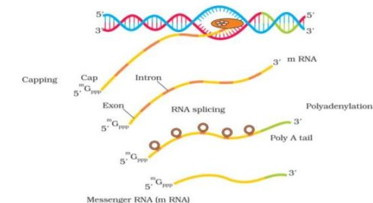
Solved examples
Example 1. Which of the following enzymes is needed for Transcription?
a) Helicase b) DNA Polymerase c) RNA Polymerase d) Ligase
Solution 1: c. RNA polymerase is needed for transcription.
Example 2. Spliceosomes are not found in cells of—-
a) Fungi b) Animals c) Bacteria d) Plants
Solution 2: Spliceosoes are not found in cells of bacteria
Summary
- Transcription is the copying of genetic information from one DNA strand into RNA-by-RNA polymerase
- There are three major types of RNAs in bacteria: m-RNA, t-RNA, r-RNA
- The process of transcription involves initiation, elongation, and termination
- In prokaryotes there is no such post transcriptional changes whereas eukaryotes involve such modifications
- In eukaryotes there are three steps after m-RNA is released i.e. capping, tailing and splicing.