Unit : Heredity
Chapter: Regulation of gene expression
Reference: Regulation of gene expression, Genes are of two types
Types of gene regulation, Lac operon, Tryptophan operon, Catabolite Activator Protein (CAP)
Learning objectives
- To learn about lac operon, tryptophan operon
- To understand catabolite activator protein
Regulation of gene expression
All the mechanism that facilitates a gene to express itself phenotypically at the molecular level, comes under the term gene expression.
In eukaryotes, the regulation could be exerted at (i) transcriptional level (formation of primary transcript), (ii) processing level (regulation of splicing), (iii) transport of mRNA from nucleus to the cytoplasm, (iv) translational level.
Genes are of two types-
- Housekeeping or consecutive genes- the gene that are expressed in the all cells of the body because their product is essential for survival. Ex. Genes that code for the proteins involved in the glycolysis.
- Non-consecutive or regulative or luxury genes or facultative or inducible – the gens that not express themselves all the time.
Gene regulation is the phenomenon of switching off and on a gene depending upon the requirement of the cell and stage of development.
Types of gene regulation-
- Negative or repressible gene regulation- the genes that continuously express themselves till their activity is supressed. Ex: tryptophan operon.
- Positive or inducible gene regulation- the gene that remain unexpressed until they are induced to do it. Ex: Lac operon.
- One of best studied example of gene expression is lactose (lac) operon. Its model is given by Jacob & Monod in 1961.
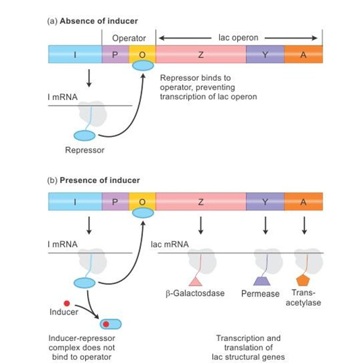
Lac operon- operon is a coordinated group of gene that function together and controls a metabolic pathway. The lac stands for lactose, whose breakdown require three enzymes that are synthesised in a coordinated manner by functional unit of DNA called, Lac operon. As lactose induce the synthesise of these enzymes it is an inducible operon. The Lac operon has-
(a)Structural gene- it has following genes-
- lac z- codes for β-galactosidase, that cause hydrolysis of lactose into glucose into galactose
- lac y- codes for permease, which increase the permeability of β- galactosidase across cell.
- lac a- codes for transacetylase, which cause the transfer of acetyl group to β-galactosidase
(b)Operator gene- it is normally switched off due to binding of repressor over it, however, if repressor is withdrawn by the inducer, the gene allows RNA polymerase to pass from promoter gene to structural gene. It is the gene that receive the product of regulator gene. It allows the functioning of operon, when it is not covered by the biochemical product of regulator gene.
(c)Regulator gene- the gene that forms the product for supressing the activity of operator gene. It produces mRNA that synthesise a biochemical product repressor. The repressor has two sites, one for attachment of operator gene and another for the inducer
(d)Promoter gene- the gene which has site for the attachment for the RNA polymerase. It becomes functional only when it passes the operator gene, this exerts positive control on Lac operon but only function in the absence of glucose.
•Inducer- it has potential to bind with repressor to free the operator gene. In this case, inducer is lactose.
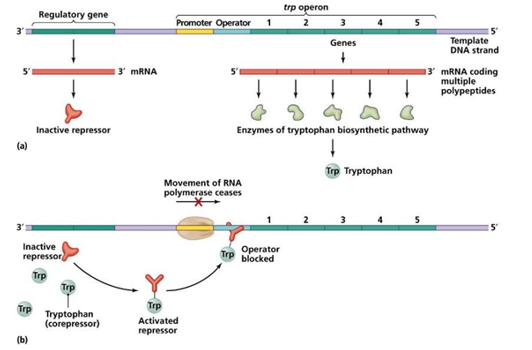
Tryptophan operon– it generally remains active but get switched off, when the product is no longer required. Components of Tryptophan operon-
- Regulator gene- the gene produce code for aporepressor, aporepressor alone is unable to block the operator gene because of the absence of binding head. Therefore, the operon system remains switched on. A complete repressor is formed only when a non- proteinaceous corepressor joins the aporepressor.
- Corepressor- is commonly product of the operon. Normally it is as soon as it is formed. Therefore, the corepressor does not accumulate. However, if the metabolic pathway is blocked or it is available from outside source, the corepressor binds with the apo repressor to produce repressor. The repressor meets the operator gene and block its activity. In tryptophan operon one of its product, amino acid tryptophan act as corepressor
- Promoter gene- it provides site for the attachment of the RNA polymerase, which move onto the structural gene. Provided operator gene remain in the functional state.
- Operator gene- normally, remain switched off and allow the passage of RNA polymerase to structural gene. The operator gene gets switched off when both aporepressor and corepressor combine to form repressor that binds to operator gene and blocks its functional state.
- Structural gene- it has 5 structural genes, trpE, trp D, trp C, trp B and trp A, they form enzymes required for the synthesise of tryptophan
Catabolite Activator Protein (CAP): A Transcriptional Activator
Catabolite activator protein (CAP) acts as a glucose sensor. When glucose levels are low, it activates transcription of the operon. CAP can sense glucose indirectly through the "hunger signal" molecule cAMP.
The CAP binding site is a positive regulatory site that is bound by catabolite activator protein (CAP). When CAP is bound to this site, it promotes transcription by helping RNA polymerase bind to the promoter.
Solved examples
Example 1. Where does the RNA Polymerase bind for the initiation?
a) Regulator b) Structural genes c) Operator d) Promotor
Solution 1: d. RNA polymerase binds to promoter for the initiation.
Example 2. RNA polymerase needs — to initiate transcription.
a) holoenzymes b) transcriptional factors c) histones d) microRNA
Solution 2: b. RNA polymerase needs transcriptional factors to initiate transcription.
Summary
- Regulation of transcription is the primary step for regulation of gene expression.
- In bacteria, more than one gene is arranged together and regulated in units called as operons. Lac operon is the prototype operon in bacteria, which codes for genes responsible for metabolism of lactose.
- The operon is regulated by the amount of lactose in the medium where the bacteria are grown.
- Therefore, this regulation can also be viewed as regulation of enzyme synthesis by its substrate.
- Catabolite activator protein (CAP) acts as a glucose sensor. When glucose levels are low, it activates transcription of the operon.