Unit: Gene expression and regulation
Chapter: Biotechnology
Reference: Biotechnology, Principles of biotechnology, Restriction endonucleases enzymes, Separation, and isolation of DNA fragments
Some important terms, Origin of replication, DNA ligases,
Recognition sites Formation of a recombinant DNA, Various steps in the recombinant DNA formation, Recombinant DNA technology
Polymerase Chain Reaction, Downstream Processing
DNA fingerprinting, Steps in DNA fingerprinting
Learning objectives
- To understand the principles of biotechnology, Restriction endonucleases
- To learn about recombinant DNA technology
- To understand about polymerase chain reaction
- To understand about the technique DNA fingerprinting
Biotechnology: Scientific discipline that deals with techniques of using live organisms or enzymes from organisms to produce products and processes useful to humans
Principles of biotechnology:
The origin of biotechnology is based on the two crucial techniques:
- Genetic engineering-technique that caused change in host phenotype by the introduction of manipulated genetic material into it. (Manipulating DNA of an organism)
- Bioprocess engineering-technique that enables to maintain a sterile (contamination free) environment to promote growth of only desired organism for higher production of products like antibiotics, enzymes, vaccine, etc.
Restriction endonucleases enzymes:
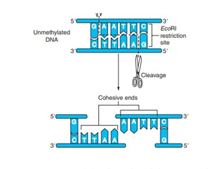
- Discovered by Arber in 1963. They are commonly called as biological scissors.
- The enzymes that cut DNA at specific sites. Ex: Eco RI (Escherichia coli), Hind II (Haemophilus influenzae)
- The specific sites they cleave in DNA are always palindrome.
Separation and isolation of DNA fragments:
- The small fragments of DNA formed after the cleavage by restriction endonuclease enzyme are separated by the help of gel electrophoresis.
- The DNA molecule is negatively charged, thus migrate from negatively charged cathode to positively charged anode.
- The migration of DNA depends upon the charge and mass ratio. Since, the entire DNA molecule is negatively charged it migrates according to its size. Hence, the heavier fragment will migrate slow and lighter will migrate fast.
- The separated fragments are visualized after staining with ethidium bromide and appeared as bright orange-coloured bands of DNA in an ethidium bromide-stained gel exposed to UV light
- The separated fragments of DNA were cut from the gel and purified. This process is called elution.
Some important terms
Origin of replication: It a specific site in DNA from where the process of replication initiates. For the replication of any alien DNA within the host organism the origin of replication must be linked to it.
DNA ligases: The enzyme that joins two strands of DNA with one another.
Recognition sites: The site having specific palindromic nucleotide sequence, which is identified by a restriction enzyme to produce cleavage on DNA. Ex: Hind III always cut at a six pair sequence.
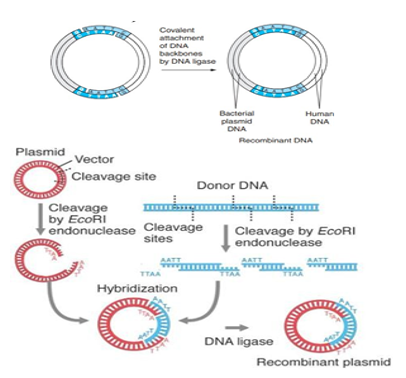
Formation of a recombinant DNA: A DNA formed after the attachment of DNA strands from different organisms is called recombinant DNA.
Various steps in the recombinant DNA formation are:
- Restriction enzymes cut DNA at recognition sites
- The sticky ends after cut
- The ends produced by restriction enzymes are joined by base pairing
- The fragments of DNA are joined by the help of DNA ligase enzyme
Recombinant DNA technology has following steps:
- Isolation of DNA: It is performed by treating cell with lysozyme, cellulose chitinases, ribonuclease and protease. Finally, after adding chilled ethanol DNA is precipitated and appeared as collection of fine thread in suspension.
- Fragmentation of DNA by restriction endonucleases-It is performed by making use of restriction enzymes and the DNA fragments were then checked by the aid of agarose gel electrophoresis.
- Vector DNA is also subjected to the same digestion by restriction endonucleases followed by agarose gel electrophoresis.
- Ligation of the DNA fragment into a vector: The DNA ligase enzyme is used to link two DNA fragments, resulting into the formation of vector plasmid.
- Amplification of gene of interest: Multiple copies of the gene of interest is synthesized in vitro by making use of PCR (Polymerase Chain Reaction).
- Transferring the recombinant DNA into the host-After the preparation of the vector with gene of interest it is inserted into the host by using suitable methods that could be direct or indirect.
- Culturing the host cells in a medium at large scale and extraction of the desired product: After the transformation the transformed cells were selected by suitable markers and allowed to grow at large scale for more and more cloning of the desired gene or its product.
- If any protein encoding gene is expressed in a heterologous host, it is called a recombinant protein.
- Small volume cultures cannot yield appreciable quantities of products. To produce in large quantities, the development of bioreactors, where large volumes (100-1000 litres) of culture can be processed, was required.
- A bioreactor provides optimal conditions for achieving the desired product by providing optimum growth conditions (temperature, pH, substrate, salts, vitamins, oxygen).
Polymerase Chain Reaction-The PCR make use of DNA template, two sets of primer, enzyme DNA polymerase (like Taq polymerase stable at high temperature and isolated from bacteria Thermus aquaticus), deoxyribonucleotide (dNTP like dATP) and buffer. All these are mixed in tube.
The three stages are:
(1) Denaturation: The reaction tube is heated to 94-960C for the separation of DNA strands, resulting in the formation of single strand formation of DNA
(2) Annealing: The reaction mixture is then allowed to cool at 55-650C so that the complimentary base paring between the primers and the target sequence can take place.
(3) Extension or elongation: The temperature is slightly increased at 70-750C and DNA polymerase extend the target DNA using primer as template. At the end of the cycle DNA doubles.
Downstream Processing
- To make a product market finished it goes under a series of processing, in the similar fashion after the large-scale production the product is also subjected to a series of processing.
- The processing comprises separation and purification of product, collectively called downstream processing.
- The product must be formulated with suitable preservatives. Such formulation must undergo thorough clinical trials as in case of drugs. Strict quality control testing for each product is also required.
- The downstream processing and quality control testing vary from product to product.
DNA fingerprinting is a technique that shows the genetic makeup of living things. It is a method of finding the difference between the satellite DNA regions in the genome.
Steps in DNA fingerprinting
- Isolating the DNA.
- Digesting the DNA with the help of restriction endonuclease enzymes.
- Separating the digested fragments as per the fragment size by the process of electrophoresis
- Blotting the separated fragments onto synthetic membranes like nylon.
- Hybridising the fragments using labelled VNTR probes.
- Analysing the hybrid fragments using autoradiography.
Solved examples:
Example 1. Which is the primary purpose of using restriction enzymes in gel electrophoresis?
a) It allows the strands of DNA to be cut into various lengths for testing
b) It restricts the number of base pairs that can be tested in a sample
c) It makes the testing simpler by moving the strands into the gel faster
d) It charges the DNA strands
Solution 1: a. The primary purpose of using restriction enzymes in gel electrophoresis is it allows the strands of DNA to be cut into various lengths for testing
Example 2. At what temperature does the denature step of PCR occur?
a) 95° C b) 50° C c) 72° C d) Any temperature
Solution 2: a. Denaturation step in PCR occur at 95° C
Summary
- Biotechnology is the integration of natural science and organisms, cells, parts thereof, and molecular analogues for products and services.
- Principle of biotechnology are genetic engineering and bioprocess engineering
- Restriction enzymes or restriction endonucleases are biological scissors that cut DNA at palindrome sites specific for every restriction enzyme.
- The different fragments of DNA obtained after cleavage with restriction enzymes can be separated by the help of gel electrophoresis.
- Recombinant DNA technology provides an opportunity to combine fragments of DNA obtained from different organisms.
- The DNA forms after the joining of two foreign DNA is called recombinant DNA.
- The DNA is then inserted into the bacteria for the multiplication of desirable genes and the process called gene cloning.
- After gene cloning the isolation of bacteria having recombinant DNA is performed and finally subjected to the purification.
- DNA fingerprinting is a technique that shows the genetic makeup of living things.