Unit : Natural selection
Chapter: Evidences of evolution
Reference: Evolution, Basis of evolution, Forms of evolution, Evidences of evolution
Learning objectives
- To describe the types of data that provide evidence for evolution.
- To explain how morphological, biochemical, and geological data provide evidence that organisms have changed for evolution
Evolution
Evolution is the change in the characteristics of a species over several generations and relies on the process of natural selection.
Basis of evolution
Genetic diversity in a population comes from two main sources: mutation and sexual reproduction. Mutation, a change in DNA, is the ultimate source of new genetic variation in any population. An individual that has a mutated gene might have a different trait than other individuals in the population
Forms of evolution
- Microevolution- A change that occurs in a population due to changes in allelic frequencies is known as microevolution. E.gs are mosquitoes evolving resistance to DDT. whiteflies evolving resistance to pesticides.
- Macroevolution- Large-scale and visible changes that occur above the level of species are known as macroevolution. The change occurs at an intraspecific level. E.gs are tetrapods, which are animals with four limbs. Evidence of macroevolution is obtained through the study of fossils, geologic data, and modern organisms.
Evidences of evolution
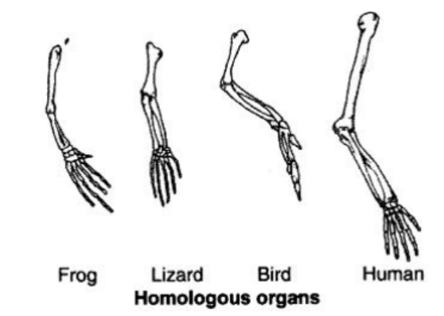
- Homologous organs -those organs which have the same basic structure but different functions are called homologous organs. For example, the forelimbs of man, a lizard, a frog, a bird, and a bat seem to be built from the same basic design of bones, but they perform different functions. The forelimbs of a human are used for grasping, the forelimbs of a lizard are used for running, the forelimbs of a frog are used to prop up the front end of its body when at rest, and act as shock absorbers. Since the forelimbs of a human, a lizard, a frog, a bird, and a bat have similar structures but perform different functions, they are called homologous structures. This provides evidence that they are derived from a common ancestor
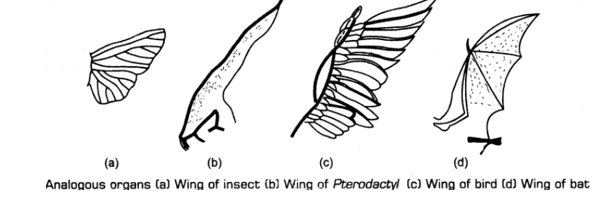
- Analogous organs – those organs which have different basic structures but have a similar appearance and perform similar functions are called analogous organs. For example, wings of bats, wings of birds, wings of insects, etc. The wings of an insect and a bird have different structures but they perform the same functions, they are analogous organs. The presence of analogous organs indicates that even organisms having organs with different structures can adapt to perform similar functions for their survival under hostile environmental conditions.
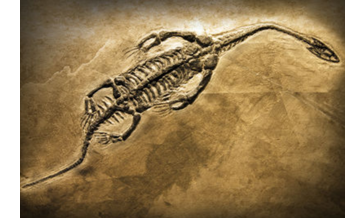
- Fossils- The remains of dead animals or plants that lived in the remote past are known as fossils. For example, a fossil bird called Archaeopteryx possesses features of both reptiles and birds. This concludes birds evolved from reptiles. There are various kinds of fossils like ammonite, trilobite, and dinosaur. There are two methods for finding the age of the fossils-
Carbon dating -All the living objects contain some radioactive carbon-14 atoms. When a living object dies and forms a fossil, its carbon-14 radioactivity goes on decreasing gradually. In the carbon dating method, the age of fossils is found by comparing the carbon-14 radioactivity left in fossils with the C -14 radioactivity present in living objects today.
By digging-When we dig into the earth, we find fossils at different depths. In the digging method, the deeper the fossil is, the older it is.
- Vestigial organs are rudimentary. They have lost their function through evolution. For example, appendix in humans, muscles of ears, wisdom tooth, etc.
Evolution by Stages
Evolution can take place in stages also. For example, the evolution of eyes. The complex body organs of animals such as eyes have been created in ‘stages’ over many generations. Flatworms have rudimentary eyes that are eyespots that can detect light, whereas insects possess compound eyes. In the last humans have binocular vision.
The evolution of feathers is also an example of evolution by stages. For example, dinosaurs have feathers but are unable to fly. Birds evolved feathers as a means of providing insulation to their bodies in cold weather but later, birds used feathers for flying. The presence of feathers on birds tells us that birds are closely related to reptiles because dinosaurs were reptiles.
Molecular Phylogeny
It is also evidence for evolution. According to this, changes in DNA during reproduction are the basic events of evolution. Organisms that are related to each other most distantly, will have greater differences in their DNA.
Embryonic Development:
Until a certain stage of gestation, the embryos of many species have a similar structure. Human embryos, pig embryos, reptile embryos, and bird embryos, for example, have comparable embryonic development. As they grow older, they transform into the appropriate species. This demonstrates shared ancestry once again.
Solved examples
Example 1. The arm of a human, the flipper of a whale, and the wing of a bat all have similar bone structures. Therefore, these parts of the body would all be considered…
a) homologous structures b) vestigial structures
c) transitional fossils d) common ancestors
Solution 1: a. The arm of a human, the flipper of a whale, and the wing of a bat all have similar bone structures. Therefore, these parts of the body would all be considered as homologous structures.
Example 2. Which of the following fossils contain the original material or remains of the organism?
a) insects in amber b) cast of marine animals
c)leaf imprint on rocks d) footprints preserved on stone
Solution 2: a. Insects in amber fossils contain the original material or remains of the organism
Summary
- Evolution is the change in the characteristics of a species over several generations and relies on the process of natural selection.
- Genetic diversity in a population comes from two main sources: mutation and sexual reproduction
- There are two forms of evolution: microevolution and macroevolution
- The evidences of evolution are homologous structures, analogous structures, fossils, molecular phylogeny, and embryonic development