Unit: Natural selection
Chapter: Origin of life on earth
Reference: Origin of life, Theory of spontaneous creation (Theory of abiogenesis or Autogenesis), Evidences against the theory
Redi’s experiment, Spallanzani experiment, Louis Pasteur experiment, Theory of panspermia or cosmozoic theory or spore theory, Theory of special creation, Theory of catastrophism, Theory of eternity, Modern theory or theory of chemical evolution, Millers’ experiment
Learning objectives
- To understand different theories provided about the origin of life
- To explain about Urey-Miller experiment
Origin of life
Origin of life and evolution of life forms-theory
Origin of universe – 15-20 billion years ago.
Origin of earth and solar system – ~ 4.6 billion years ago.
Origin of life – ~ 4.0 billion years ago Theories-
Theory of spontaneous creation (Theory of abiogenesis or Autogenesis)- Life originated from the non-living things in the spontaneous manner. Ex- (i) Lice develop from human-sweat (ii) Flies develop from rotten meat. (iii) Frogs develop from mud/soil iv) Snakes develop from dead-man’s hair.
Van Helmont- if a shirt kept in the dark in a heap of heat for 21 days mice will appear
Evidences against the theory-
Redi’s experiment-
- It proved that flies do not appear from rotten meat if the container is kept covered with a parchment sheet.
- Only the Jars which are open show the presence of larvae (maggots) of housefly. He stated that houseflies develop only from the eggs and not spontaneously.
Spallanzani experiment–
- He also performed similar experiment to disprove spontaneous creation of microorganisms. He boiled the meat and vegetables etc. for more than an hour to prepare broth and placed that in open and sealed flasks.
- The microorganisms did not develop in sealed flasks. This experiment was however objected by scientist, like Needham, who said that on boiling the ‘vital force’ or ‘vegetative force’, essential for spontaneous creation was destroyed. As this force could not re-enter due to sealing of flasks, the spontaneous creation could not take place
Louis Pasteur experiment-
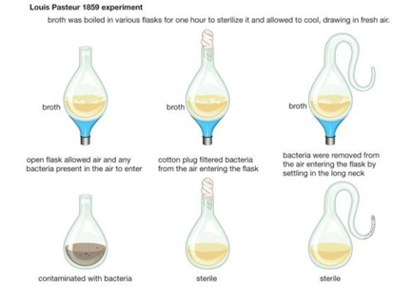
- He designed ‘swan-necked flasks. He boiled the broth (nutrient medium) to kill the microorganisms.
- The mouths of the flasks were kept open. The humid bends in the swan-neck prevented the entry of microorganisms into the flasks.
- The straight necked flasks with similar broth were kept as control. After few days when the neck of the special flasks was broken the broth was found to be free from microorganism.
- He proved that not only microorganisms but the microorganisms also cannot arise spontaneously. All organisms arise from pre-existing organisms.
Theory of panspermia or cosmozoic theory or spore theory– by Arrhenius in 1904 and he believed that life has not been created on earth but has been transferred to it in the form of spores which germinated to start the life on this planet.
Evidence against theory- living matter cannot survive unfavourable conditions such as ultra-violet radiation and extreme cold required to reach.
Theory of special creation– by father Suarez-According to this theory the life has been created by super natural power (GOD). The living form have been created as such.
Theory of catastrophism- by Cuvier and according to him life has been created and destroyed regularly due to major revolutions calamities or catastrophies.
Theory of eternity- by Prayer and according to this theory life has no beginning and ending, thus eternal.
Modern theory or theory of chemical evolution–
- A.I. Oparin, a Russian biochemist, proposed the idea of chemical evolution in 1923, and later published it in the book, Origin of life (1936).
- A similar idea was independently proposed by J.B.S. Haldane in 1928. The modern theory is, therefore, also known as Oparin- Haldane theory.
- The elements like carbon, nitrogen, hydrogen was present on the proto-planet. The hydrogen being more reactive combined with nitrogen and carbon to form compounds like ammonia, cyanogen’s (CN) and methane (CH4).
- The hydrogen was also present in the form of water-vapours. The atmosphere on the earth was reducing, not oxidizing, as the oxygen was absent in free form. By the interactions of the elements and compounds, various organic compounds like aldehydes, sugars fatty acids, lactic acid, ketones, acetates and amino acids were formed.
- The energy for such chemical reactions was made available in the form of heat energy from volcanic eruptions or electrical energy in the form of lightening. There were UV radiations from the sun, and the energy of radioactive elements was also available.
- J.B.S. Haldane used the term ‘Hot soup solution’ for the fluid containing organic compound in the primitive ocean. The complex organic compounds were developed by oxidation-reduction, condensation and polymerization reactions.
- According to A.I. Oparin the first living molecules were proteinaceous which he called Coacervates. The Coacervates were larger and denser colloidal particles. They did not have lipid membrane and nucleic acids, hence did not replicate.
- Sydney Fox (1952) named proteinoid molecules as Microspheres (1-2µ). Such molecules could be created by heating mixtures of amino acids and then by cooling them suddenly.
- There are 3-schools of thoughts regarding the nature of first living molecule. According to one, the first living molecule was protein but according to others it was either nucleic acid or nucleoprotein.
- In nucleic acids the RNA is supposed to be the primary hereditary material as it can also act as enzyme (Ribozyme). The protobionts or eobionts (coacervates/microspheres or lipospheres) formed the protocell by acquiring cell membrane and started replication of similar structure.
- The evolution of the living forms occurred in following succession. Anaerobic chemoheterotrophs → Anaerobic chemoautotrophs → Anaerobic photosynthetic autotrophs → Aerobic photosynthetic autotrophs.
- The earliest living forms, the anaerobic chemoheterotrophs, acquired energy by consuming organic compounds of the ocean. The first chemoautotrophs were just like modern sulphur bacteria that utilized carbon-di-oxide and hydrogen sulphide to produce sugar.
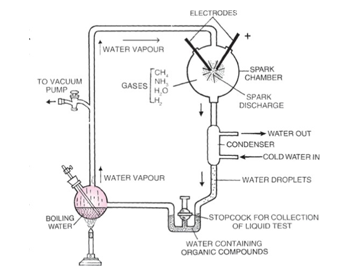
Millers’ experiment-Miller, under the guidance of his teacher, Harold C. Urey performed a classical, ‘Simulation experiment’ by using ‘Spark discharge apparatus’. He created the conditions prevailing on proto-planet.
- He used the mixture of water vapours (H2O), hydrogen (H2), ammonia (NH3) and methane (CH4), the last three in the ratio of 2:1:2, at 800°C.
- The tungsten electrodes were used to simulate lightening effect. The experiment was carried out in dark for more than 15-days.
- This experiment also had a control (experiment) in which electric discharge was not provided. A red colour liquid was collected in the U-shaped tube.
- On analysis this liquid was found to contain Urea, lactic acid, sugars, acetic acid, and amino acids like Glycine, Glutamic acid, Alanine and Aspartic acid.
- All these complex organic compounds, including amino acids, were synthesized non-enzymatically.
- This proved that complex organic compounds could be synthesized in reducing atmosphere without the help of enzymes, and thus supported the theory of chemical evolution.
Solved examples
Example 1.This theory of the origin of life states that living things come from nonliving matter.
a)spontaneous generation b)bubble hypothesis
c)Primordial Soup theory d)Meteorite theory
Solution 1: a.Spontaneous generation is the theory which states that living things come from non living matter.
Example 2.Louis Pasteur used a goose-neck flask and demonstrated what?
a)life spontaneously appears b)life begins from other organisms
c)DNA is the building block d)Amino acids can be created artificially
Solution 2:b.Louis Pasteur used a goose-neck flask and demonstrated that life begins from other organisms.
Summary
- The Big Bang Theory tries to explain how the universe came to be.
- The genesis of primordial life is referred to as biogeny.
- Due to the lack of chlorophyll, the anaerobic chemical breakdown has given the energy required for organic food production.
- Through the colonization process, multicellular species have developed from unicellular creatures.
- Various theories explaining of origin of life were proposed but out of this most widely accepted theory is Modern theory or chemical evolution theory proposed by A.I. Oparin, Russian biochemist and Haldane.
- This theory was later on proved by miller through his experiment.