Unit : Chemistry of life
Chapter: Structure and function of biological macromolecules
Reference: Carbohydrates, Oligosaccharides, Disaccharides, Trisaccharide, Tetra saccharides, Polysaccharides, Functions of carbohydrates, Proteins, Structure of protein, Primary structure, Secondary structure, Tertiary structure, Quaternary structure, Functions of proteins, Lipids, Fatty acids, Conjugated lipids, Derived lipids, Functions of lipids, Nucleic acids, Functions of nucleic acids
Learning objectives
- To understand the structure of biological macromolecules like carbohydrates, lipids, proteins, and nucleic acids
- To identify the functions of biological macromolecules.
Carbohydrates- hydrates of carbon. It consists of hydroxyl group, aldehyde, and ketone group.
Simplest carbohydrate- monosaccharide- cannot break more. It is made of single sugar. The formula is CnH2nOn where n= 3to 7
Triose n=3, C3-glyceraldehyde
Tetrose n=4, C4-Erythrose
Pentose n=5, C5-Pentose (Ribose)
Hexose n=6, C6-Glucose, fructose
Heptose n=7, C7- Seduheptulose
Glucose-C6- Hexose, Aldose (presence of universal sugar, blood sugar, grape sugar, and corn sugar.
When polarised light falls on C1 carbon (chiral carbon, asymmetric carbon). When it rotates polarised light towards right it is called dextro-rotatory e.g., glucose. When it rotates polarised light towards left, it is called levo rotatory e.g., fructose.
Fructose- C6H12O6-found in all fruits except grapes(glucose). It is ketose, sweetest occurring fruit sugar.
Test for monosaccharides- when Benedict’s/Fehling’s solution is added which is blue in colour turns into red colour which is a positive test.
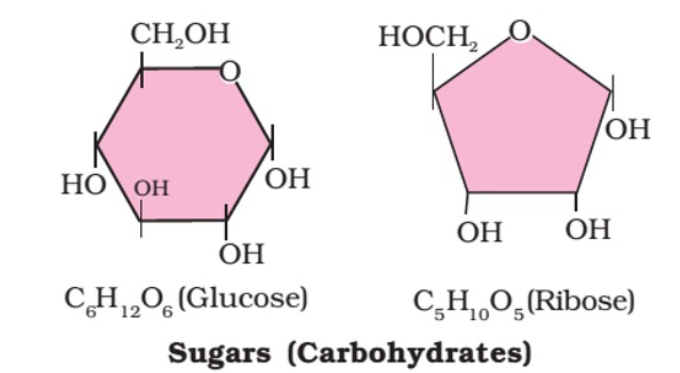
Oligosaccharides
It is formed due to condensation of 2–10 monosaccharide units, the oxygen bridge is known as “glycoside linkage” and water molecule is eliminated. The bond may be α and β.
Disaccharides C12H22O11: It is composed of two molecules of the same or different monosaccharide units. Also called “double sugars”.
Maltose: Also called “malt sugar” stored in germinating seeds of barley, oats, etc. It is formed by enzymatic (enzyme amylase) action on starch. It is a reducing sugar.
Sucrose: “Cane sugar” or “table-sugar”. It is obtained from sugarcane and beetroot and on hydrolysis splits into glucose and fructose.
Lactose: “Milk sugar’’, present in mammalian milk. On hydrolysis if yields glucose and galactose.
Trisaccharide C18H32O16: It is composed of three molecules of sugars.
Raffinose: Found in sugar beet, cotton and in some fungi. It is made up of glucose, fructose, and galactose.
Tetra saccharides: It is composed of four molecules of the same or different sugars. Stachyose is found in Stachys tubifera. It is made up of two units of galactose, one units of glucose and one unit of fructose.
Polysaccharides: General formula is (C6H10O5) n formed by condensation of several molecules (300–1000) of monosaccharides.
Functions of carbohydrates
The four primary functions of carbohydrates in the body are to provide energy, store energy, spare protein, and prevent ketosis. Glucose energy is stored as glycogen, with most of it in the muscle and liver.
Proteins – are made of amino acids(biomacromolecule), found in acid insoluble fraction.
Protein-monomer is amino acids. It is an organic component. It falls in filtrate fraction.
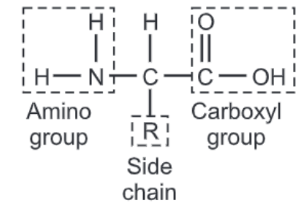
When all the groups attached to carbon is different. It is called chiral carbon.it shows optical activity on polarised light except glycine. If R is acidic-the amino acid will be acidic. If R is basic, the amino acid will be basic. If R is neutral the amino acid will be neutral.
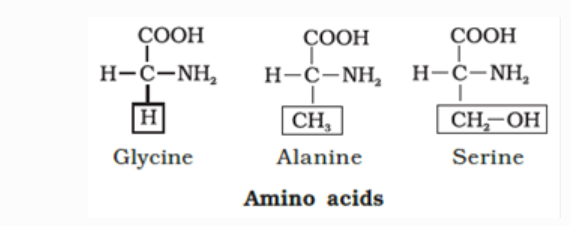
Amino acid is also called substituted methane.
- Neutral amino acids-1NH2 and 1 COOH. e.g., Glycine, alanine and valine.
- Acidic amino acid- the number of COOH groups is more than NH2 group. e.g., glutamic acid, aspartic acid.
- Basic amino acid-NH2 group is more than COOH group. E. g Arginine, lysine, histidine.
- Aromatic amino acid- phenylalanine, Tryptophan, tyrosine.
- Sulphur containing amino acid- cysteine and methionine.
PH at which zwitter ion is formed is called isoelectric point (PI). Every amino acid has different PI
Standard amino acid-which holds information is coded by DNA. It is coded by amino acid. Every organism has same 20 standard amino acids. Essential amino acids are nutritionally essential, body cannot synthesize. It is taken from diet. Non -essential amino acids are synthesized by body.eg. glycine, arginine.
Non-coded amino acids-not coded by DNA. E.g., GABA, Ornithine, Citrulline, antibiotic (do not form protein)
Structure of protein
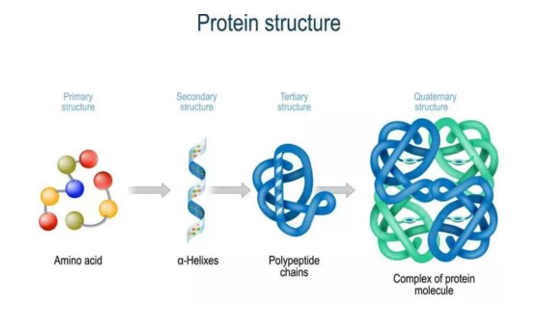
Primary structure
- Linear sequence of amino acids in a polypeptide
- This sequence is determined by genes and hereditary material, DNA. Correct sequence is important for proper functioning.
Secondary structure
- Primary structure does not make a protein functional
- Due to interactions with immediate neighbours, polypeptides tend to fold into pleats or wrap into coils forming the Secondary structure
- Polypeptides folding into coils form alpha-helix structure
- Polypeptides folding into plates form beta-plated structure. This structure is less stable than alpha-helix structure.
Tertiary structure
- Bonds between neighbouring amino acids results in further folded structure
- Tertiary structure depends upon the primary structure
- Creates active sites of enzymatic proteins
- Some of the tertiary structures are spherical forming Globular proteins; while some others are like long fibres forming Fibrous proteins
- This structure can be denatured by high temperature
- 3D structure
- Provides functionality
- Active site of enzyme is made in tertiary structure. e.g., myoglobin.
Quaternary structure-oligomeric polypeptide. e.g., adult Hb. It consists of 4 polypeptide chains. It is the most stable structure. E. g collagen, trypsin, insulin, antibody, receptor, GLUT-4 (enables glucose transport into cells).
Functions of proteins– The major functions of proteins are providing structure, regulating body processes, transporting materials, balancing fluids, helping with immunity, and providing energy
Lipids -not strict macromolecule. Size is just 800 da. It forms vesicles during grinding, retentate fraction/acid insoluble fraction. Lipids are esters of fatty acids and alcohol. They are not soluble in water. They are hydrophobic. It is soluble in benzene and chloroform.
Fatty acids
There are two types fatty acids: saturated fatty acid- only single bond.e.g., palmitic acid, stearic acid, melting, and boiling point is high, solid at room temperature, increases blood cholesterol.
Unsaturated fatty acids- contains double bonds. oleic acid, linoleic acid, linolenic acid, arachnoid acid, melting and boiling point decreases, liquid at room temperature, decreases blood cholesterol.
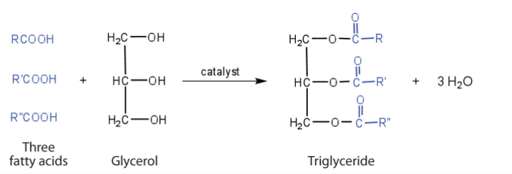
Oleic acid-MUFA (Mono-unsaturated fatty acids)- single bonds
PUFA- polyunsaturated fatty acids, good and essential for our body, essential fatty acids, body cannot synthesize, taken from diet
Deficiency of PUFA-hyperpigmentation of skin, kidney failure, sterility
Conjugated lipids– lipid+ non-lipid component
1)Phospholipid-most abundant +conjugated lipid, 1 glycerol+2 fatty acid+1 phosphate.one fatty acid of triglyceride replaced by phosphate group.
Lecithin-formed during 7th month of gestation. It acts as surfactant (prevents collapse in expiration)
2)Lipoproteins- chylomicrons-fats absorption.
LDL- Low density lipoprotein-increases the cholesterol. It will take cholesterol from liver to blood vessel.
HDL-High density lipoprotein-good cholesterol- take cholesterol from blood vessels to liver. Liver will break down.
3)Sphingolipids- fatty acids+ sphingosine alcohol(ceramide)
4)Chromolipids
5)Glycolipids
Derived lipids– no ester bond, no fatty acids, properties are like lipids (insoluble to water). E.g., terpenes, sterols, prostaglandins, diosgenin (birth control pill), digitoxin.
Sterols- 4 close rings+ long chain. They help in formation of steroidal hormones, its D and bile salts
Prostaglandins- 20C arachidonic acid which helps in contraction pain. Aspirin stops the release of prostaglandins
Functions of lipids: Lipids perform functions both within the body and in food. Within the body, lipids function as an energy reserve, regulate hormones, transmit nerve impulses, cushion vital organs, and transport fat-soluble nutrients.
Nucleic acids
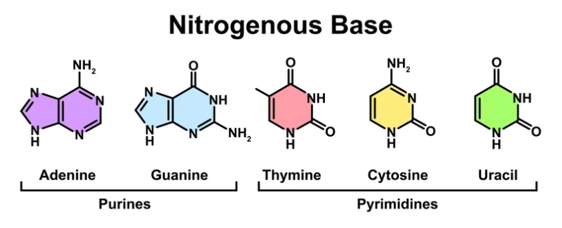
Largest biomolecule, macromolecule, acid insoluble pool(retentate). Its monomeric unit is nucleotide which is made of pentose sugar, phosphate group and nitrogenous base. The pentose sugar is beta ribose and beta deoxyribose. The nitrogenous bases include purine (2 rings) and pyrimidine(1ring). The purine ring is made of adenine and guanine and pyrimidines are cytosine, thymine, and uracil.
Functions of nucleic acids: Nucleic acids are responsible for the transmission of inherent characters from parent to offspring.
Solved examples
Example 1. What is the primary function of nucleic acids?
a) They store genetic information.
b) Movement and catalysing chemical reactions
c)They are the main source of cellular energy.
d)Insulation and energy storage
Solution 1: a. They store genetic information.
Example 2. What is the strongest type of bond found in a protein?
a) Peptide bond
b) Disulphide bridge
c)Vander Waals interactions
d)Hydrogen bond
Solution 2: b. The strongest bond found in protein is disulphide bridge
Summary
1.The elemental composition of living tissues and non-living matter appear also to be similar when analysed qualitatively.
2.Amino acids, monosaccharide and disaccharide sugars, fatty acids, glycerol, nucleotides, nucleosides, and nitrogen bases are some of the organic compounds seen in living organisms.
3.Only three types of macromolecules i.e., proteins, nucleic acids and polysaccharides are found in living systems.
4.Proteins are heteropolymers made of amino acids. Nucleic acids are composed of nucleotides.
5.Collagen is the most abundant protein in animal world and RUBISCO is the most abundant protein in the whole biosphere.