Unit : Cell structure and function
Chapter: Plasma membrane
Reference: Plasma membrane, Structure, Components of Plasma Membrane, Models of structure of plasma membrane, Sandwich model, Unit membrane model, Fluid mosaic model, Functions
Learning objectives
- To study the structure of plasma membrane
- To understand different models of plasma membrane
Plasma membrane
The unit membrane which acts as an outer cover for all the other cell organelles such as lysosomes, mitochondria, ribosomes, chromosomes, and nucleus, is known as the cell membrane or plasma membrane. It is a selectively permeable membrane that allows selective particles to pass through it. It is present in animals, plants, and microorganisms.
Structure
- A plasma membrane or cell membrane is a living, thin, flexible, and delicate membrane that is about 7 nm thick.
- When seen under a microscope, it entirely appears as a thin sheet.
- Analysis shows that the membrane is 75 percent phospholipids, which form the main element in its structure.
- It also contains proteins, cholesterol, and polysaccharides.
Components of Plasma Membrane
Plasma Membrane comprises of following components: –
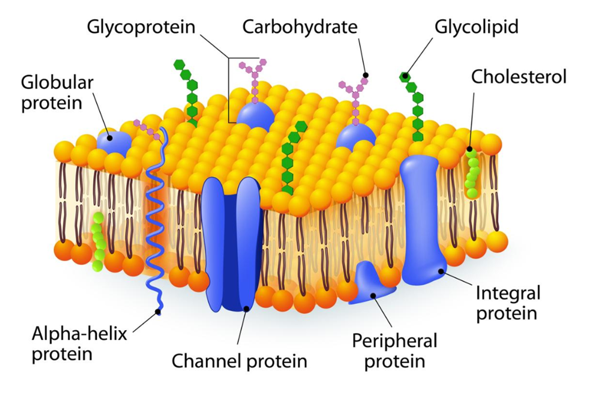
- Cholesterol: – It is folded between the hydrophobic tails of phospholipid membrane.
- Phospholipids: – It helps in forming the ultimate fabric of the membrane and is one of the most important components of a plasma or a cell membrane.
- Peripheral proteins: – They are present either on the internal or external surface of the phospholipid bilayer.
- Carbohydrates: – It is attached either to the lipids or to the protein on the extracellular part of the plasma membrane. It leads to the formation of glycolipids and glycoproteins.
- Integral Proteins: – They are located in the phospholipid bilayer.
Models of structure of plasma membrane
The following are the molecular models of the plasma membrane proposed by various biologists,
Sandwich model
In 1935, Davison and Danielli proposed sandwich or trilamellar model for plasma membrane structure. According to this model, plasma membrane is a sheath like structure composing of two lipid layers sandwiched between continuous layers of proteins. The stability of the membrane was maintained by the mutual attraction between hydrocarbon chains of lipids and electrostatic forces between proteins and lipid molecules.
They also predicted the thickness of the lipid layer to be about 6.0 nm and protein layer to be 1.0 nm. The total thickness was said to be around 8.0 nm. Finally, electron micrograph studies also supported this model proposed by Davison and Danielli.
 Unit membrane model
Later in 1959, Robertson proposed unit membrane hypothesis which states that all cellular membranes have an identical membrane structure. They named this identical membrane structure as unit membrane. According to this model, unit membrane consists of bimolecular lipid
leaflet packed in between outer and inner layers of protein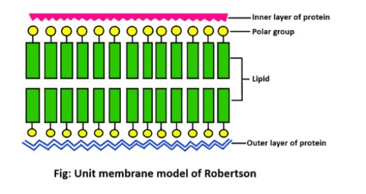
Fluid mosaic model
Finally in 1972, Singer and Nicolson proposed the well accepted Fluid mosaic model. As per this model, both lipids and proteins are distributed in a kind of mosaic arrangement. All the biological membranes are quasi-fluid structures in which lipids and the proteins can move. In other words, the proteins are embedded in lipid bilayer in such a way that proteins float in lipid sea. The surface of the lipid layers is interrupted by randomly distributed protein molecules. These proteins may either attach to the polar surface of the lipids or partially penetrate the lipid bilayer. Some proteins are also found to be associated with the sugar chains of glycoprotein.
Functions:
- Plasma membrane is a selective permeable membrane. Therefore, it allows or permits the entry and exit of some materials in and out of the cell.
- It protects the cell from injury.
- The flexibility of plasma membrane helps the cell to engulf in food and other substances from its external environment. This process is known as endocytosis.
- It bounds the semi-fluid content of the cell.
Solved examples
Example 1. Which of the following types of molecules are hydrophilic and therefore excluded from the hydrophobic portion of the phospholipid bilayer?
- transmembrane proteins b) integral membrane proteins
- peripheral proteins d) cholesterol
Solution 1: d) peripheral proteins
Example 2. According to the fluid mosaic model of cell membranes, phospholipids___________________.
a) can shift laterally along the plane of the membrane
b) frequently flip-flop from one side of the membrane to the other
c)occur in an uninterrupted bilayer, with membrane proteins restricted to the surface of the membrane
d)have hydrophilic tails in the interior of the membrane
Solution 2: a) phospholipids can shift laterally along the plane of the membrane
Summary
- A plasma membrane or cell membrane is a living, thin, flexible, and delicate membrane that is about 7 nm thick.
- Plasma membrane is composed of peripheral proteins, integral proteins, cholesterol, phospholipids, carbohydrates
- There were many molecular models were suggested by different scientists
- In 1935, Davison and Danielli proposed sandwich or trilamellar model for plasma membrane structure.
- Later in 1959, Robertson proposed unit membrane hypothesis which states that all cellular membranes have an identical membrane structure.
- Finally in 1972, Singer and Nicolson proposed the well accepted Fluid mosaic model. As per this model, both lipids and proteins are distributed in a kind of mosaic arrangement.