Unit: Cell structure and function
Chapter: Membrane transport
Reference: Cell membrane, Passive Transport, Simple diffusion, Osmosis, Facilitated diffusion, Active Transport, Primary (direct) active transport, Secondary (indirect) active transport, Bulk transport, Exocytosis, Endocytosis
Learning objectives
- To understand the transport of materials across the membrane
Cell membrane
Cellular membranes possess two key qualities:
- They are semi-permeable (only certain materials may freely cross – large and charged substances are typically blocked)
- They are selective (membrane proteins may regulate the passage of material that cannot freely cross)
Movement of materials across a biological membrane may occur either actively or passively
Passive Transport
- Passive transport involves the movement of material along a concentration gradient (high concentration ⇒ low concentration)
- Because materials are moving down a concentration gradient, it does not require the expenditure of energy (ATP hydrolysis)
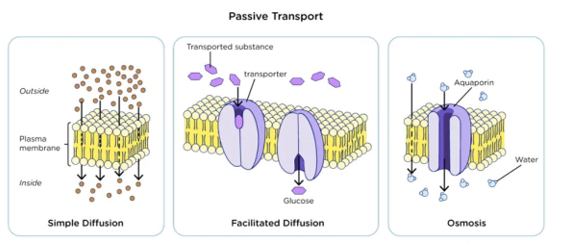
There are three main types of passive transport:
Simple diffusion – movement of small or lipophilic molecules (e.g., O2, CO2, etc.) This process of gradual movement from where they are more concentrated to where they are less concentrated is called diffusion.
Osmosis – movement of water molecules (dependent on solute concentrations). Osmosis is a passive process and happens without any expenditure of energy. It involves the movement of molecules from a region of higher concentration to lower concentration until the concentrations become equal on either side of the membrane.
Facilitated diffusion – movement of large or charged molecules via membrane proteins (e.g., ions, sucrose, etc.) There are a number of specialized integral proteins that assist in the diffusion of solutes across the membrane. This type of diffusion is referred to as facilitated diffusion. Facilitated diffusion can occur in two different ways. The first is via channel proteins. These channel proteins resemble fluid filled tubes through which the solutes can move down their concentration gradients across the membrane.
Active Transport
- Active transport involves the movement of materials against a concentration gradient (low concentration ⇒ high concentration)
- Because materials are moving against the gradient, it requires the expenditure of energy (e.g., ATP hydrolysis)
There are two main types of active transport:
Primary (direct) active transport – Involves the direct use of metabolic energy (e.g., ATP hydrolysis) to mediate transport. Primary active transport can move solutes, such as ions against their concentration gradient. This process requires a carrier protein that is much like the proteins involved in carrier-mediated diffusion mentioned above. However, in this case, the carrier has a site for the binding of ATP, which provides the energy to move the solute against its gradient.
Secondary (indirect) active transport – Involves coupling the molecule with another moving along an electrochemical gradient. Like primary active transport, secondary active transport also moves solutes against their concentration gradients. However, with secondary active transport, ATP is not directly involved in the pumping of the solute. Instead, this process uses the energy stored in concentration gradients to move the solute.
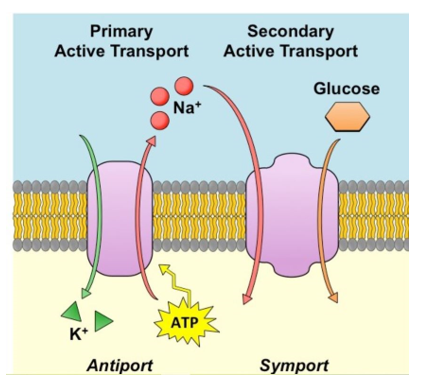
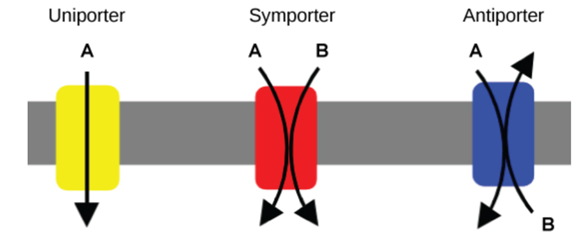
In a symport, both molecules cross the membrane in the same direction
In an antiport, both the molecules move in opposite directions.
When a molecule moves across a membrane independent of other molecules, the process is called uniport.
Bulk transport
- Bulk transport is a mode of transport of large quantities of materials and food particles across the membrane.
- It occurs both inward and outward.
- It is achieved with the help of carrier molecules.
Bulk transport is of two types:
Exocytosis: It is the process of expulsion of materials from the cell with the help of a carrier vesicle.
Endocytosis: It is a process whereby the cells absorb materials from outside by engulfing them.
Solved examples
Example 1. Which of the following is not an active transport method?
a) filtration b) sodium-potassium pump c) endocytosis d) exocytosis
Solution 1: a) Filtration
Example 2. What type of active transport occurs when the cell uses a vesicle to transport a substance outside of the cell?
a) exocytosis b) endocytosis c) diffusion d) active transport pumps
Solution 2: a) Exocytosis
Summary
- Movement of materials across a biological membrane may occur either actively or passively
- Passive transport involves the movement of material along a concentration gradient which do not involve the expenditure of energy
- Active transport involves the movement of materials against a concentration gradient which requires energy
- Passive transport involves diffusion, osmosis and facilitated diffusion
- Active transport involves primary and secondary transport
- Bulk transport is a mode of transport of large quantities of materials and food particles across the membrane.