Unit: Cellular energetics
Chapter: Enzyme structure
Reference: ENZYMES, CHARACTERISTICS OF ENZYMES, STRUCTURE OF ENZYMES, TERMS RELATED TO ENZYMES, NOMENCLATURE AND CLASSIFICATION OF ENZYMES
Learning objectives
- To understand about the structure of enzyme
- To learn the characteristics of enzyme
ENZYMES
- Enzymes are biocatalysts made up of proteins (except ribozyme) which increases the rate of biochemical reactions by lowering down the activation energy, but does not affect the nature of final product.
- The term enzyme (meaning in yeast) was used by Willy Kuhne (1878) while working on fermentation.
- Zymase (from yeast) was the first discovered enzyme by Buchner.
- The first purified and crystalized enzyme was urease
- (By J.B. Sumner) from Canavalia/Jack Bean (Lobia plant) and suggested that enzymes are proteins.
CHARACTERISTICS OF ENZYMES
- All enzymes are proteins, but all proteins are not enzymes. Enzymatic proteins consist of 20 amino acids.
- All enzymes are tertiary and globular proteins (isoenzymes quaternary protein). Their tertiary structure is very specific and important for their biological activity.
- Enzymes accelerate the rate of reaction without undergoing any change in themselves. Enzymes lower the activation energy of substrate or reactions.
- Enzymes are macromolecules of amino acids which are synthesized on ribosomes under the control of genes.
- Molecular weight of enzymes is high and these are colloidal substances.
- Enzymes are very sensitive to pH and temperature. Optimum temperature for enzymes is 20-35°C. Most of the enzymes are active at neutral pH, hydrolytic enzymes of lysosomes are active at acidic pH (5).
- Enzymes are required in very minute amounts for biochemical reactions.
- Their catalytic power is represented by Michaelis Menten constant or Km constant and turn over number. ‘‘The number of substrate molecules converted into products per unit time by one molecule of the enzyme in favourable conditions is called turnover number.’’
- Enzymes are very specific to their substrate or reactions.
STRUCTURE OF ENZYMES
- Simple enzymes: These are exclusively made up of protein i.e., simple proteins.
- E.g., pepsin, trypsin, papain.
- Conjugated enzymes: Enzymes are composed of one or several polypeptide chains. However, there are a number of cases in which non-protein constituents called co-factors are bound to the enzyme to make the enzyme catalytically active. The protein part of the enzyme is called apoenzyme. There are 3 kinds of cofactors which are given as follows:
- Co-enzymes: These are non-protein organic groups, which are loosely attached to apoenzymes. These are generally made up of vitamins, e.g., coenzyme nicotinamide adenine dinucleotide (NAD), nicotinamide adenine dinucleotide phosphate (NADP) contains the vitamin niacin, coenzyme A contains pantothenic acid, flavin mononucleotide (FMN), flavin adenine dinucleotide (FAD) contains riboflavin (Vitamin B2), and thiamine pyrophosphate (TPP) contains thiamine (Vitamin B1).
- Prosthetic group: When non-protein part is tightly or firmly attached to apoenzyme. These are organic compounds. E.g., in peroxidase and catalase, which catalyse the breakdown of H2O2 to H2O and O.
- Metal ions: Metal ions play an essential role in regulating the activity of enzymes by forming coordination bonds with side chains at the active site and at the same time form one or more coordination bonds with the substrate. E.g., Mn, Fe, Co, Zn, Ca, Mg, Cu.
Active site: Specific part of enzyme at which specific substrate is to bind and catalyse the reaction is known as an active site. Active site of enzyme is made up of very specific sequence of amino acids which is, determined by genetic codes.
Allosteric site: Besides the active site, some enzymes possess additional sites, at which chemicals other than substrate (allosteric modulators) bind. These sites are known as allosteric sites and enzymes with allosteric sites are called as allosteric enzymes, e.g., hexokinase, phosphofructokinase.
TERMS RELATED TO ENZYMES
Endoenzymes: Enzymes which are functional only inside the cells.
Exoenzymes: Enzymes catalysed the reactions outside the cell. E.g., enzymes of digestion, some enzymes of insectivorous plants, zymase complex of fermentation.
Proenzyme/Zymogen: These are precursors of enzymes or inactive forms of enzymes.
E.g., Pepsinogen, Trypsinogen, etc.
Iso-enzymes: Enzymes having similar action, but little difference in their molecular configuration is called isoenzymes. 16 forms of α-amylase of wheat and 5 forms of LDH (Lactate dehydrogenase) are known. These all forms are synthesised by different genes.
Inducible enzymes: When formation of enzyme is induced by substrate availability. E.g., Lactase, Nitrogenase, β-galactosidase.
Bio detergents: Enzymes used in washing powders are known as bio-detergents, e.g., amylase, lipase, proteolytic enzymes.
Housekeeping / constitutive enzymes: These enzymes are always present in constant amount and are also essential to cell.
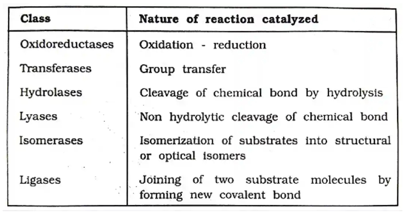
NOMENCLATURE AND CLASSIFICATION OF ENZYMES
Solved examples
Example 1. The part of the enzyme that the substrate bonds to is called the _____.
a) active site b) activation energy c) bond site d) peptide bond
Solution 1: a). The part of the enzyme that the substrate bonds to is called the active site.
Example 2. Which of the following correctly describes enzyme structure and function?
a) The shape of an enzyme is responsible for its function.
b) All enzymes can bind to all substrates.
c) The substrate is responsible for the shape of the enzyme.
d) The location of an enzyme determines its function.
Solution 2: a) The shape of an enzyme is responsible for its function.
Summary
- Enzymes are biocatalysts made up of proteins (except ribozyme) which increases the rate of biochemical reactions
- Specific part of enzyme at which specific substrate is to bind and catalyse the reaction is known as an active site
- Some enzymes possess additional sites, at which chemicals other than substrate bind. These sites are known as allosteric sites.
- Co-enzymes: These are non-protein organic groups, which are loosely attached to apoenzymes.
- Prosthetic group: When non-protein part is tightly or firmly attached to apoenzyme.
Unit (3) : Cellular energetics
Chapter: Fitness
Common Core Standards: US Common Core Standards for AP Courses
Learning objectives
- To understand about biological fitness with the help of examples
Fitness
In biology, the condition or attribute of being fit, such as the suitability of an organism or a species to find a mate and reproduce offspring successfully, thus genes may persist throughout generations.
Components of biological fitness
- ATP
- Carbohydrates
- Condensation Reaction
- DNA and RNA
- DNA replication
- Denaturation
- Enzymes
- Factors Affecting Enzyme Activity
Importance of biological fitness
Also known as Darwin fitness, biological fitness is a critical factor in the survival of species. Species that are more "fit" can pass on their genes and ensure their survival. Conversely, those not considered biologically fit will eventually become extinct due to the lack of passing genes.
In order to increase their fitness, organisms must adapt to their surroundings. Adaptations are biological processes by which an organism adjusts to new environments or changes within its current environment.
Examples of biological fitness
- There are two species of giraffe, one a taller and another shorter one. The taller giraffe can eat the leaves of the trees whereas the shorter one finds difficulty in eating. The taller one can manage well and all its off springs are well adapted to the environment. As the taller one is more fit so their population increases.
- Bacterial infections are treated with antibiotics. While most bacteria are killed by them, some occasionally develop mutations that give them the ability to survive the treatment, thus allowing them to reproduce and pass that gene onto their progeny. Bacteria reproduce at a tremendous speed, thus increasing the likelihood of favourable mutations and allowing antibiotic-resistant cells to create an entire population with the same trait in a very short amount of time.
Summary
- Biological fitness reflects an organism's ability to thrive in its environment pass its DNA down to its offspring.
- The physical and environmental impact determines biological fitness.
- Fitness determines the ability of an organism to survive and reproduce