Module: Cellular energetics
Chapter: enzyme catalysis
Reference : Mechanism of enzyme action, Mode of action of enzyme ,lock & key theory or template theory enzyme – substrate complex theory, induced fit theory, Competitive inhibition, Non -competitive inhibition
Learning objectives
- To understand the mechanism of enzyme action
- To learn about competitive and non-competitive inhibition
MECHANISM OF ENZYME ACTION
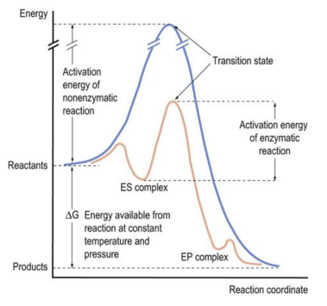
Energy is required to convert the inert molecules into the activated state. The amount of energy required to raise the energy of molecules at which chemical reaction can occur is called activation energy. Enzymes act by decreasing the activation energy so that the number of activated molecules is increased at lower energy levels. If the activation energy required for the formation of the enzyme-substrate complex is low, many more molecules can participate in the reaction than would be the case if the enzymes were absent.
MODE OF ACTION OF ENZYME
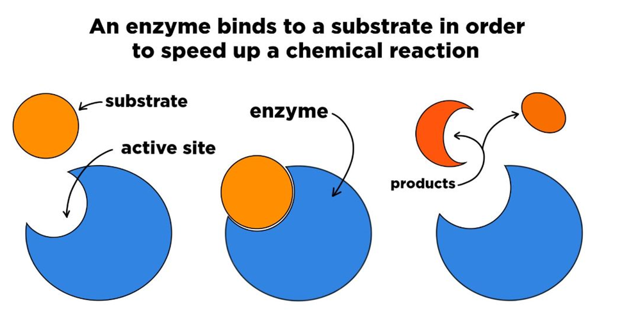
An enzyme attracts substrates to its active site, catalyses the chemical reaction by which products are formed, and then allows the products to dissociate (separate from the enzyme surface). The combination formed by an enzyme and its substrates is called the enzyme–substrate complex.
(1) LOCK & KEY THEORY OR TEMPLATE THEORY
The theory was given by Emil Fischer.
According to this theory, active sites of enzymes serve as a lock into which the reactant substrate fits like a key. Enzymes have specific sites where a particular substrate can only be attached. This model accounts for enzyme specificity.
(2) ENZYME – SUBSTRATE COMPLEX THEORY
In 1913, Michaelis and Menten proposed that for a catalytic reaction to occur it is necessary that the enzyme and substrate bind together to form an enzyme substrate complex.
It is amazing that the enzyme-substrate complex breaks up into chemical products different from that which participated in its formation (i.e., substrates). On the surface of each enzyme, there are many specific sites for binding substrate molecules called active sites or catalytic sites.
(3) INDUCED FIT THEORY
This hypothesis was proposed by Koshland (1959). According to this theory, active site is not static but it undergoes a conformational change which is induced by specific substrate.
Competitive inhibition:
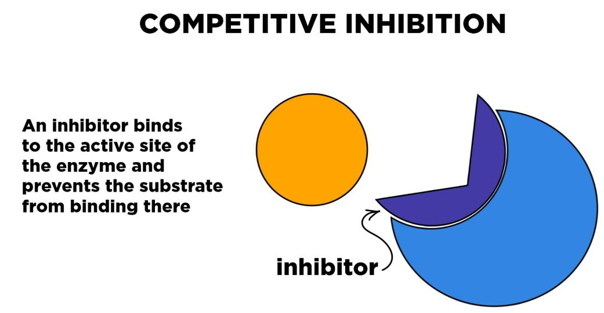
- Competitive inhibition occurs when molecules very similar to the substrate molecules bind to the active site and prevent binding of the actual substrate.
- Penicillin, for example, is a competitive inhibitor that blocks the active site of an enzyme that many bacteria use to construct their cell wall.
- Competitive inhibitors compete with the substrate for active sites.
- Competitive inhibitors have a similar shape to that of substrate
- The substrate and the competitive inhibitor cannot be found on an enzyme at the same time.
- The binding of competitive inhibitors with the active site is reversible.
- The shape of the active site does not change when a competitive inhibitor binds to the active site.
Non -competitive inhibition:
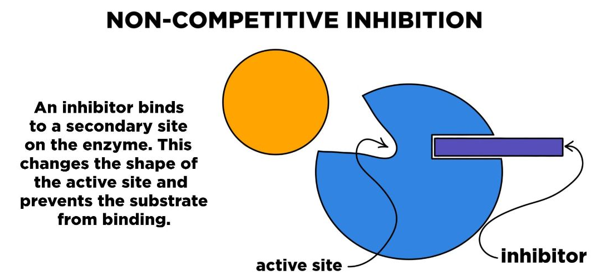
- Non-competitive inhibition is a type of enzyme inhibition in which an inhibitor reduces the activity of an enzyme.
- For example, both alanine and ATP act as non-competitive inhibitors of pyruvate kinase, the enzyme that catalyses the final step in the glycolytic pathway.
- Non-competitive inhibitors do not compete with the substrate for active sites.
- Non-competitive inhibitors have a shape that is different from the shape of the substrate.
- The substrate and the non-competitive inhibitor can be found on an enzyme at the same time.
- The binding of non-competitive inhibitors with the active site is irreversible.
- The shape of the active site changes when an inhibitor is bound to the enzyme.
Solved examples
Example 1. Enzymes can speed up chemical reactions because they
a) increase the temperature inside the cell
b) reduce the friction between the reactants
c) make the raw materials more chemically reactive
d) lower the activation energy of the reaction
Solution 1: d. Enzymes can speed up chemical reactions because they lower the activation energy of the reaction
Example 2. When a molecule can occupy the same active site as the substrate, a situation called __________________ can result
a) Competitive inhibition b) Allosteric Regulation
c) Non-Competitive Inhibition d) Feedback Inhibition
Solution 2: a. When a molecule can occupy the same active site as the substrate, then competitive inhibition occurs
Summary
- An enzyme attracts substrates to its active site, catalyses the chemical reaction by which products are formed, and then allows the products to dissociate
- The amount of energy required to raise the energy of molecules at which chemical reaction can occur is called activation energy.
- Competitive inhibition occurs when molecules very similar to the substrate molecules bind to the active site and prevent binding of the actual substrate.
- Non-competitive inhibition is a type of enzyme inhibition in which an inhibitor reduces the activity of an enzyme.