Unit: Cellular energetics
Chapter: Cellular respiration
Reference: cellular respiration, types of respiration, aerobic respiration, anaerobic respiration, obligate aerobes, facultative anaerobes, obligate anaerobes, facultative aerobes, glycolysis, fermentation, alcoholic fermentation, lactic acid fermentation, aerobic respiration, tricarboxylic acid cycle, electron transport system (ets) and oxidative phosphorylation
Learning objectives
- To understand about respiration and its types
- To learn about glycolysis, Kreb’s cycle and electron transport system
Cellular respiration
Cellular respiration is an enzyme-controlled process of biological oxidation of food materials in a living cell, using molecular O2, producing CO2 and H2O and releasing energy in gradual steps and storing it in biologically useful forms, generally ATP. So, respiration is catabolic, exothermic, and oxidative process. Most of the respiration processes occur in mitochondria.
Respiratory substrates are compounds that are oxidised during the process of respiration. Usually, carbohydrates are oxidised to release energy but proteins, fats and even organic acids can be used as respiratory substances in some plants, under certain conditions.
Energy trapped in ATP is utilised in various energy requiring processes of organisms, and the carbon compounds produced during respiration are used as precursors for biosynthesis of other molecules in the cell.
TYPES OF RESPIRATION
Based on the availability of oxygen and the complete or incomplete oxidation of respiratory substrate, it is of two types:
Aerobic respiration: When O2 is utilized during the process of respiration it is called aerobic respiration. In this process, there is complete oxidation of food and entire carbon is released as CO2 and large amount of energy is released.
Anaerobic respiration: When there is no utilisation of O2 during respiration, then food substances are incompletely oxidized and produce alcohol or organic acids and most of the energy is lost in the form of heat.
Organisms can be grouped into the following four classes on the basis of their respiratory habit
Obligate aerobes: These organisms can respire only in the presence of oxygen. Thus, oxygen is essential for their survival (e.g., bacterium Bacillus subtilis).
Facultative anaerobes: Such organisms usually respire aerobically (i.e., in the presence of oxygen) but under certain conditions may also respire anaerobically (e.g., Yeast, parasites of the alimentary canal).
Obligate anaerobes: These organisms normally respire anaerobically. Such organisms are in fact killed in the presence of substantial amounts of oxygen (e.g., Clostridium botulinum and C. tetani).
Facultative aerobes: These are primarily anaerobic organisms but under certain conditions may also respire aerobically (e.g., yeast).
GLYCOLYSIS
All living organisms retain the enzymatic machinery to partially oxidise glucose without the help of oxygen. This breakdown of glucose to pyruvic acid is called glycolysis. The scheme of glycolysis was given by Gustav Embden, Otto Meyerhof, and J. Parnas, and is often referred to as the EMP pathway.
In anaerobic organisms, it is the only process of respiration. Glycolysis involves a series of ten biochemical reactions in cytoplasm. In plants, glucose is derived from sucrose, which is the product of photosynthesis, or from storage carbohydrates. Sucrose is converted into glucose and fructose by the enzyme, invertase, and these two monosaccharides readily enter the glycolytic pathway. In glycolysis, neither consumption of oxygen nor liberation of CO2 takes place.
In glycolysis, 1 glucose, produces 2 molecules of pyruvic acid (3C).
In glycolysis, four molecules of ATP are formed by two ways:
- Direct / substrate phosphorylation of ADP to ATP.
- Another ATP is synthesized during the conversion of PEP to pyruvic acid.
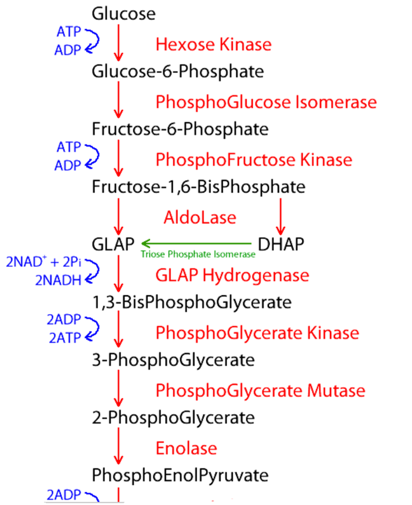
•During aerobic respiration (when oxygen is available) each NADH2 forms 3 ATP and H2O through electron transport system of mitochondria. In this way during aerobic respiration there is additional gain of 6 ATP in glycolysis
•Glycolysis is also known as oxidative anabolism or catabolic resynthesis, because it is linked with anabolism of fats and amino acids. An intermediate phosphoglyceraldehyde (PGAL) is used for the synthesis of glycerol which later forms fats or lipids. PGA is used for synthesis of amino acids like serine, glycine, cystine. Alanine forms from pyruvate.
•Phosphofructokinase is an allosteric enzyme. The phosphorylation of fructose-6-phosphate is the most important regulation reaction of glycolysis.
•Phosphofructokinase has multiple allosteric modulators. Its activity is inhibited by ATP (–ve modulator) and stimulated by ADP & AMP
•The product of glycolysis are 2 molecules of pyruvic acid, NADH + H+, H2O and ATPs.
•Further oxidation of pyruvic acid and NADH2 after glycolysis in mitochondria requires oxygen.
•Pyruvic acid is the key product of glycolysis. The metabolic fate of pyruvate depends on the cellular need.
•Further fate of pyruvic acid depends upon the availability of O2 and one of the given three routes is followed: Lactic acid fermentation, Aerobic respiration, Alcoholic fermentation
Fermentation – there are two types of fermentation:
1.Alcoholic fermentation: Buchner discovered the enzyme zymase complex, which is responsible for alcoholic fermentation. This is the oldest & the best-known type of fermentation performed by yeast & some bacteria
2.Lactic acid fermentation: It occurs in lactic acid bacteria (Lactobacillus) and in muscles during exercise (human). Pyruvic acid produced in glycolysis is reduced by NADH2 to form lactic acid without producing carbon dioxide.
AEROBIC RESPIRATION
The breakdown of glucose and its successor molecules in the presence of oxygen to release energy is called aerobic respiration. For aerobic respiration, pyruvate is transported from the cytoplasm into the mitochondria. The crucial events in aerobic respiration are:
- The complete oxidation of pyruvate by the stepwise removal of all the hydrogen atoms, leaving three molecules of CO2.
- The passing on of the electrons removed as part of the hydrogen atoms to molecular O2 with simultaneous synthesis of ATP.
- The first process takes place in the matrix of the mitochondria, whereas the second process is located on the inner membrane of the mitochondria.
- Pyruvate undergoes oxidative decarboxylation by a complex set of reactions catalysed by pyruvic dehydrogenase with the participation of several coenzymes, including NAD+ and Coenzyme A.
- Two molecules of NADH are produced from the metabolism of two molecules of pyruvic acid.
- The acetyl CoA then enters a cyclic pathway, tricarboxylic acid cycle, more commonly called as Krebs’ cycle after the discovery of the scientist Hans Krebs.
TRICARBOXYLIC ACID CYCLE
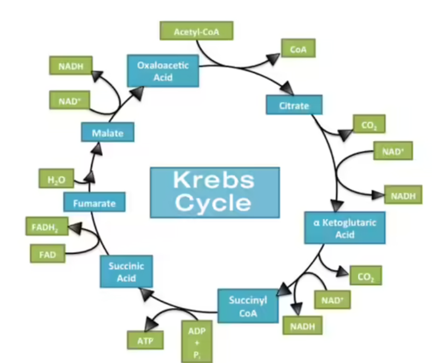
•Kerb’s cycle takes place in the mitochondrial matrix.
•Several intermediate compounds are formed, which contain three carboxylic groups and therefore the process is called as tricarboxylic acid cycle (TCA).
•First, the condensation of acetyl group with oxaloacetic acid (OAA) and water takes place to yield citric acid, catalysed by the enzyme citrate synthase and a molecule of CoA is released.
•Citrate is then isomerised to isocitrate, which is followed by two successive steps of decarboxylation, leading to the formation of α-ketoglutaric acid and then succinyl-CoA.
•Succinyl-CoA is oxidised to OAA allowing the cycle to continue and during the conversion of succinyl-CoA to succinic acid a molecule of GTP is synthesised.
•In a coupled reaction, GTP is converted to GDP with the simultaneous synthesis of ATP from ADP.
•Pyruvic acid + 4 NAD+ + FAD+ + 2H2O + ADP + Pi à 3CO2 + 4NADH + 4H+ + FADH2 + ATP
•During the process, 8NADH2, 2FADH2, 2 GTPs are formed.
ELECTRON TRANSPORT SYSTEM (ETS) AND OXIDATIVE PHOSPHORYLATION
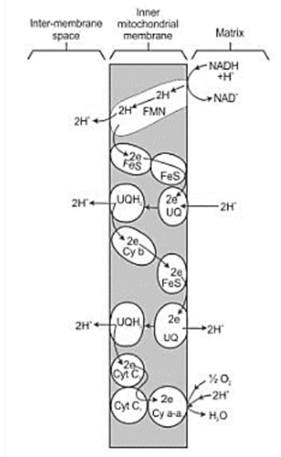
The metabolic pathway through which the electrons pass from one carrier to another, is called the electron transport system and it is present in the inner mitochondrial membrane.
The system consists of a series of precisely arranged nine electron carriers (coenzyme) in the inner membrane of the mitochondrion. These nine electron-carriers function in a specific sequence: Nicotinamide adenine dinucleotide (NAD), Flavin mononucleotide (FMN), Flavin adenine dinucleotide (FAD), Co-enzyme-Q or ubiquinone, Cytochrome-b, Cytochrome-c1, Cytochrome-c, Cytochrome-a and Cytochrome-a3.
•The ETC is comprised of four complexes and two mobile carriers i.e., coenzyme Q, a non protein part of the chain
•Complex I: Consists of flavoproteins of NADH dehydrogenase (FPN).
•Complex II: Consists of flavoproteins of succinic dehydrogenase.
•Between complexes II and III, is the mobile carrier-coenzyme Q (CoQ) or ubiquinone (UQ).
•Complexes III: Consists of cytochrome b and cytochrome c1. Associated with cytochrome b is the non-haem iron of complex III (Fe NHR).
•Complex IV: Consists of cytochrome a and cytochrome a3 and bound copper that are required for this complex reaction to occur.
•The electrons either follow the pathway of complexes I, III and IV or II, III and IV.
•Electrons from NADH produced in the mitochondrial matrix during citric acid cycle are oxidized by an NADH dehydrogenase (complex I), and electrons are then transferred to ubiquinone located within the inner membrane.
•Ubiquinone also receives reducing equivalents via FADH2 generated during the oxidation of succinate-by-succinate dehydrogenase (complex II).
•The reduced ubiquinone, called ubiquinol, is then oxidized by transfer of electrons to cytochrome c, cytochrome bc1 – complex (complex III).
•Cytochrome c acts as a mobile carrier between complex III and complex IV.
•Complex IV refers to cytochrome c oxidase complex containing cytochromes a and a3 and two copper centres.
•When the electrons pass from one carrier to another carrier via complex I to IV in the electron transport chain, they are coupled to ATP synthase (complex V) for the formation of ATP from ADP and Pi.
•Oxygen functions as the terminal acceptor of electrons and is reduced to water along with the hydrogen atoms. It drives the whole process by removing hydrogen from the system.
•In respiration, energy of oxidation-reduction is utilized to produce proton gradient.
•Higher proton concentration in the outer chamber causes the protons to pass inwardly into the matrix or inner chamber through the inner membrane.
•The energy of the proton gradient is used in attaching a phosphate radicle to ADP by high energy bond. So, the process is called oxidative phosphorylation.
•Oxidation of one molecule of NADH2 produces 3 ATP molecules while a similar oxidation of FADH2 forms 2 ATP molecules.
•ATP synthase (complex V) helps in ATP synthesis. It consists of two major components F1 and F0. F1 (head piece) is a peripheral membrane protein complex and contains the site for ATP synthesis while F0 is an integral membrane protein complex that forms a channel through which protons cross the inner membrane. For each ATP produced, 2H+ passes through F0 from the intermembrane space to the matrix down the electrochemical proton gradient.
Solved examples
Example 1. Which process is the largest contributor to the release of CO2
a) Citric Acid Cycle or Krebs Cycle b) Pyruvate Oxidation
c) Glycolysis d) Oxidative Phosphorylation
Solution 1: a. The largest contributor to the release of CO2 is Citric acid cycle
Example 2. Glucose is broken down into pyruvate in a process known as-
a) glycolysis b) electron transport c) the Krebs cycle d) phosphorylation
Solution 2: a. Glucose is broken down into pyruvate in a process known as glycolysis
Summary
1. Respiration is simply a process where in the unusable energy present in glucose molecule is transferred to ATP molecule in a step wise manner.
2.Step wise transfer prevents loss of energy.
3.Respiration makes energy available to the cells for their vital activities.
4.It can be of aerobic type or anaerobic type. Anaerobic respiration has wide industrial application.
5.In glycolysis, glucose is broken through a series of enzyme catalysed reactions into two molecules of pyruvic acid.
6.Fermentation takes place under anaerobic conditions in many prokaryotes, unicellular eukaryotes and in germinating seeds.
7.Acetyl Co-A enters the TCA cycle operating in the matrix of mitochondria.
8.The energy is synthesised in electron transport chain located on the inner membrane of the mitochondria.