Unit: Cell communication and cell cycle
Chapter: Cell cycle
Reference: Cell cycle, Interphase, G1 phase, S-phase, G2 phase
M-phase or period of division, Mitosis, Prophase, Metaphase, Anaphase, Telophase, Cytokinesis
Learning objectives
- To learn about the phases of interphase
- To understand the different phases of mitosis
Life of all multicellular organisms starts from single cell i.e., zygote. Growth of every living organism depends on cell division.
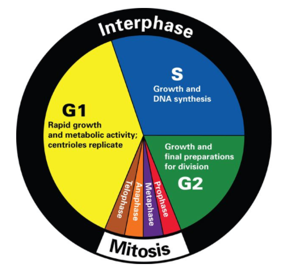
Cell cycle: The sequence of events occurring in the life of a cell is called cell cycle. There are two phases of cell cycle as interphase and M-phase.
During interphase, cell undergoes growth or rest as per the need. During M-phase ,the cell undergoes division. Interphase alternates with the period of division.
Interphase
- It is the stage between two successive cell divisions
- Longest phase of cell cycle during which the cell is highly active and prepares itself for cell division
- The interphase is divisible into three sub -phases as G1 phase, S-phase and G2 phase
G1 phase
- This is also known as first gap period or first growth period
- Organelles gets duplicated
- This phase corresponds to the interval between mitosis and initiation of DNA replication
- Cell performs RNA synthesis
S-phase
- It is synthesis phase in which DNA is synthesized or replicated, so that the amount of DNA per cell doubles.
- Histone proteins are also synthesized during this phase
G2 phase
- Metabolic activities essential for cell division occur during this phase
- Various proteins necessary for cell division are synthesized during this phase
- Besides ,RNA synthesis also occurs during this phase
- In animal cells ,a daughter pair of centrioles appear near the pre-existing pair.
M-phase or period of division
M stands for mitosis or meiosis. M-phase involves karyokinesis and cytokinesis. Karyokinesis is the division of nucleus into daughter nuclei whereas cytokinesis is division of cytoplasm resulting in two daughter cells.
Mitosis
It is type of cell division in which chromosome number remains the same in the daughter cells as in the parent cell. It occurs in all the somatic cells. It leads to growth and aids in maintenance.
Karyokinesis involves four phases: Prophase, Metaphase, Anaphase, Telophase
Prophase
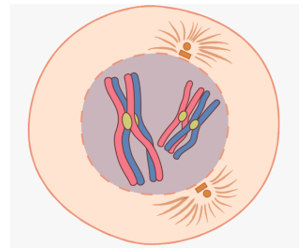
- This is the first stage after interphase
- Chromatin threads condense and form compact mitotic chromosomes
- Each chromosome divides longitudinally into two chromatids except in centromere region where it remains undivided.
- Mitotic spindle is assembled
- In late prophase both nucleolus and nuclear membrane, cytoskeleton, Golgi complex and ER fragments etc. disappear.
Metaphase
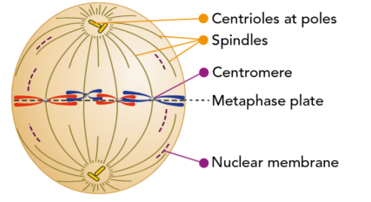
- At this stage all the chromosomes come on the equator
- Spindle is formed by centrioles. The centrioles move on both the poles
- Spindle attaches to the centromere of chromosomes and the arms are positioned towards the poles.
- Chromosomes are aligned along the metaphase plate, attached by microtubules to both the poles.
Anaphase
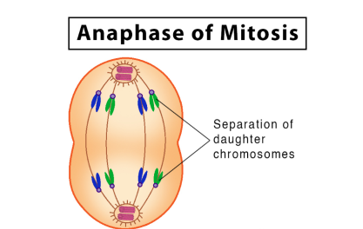
- Centromere splits from the middle and the two chromatids get separated
- Both the chromatids move towards opposite poles
- Chromatid arms are positioned towards poles.
- Chromosomes takes V,S,L or I shape
- The centromere faces towards equator
- Spindle poles move farther apart
Telophase
- The final stage of karyokinesis is telophase
- The chromosomes with their centromeres at the poles begin to uncoil, lengthen and lose their individuality
- The nucleolus begins to reappear
- The nuclear membrane begins to appear around the chromosomes
- Spindle fibers break down and get absorbed in the cytoplasm
- The two daughter nuclei are formed in the cell
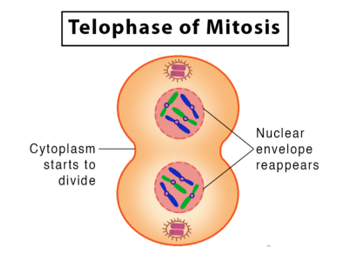
Cytokinesis-The division of the cytoplasm into two daughter cells is called cytokinesis.
In animal cells:
- The division starts with a constriction
- This constriction gradually deepens and ultimately joins in the center dividing into two daughter cells
- This division of cytoplasm is perpendicular to the spindle.
In plant cells:
- Plant cells are covered by a relatively non-flexible cell wall.
- A furrow is made
- Instead, cell wall /partition starts to appear at the center of the cell and grows outward to meet the existing lateral walls
- The formation of the new cell wall begins with the formation of a simple pre-cursor called the cell plate that represents the middle lamella between the walls of the two adjacent cells

Significance of mitosis
- Mitosis is equational division; the chromosome number is maintained constant
- It ensures equal distribution of the nuclear and the cytoplasmic content between the daughter cells
- The heredity material is equally distributed
- Old and worn-out cells are replaced through mitosis
- It helps in the asexual reproduction of organisms and vegetative propagation in plants
- It maintains the nucleo-cytoplasmic ratio
- It is a reliable process for preserving the genetic make-up of cells or organisms, it cannot introduce variation or new combination of existing genes.
Solved examples
Example 1.Why is DNA replication important?
- it makes sure each new cell has the correct information
- It makes proteins for a cell
- it produces energy for a cell
- it gives a cell its shape
Solution 1: a. DNA replication is important because it makes sure that each new cell has the correct information.
Example 2. Which is not a phase of the cell cycle?
a) Interphase b) Mitosis c) Cytokinesis d) Duplication
Solution 2: d. Duplication is not a phase of cell cycle.
Summary
- The sequence of events occurring in the life of a cell is called cell cycle. There are two phases of cell cycle as interphase and M-phase.
- Interphase is the stage between two successive cell divisions cycle during which the cell is highly active and prepares itself for cell division
- The interphase is divisible into three sub -phases as G1 phase, S-phase and G2 phase
- M-phase involves karyokinesis and cytokinesis.
- Karyokinesis involves four phases: Prophase, Metaphase, Anaphase, Telophase
- Cytokinesis-The division of the cytoplasm into two daughter cells is called cytokinesis.