Unit: Linear Equations in Two Variables
Forms of Linear Equations and Solution Techniques
Linear equations in two variables represent relationships between two quantities. They can be graphed as straight lines in the coordinate plane and are fundamental in algebra and coordinate geometry.
Definition and Standard Form
A linear equation in two variables can be written in the standard form: ax + by=c where a, b, and c are constants, and x and y are variables.
Forms of Linear Equations
- Standard Form: ax + by=c
- Slope-Intercept Form: y=mx + b
- m is the slope.
- b is the y-intercept.
- Point-Slope Form: y−y1=m(x−x1)
- (𝑥1,𝑦1) is a point on the line.
- m is the slope.
Graphing Linear Equations
To graph a linear equation in two variables, follow these steps:
- Identify the Form:
- Convert the equation to the slope-intercept form y=mx+b if necessary.
- Plot the Y-Intercept:
- The y-intercept b is where the line crosses the y-axis (x=0).
- Use the Slope:
- The slope m indicates the rise over run. From the y-intercept, use the slope to find another point on the line.
- Example: If m=2, from the y-intercept, go up 2 units and right 1 unit.
- Draw the Line:
- Connect the points with a straight line extending in both directions.
Example
Graph the equation y=2x+1:
- Slope m=2
- Y-intercept b=1
- Plot the y-intercept (0, 1).
- Use the slope to find another point: From (0, 1), move up 2 units and right 1 unit to (1, 3).
- Draw the line through (0, 1) and (1, 3).
Intercepts
- Y-Intercept:
- Set x=0 in the equation and solve for y.
- Example: For 2x+3y=6, the y-intercept is ((0,2).
- X-Intercept:
- Set y=0 in the equation and solve for 𝑥x.
- Example: For 2x+3y=6, the x-intercept is (3,0).
Slope
The slope of a line measures its steepness and is calculated as: 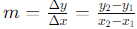
where (𝑥1,𝑦1) and (x2,y2) are two points on the line.
Example
Find the slope of the line passing through (1,2) and (3,6): 𝑚= =
= =2
=2
Solving Systems of Linear Equations
A system of linear equations consists of two or more linear equations. Common methods to solve these systems include:
- Graphical Method:
- Graph each equation and find the intersection point(s).
- Substitution Method:
- Solve one equation for one variable and substitute into the other equation.
- Elimination Method:
- Add or subtract equations to eliminate one variable, then solve for the other.