Unit : -RATIOS & RATES
Chapter: – Understanding Numbers & ratios
What students will learn in this Section
In this segment of the Ratios & Rates course, students delve into essential concepts. Ratios and rates are foundational in mathematics. Ratios compare quantities, while proportions establish balanced relationships. Equivalent proportions offer different ways to express the same relationship. Proportional relationships maintain a constant ratio between varying quantities.
Furthermore, students develop a nuanced understanding of rates, allowing them to analyze changes over time and make informed decisions based on these variations. The concepts of simple and compound interest contribute to financial literacy, helping students comprehend how interest impacts investments. The versatility of these concepts is evident as they find applications in diverse fields, including science, economics, and everyday decision-making.
Important Definitions:
- Ratio:
- Definition: A ratio is a comparison of two quantities, often expressed as a fraction. It represents the relative size or magnitude of one quantity concerning another.
- Proportion:
- Definition: A proportion is an equation stating that two ratios are equal. It is a way of expressing the equivalence of two relationships between quantities.
- Percentage:
- Definition: Percentage is a way of expressing a fraction of a whole in terms of 100. It is often used to represent proportions or to compare quantities.
- Rate:
- Definition: A rate is a comparison of two quantities measured in different units. It expresses how one quantity changes concerning another, often per unit of time.
- Simple Interest:
- Definition: Simple interest is a method of calculating interest on a principal amount over time. It is proportional to the initial investment and the time for which the investment is made.
- Compound Interest:
- Definition: Compound interest is the accrual of interest not only on the initial principal but also on the accumulated interest. It leads to exponential growth in the value of an investment.
- Equivalent Proportions:
- Definition: Equivalent proportions are different ratios that express the same relationship between quantities. They can be obtained by multiplying or dividing both parts of a proportion by the same non-zero number.
Important Formulae:
- Ratio:
- The ratio of two quantities a and b is expressed as: Ratio=

- The ratio of two quantities a and b is expressed as: Ratio=
- Proportion:
- If
 , then a, b, c, and d are in proportion.
- If
- Percentage:
- The percentage of a quantity x in relation to a whole y is calculated as: Percentage=
 ×100%
×100%
- The percentage of a quantity x in relation to a whole y is calculated as: Percentage=
- Rate:
- The rate of change is given by: Rate=
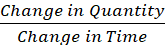
- The rate of change is given by: Rate=
- Simple Interest:
- Simple Interest (I) is calculated using the formula: I=P⋅R⋅T, where P is the principal amount, R is the rate of interest, and T is the time (in years).
Speed Strategy
- Consistent Units:
- Always ensure that the units for distance and time are consistent. Convert if necessary for uniformity.
- Understand Proportional Relationships:
- Recognize situations where speed, distance, and time maintain proportional relationships. Understand that this can simplify problem-solving.
- Work with Percentages:
- Practice solving problems involving changes in speed represented as percentages. Understand how it affects travel time.