Unit: Electrostatics
Chapter: Coulomb’s Law
Reference: AP Physics Electricity and Magnetism, Electrostatics, Coulomb’s Law, Electric Charge, Conductors and Insulators, Charging by Induction, Facts about Coulomb’s law, Superposition Principle, Electric Field, Electric Field lines, Electric Dipole, Electric Flux, Charge distribution: Friction, conduction, and induction
After studying this chapter, you should be able to,
- State the definition of Coulomb’s Law
- Understand the concept of electric charges and fields
- Electric permittivity
- Know the concept of charge distribution friction, conduction, and induction
Electric Charge
• Electrostatic charge is a fundamental property of matter due to which it produces and experiences
electrical and magnetic effects.
• Properties of atoms, molecules and bulk matter are determined by electric and magnetic forces.
• It can be inferred from simple experiments based on frictional electricity that there are two types of charges in nature: negative and positive; and like charges repel and unlike charges attract.
• By convention, the charge on the electron is considered negative and the charge on the proton is considered positive and the charge present is equal. The S.I. unit of electric charge is the coulomb. Its C.G.S unit is stat coulomb.
• The nature and amount of electric charge present in a charged body is detected by Gold-leaf
electroscope.
• Total charge on a body is expressed as q = ± ne.
Conductors and Insulators
• Objects that allow charges to flow through them are called Conductors (metals) and objects that
do not allow charges to flow through are called Insulators (rubber, wood, and plastic).
• Objects that behave as an intermediate between conductors and insulators are called semiconductors,
for example- silicon.
• The process of sharing charges with the earth, when we bring a charged body in contact with the earth is called grounding or earthing.
Charging by Induction
• Charging by induction means charging without contact.
• If a plastic comb is rubbed with wool, it becomes negatively charged.
Three basic properties of electric
charge
• Quantization: When the total charge of a body is an integral multiple of a basic quantum of charge, this is known as quantization of electric charge.
i.e., q = ne where
n = ±1, ±2, ±3, ……………..
• Additivity: It means that the total charge of a system is the algebraic sum (adding taking into account negative and positive signs) of all
the charges in the system.
• Conservation of charge: Conservation of electric charges means that there will be no change in the total charge of the isolated system with time. There is the transfer of the electric charge from one body to another, but no charge will be created or destroyed.
Coulomb’s law
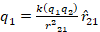
The force between two-point charges q1 and q2 is directly proportional to the product of the two charges(q1q2) and inversely proportional to the square of the distance between them(r2) and it acts along the straight line joining the two charges.
F12 = force on q2 due to
Where

ε0 is the electric permittivity
The experimental value of the constant ε0 is 8.854 × 10⁻¹²C2N–1m–2
Therefore, the approximate value of k is 9 × 10⁹Nm2C–2
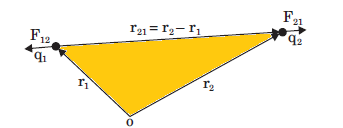
Depiction of Coulomb’s law
Facts about Coulomb’s law:
• Coulomb’s law is not valid for charges in motion; it should only be used for point charges in a vacuum at rest.
• The electrostatic force obeys Newton’s third law of motion and acts along the line joining the two charges.
• Presence of other charges in the neighbourhood does not affect Coulomb’s force.
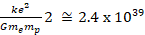
• The ratio of electric force and the gravitational force between a proton and an electron is represented
By
Superposition Principle
The presence of an (or more) additional charge does not affect the forces with which two charges attract or repel each other. The superposition principle states that the net force on any charge due to n number of charges at rest is the vector sum of all the forces on those charges, taken one at a time.
i.e., =

• The force on a small positive test charge q placed at the point divided by the magnitude of the charge is the electric field E at a point due to charge configuration.
Electric Field
• The space around a charge up to which its force can be experienced is called the electric field.
• Electric field due to a point charge q has a magnitude
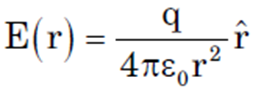
- It is radially outwards if q is positive.
- It is radially inwards if q is negative.
- The electric field satisfies the superposition principle.
- The unit of the electric field is N/C.
- The electric field inside the cavity of a charged conductor is zero.
Electric Field lines
• The tangent at each point on the curve of the electric field line, gives the direction of the electric field at that point.
• The relative strength of the electric field at different points is indicated by the relative closeness of field lines.
- In regions of strong electric fields, they crowd near each other.
- In regions of weak electric fields, they are far apart.
- In regions of constant electric field, the field lines formed are uniformly spaced parallel straight lines.
- Field lines are continuous curves. There will be no breaks.
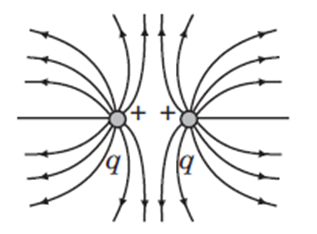
Electric field lines
• Field lines are not intersecting. They cannot cross each other.
• Electrostatic field lines begin at positive charges and terminate at negative charges.
• No closed loop can be formed by them.
Electric Dipole
A pair of equal and opposite charges q and –q separated by a small distance 2a is known as an electric dipole. The magnitude of its dipole moment vector is 2qa and is in the direction of the dipole axis from –q to q.
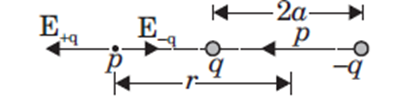
Electric dipole
• Field of an electric dipole in its equatorial plane at a distance r from the centre:
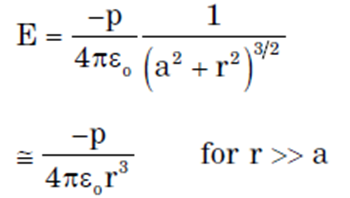
Dipole electric field on the axis at a distance r from the centre:
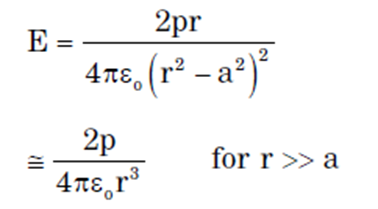
The 1/r3 dependence of dipole electric fields should be noted in contrast to the 1/r2 dependence of electric fields due to point charges.
• In a uniform electric field E, a dipole experience
a torque t is given by
t = p × E
But no net force will be experienced by it.
Electric Flux:
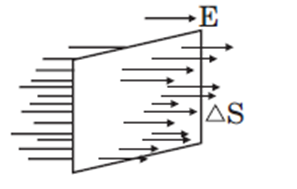
Electric flux is proportional to the number of lines leaving a surface, outgoing lines with positive sign, incoming lines with a negative sign.
Electric flux
• Through a small area element ∆S, the flux ∆f of electric field E is given by
∆f = E. ∆S
And the vector area element DS is
ΔS = ΔSnˆ
Where ∆S is magnetic of the area element and ˆn is normal to the area element, which can be considered planar for the sufficiently small ∆S.
Charge distribution: Friction, conduction, and induction
Charge distribution refers to the arrangement and movement of electric charges within a system. There are three primary mechanisms by which charge distribution can occur: friction, conduction, and induction.
Friction: Frictional charging occurs when two objects are rubbed together, resulting in the transfer of electrons from one object to the other. This transfer can cause one object to become positively charged (losing electrons) and the other to become negatively charged (gaining electrons). For example, when you rub a balloon against your hair, the balloon becomes negatively charged due to the transfer of electrons.
Conduction: Conduction involves the direct transfer of electric charges between objects that are in contact with each other. When a charged object is brought into contact with a neutral object, the charges redistribute themselves until both objects reach the same potential. If a negatively charged object is brought into contact with a neutral object, some of the excess electrons will flow from the charged object to the neutral one, causing the neutral object to become negatively charged as well.
Induction: Induction is the redistribution of electric charges in a neutral object caused by the presence of a charged object nearby, without direct contact between the two objects. When a charged object is brought close to a neutral object, the electric field of the charged object induces a separation of charges within the neutral object. This results in one side of the neutral object becoming positively charged and the other side becoming negatively charged. The induced charges are temporary and disappear when the charged object is removed.
These mechanisms of charge distribution play a crucial role in various phenomena, such as static electricity, electrical discharge, and the operation of electronic devices. Understanding these processes is important for fields such as physics, electronics, and electrostatics
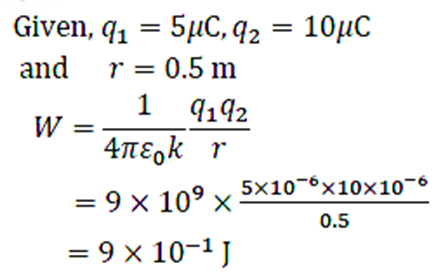
Example: Charges 5𝜇C and 10𝜇C are placed 1 m apart. Work done to bring these charges at a distance 0.5 m from each other is _______
Solution:
Key points:
- Electric Charge: Electric charge is a fundamental property of matter. It can be positive or negative. Like charges repel each other, while opposite charges attract each other.
- Protons and Electrons: Protons carry a positive charge, while electrons carry a negative charge. The charge of a proton is equal in magnitude but opposite in sign to that of an electron.
- Conservation of Charge: The total electric charge in a closed system remains constant. The charge cannot be created or destroyed; it can only be transferred from one object to another.
- Electric Fields: Electric charges create electric fields in the space surrounding them. An electric field exerts a force on other charged objects placed within the field.
- Conductors and Insulators: Conductors are materials that allow electric charges to move freely through them. Metals, for example, are good conductors. Insulators, on the other hand, do not allow the easy flow of electric charges. Examples include rubber, plastic, and glass.
- Electric Current: Electric current is the flow of electric charges through a conductor. It is measured in amperes (A). Current flows from areas of higher electric potential to areas of lower electric potential.
- Voltage: Voltage, also known as electric potential difference, is the driving force that pushes electric charges through a circuit. It is measured in volts (V). A higher voltage leads to a greater current flow.
- Resistance: Resistance is a property of a material that opposes the flow of electric current. It is measured in ohms (Ω). Materials with high resistance, such as rubber or wood, impede the flow of current more than materials with low resistance, such as metals.
- Ohm's Law: Ohm's Law states that the current flowing through a conductor is directly proportional to the voltage across it and inversely proportional to the resistance of the conductor. Mathematically, it is expressed as I = V/R, where I is the current, V is the voltage, and R is the resistance.
- Circuits: A circuit is a closed loop through which electric current can flow. It typically consists of a power source (e.g., a battery or generator), conductive wires, and various components such as resistors, capacitors, and switches.
- Series and Parallel Circuits: In a series circuit, the components are connected sequentially, so the same current flows through each component. In a parallel circuit, the components are connected in parallel branches, and the voltage across each component is the same while the current divides between them.
- Capacitance: Capacitance is a measure of a component's ability to store electric charge. It is measured in farads (F). Capacitors are widely used in electronic circuits to store and release electrical energy.