Unit: Magnetic Fields
Chapter: Magnetic Systems, Field and Forces
Reference: AP Physics Electricity and Magnetism, Magnetic Fields, Magnetic Systems, Field and Forces, Magnetic Field Laws and their Applications, Applications of Biot-Savart’s Law, Applications of Ampere’s Law, Lorentz Force and Cyclotron, Force on a current-carrying conductor in a uniform magnetic field, The force between two parallel current-carrying conductors, Torque experienced by a current loop in a uniform magnetic field, Moving coil galvanometer, Current sensitivity of the galvanometer, Conversion of galvanometer into ammeter, Conversion of galvanometer into voltmeter, Magnetic Dipole and Magnetic Field Lines, Bar Magnet, Gauss’s law for magnetic fields
After studying this chapter, you should be able to,
- state the Magnetic fields and forces
- explain the concepts of magnetic permeability and magnetic dipole
- state the laws of magnetic field
Magnetic Field Laws and their Applications
• Oersted's law states that an electric current creates a magnetic field.
• The Biot Savart's law states that the magnitude of magnetic field dB is proportional to the current I, the element length dl and inversely proportional to the square of the distance r. Its direction is perpendicular to the plane containing dl and r.
Thus, in vector notation,
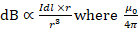
is the constant of proportionality and is equal to 10–7 Tm/A.
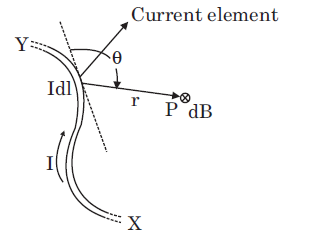
Biot Savart’s law
Applications of Biot-Savart’s Law:
• Magnetic field at a point in the circular loop will be
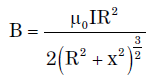
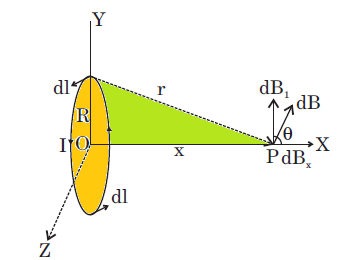
The magnetic field at a point in a circular loop
• Magnetic field at the centre of the coil is

Magnetic field due to current carrying circular arc with centre O is

• If we curl the palm of our right hand around the circular wire with the fingers pointing in the direction of the current, the right-hand thumb rule gives the direction of the magnetic field.
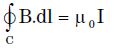
• Ampere’s circuital law: The line integral of the magnetic field around some closed loop is equal to the times the algebraic sum of the currents which pass through the circular loop. For some circuital loop, C,
Applications of Ampere’s Law
Magnetic field due to current carrying solenoid, B

At the end of a short solenoid, B
=
• The magnetic force produced by a Solenoid as stated by Ampere’s law is given as
 ,
,
where n is the number of turns of the wire per unit length, I is the current flowing through the wire and the direction is given using the right-hand thumb rule.

• Antiparallel currents repel and parallel currents attract.
• Magnetic moment on a rectangular current loop in a uniform magnetic field, m = NIA where m is the magnetic moment and N is the number of closely wounded turns and A is the area vector.
Lorentz Force and Cyclotron
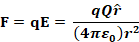
The electric field, E produced by the source of the field Q, is given as

where  is the unit vector and the field E is a vector field. A charge ‘q’ interacts with this field and experiences a force F, expressed as
• In the presence of both electric field E(r) and magnetic field B(r) there is a point charge q (moving with a velocity v and located at ‘r’ at a given time (t). The force on an electric charge ‘q’ due to both of them is written as

This force is called the Lorentz force.
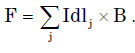
We can calculate the Lorentz force for a straight rod, if B is the external magnetic field by considering the straight rod as a collection of linear strips dlj, where l is the length of the rod, j is the current density. Hence, the force can be calculated as
Cyclotron:
• It consists of two D’s which are placed in a strong magnetic field. An oscillating electric field is applied from the oscillator which is parallel to the magnetic field.
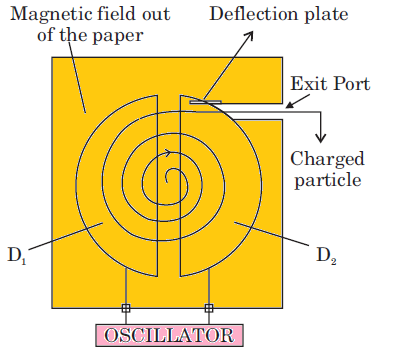
• The charged particle gets accelerated and moves in a circular path whose radius is given by

The frequency of the cyclotron is given by

• A charge of any type in uniform circular motion would have an associated magnetic moment given by

where l is the magnitude of the angular momentum of the electron.

C/kg and this ratio is called Gyromagnetic ratio.
Force on a current-carrying conductor in a uniform magnetic field:
• The force on a current-carrying conductor of length l in a uniform magnetic field B when q is
the angle between the current and magnetic field can be calculated by
F = IBl sinθ
• Fleming’s Left-Hand Rule is used to find the direction of the magnetic force which is right-angled to the plane containing conductor and magnetic field.
The force between two parallel current-carrying conductors:
Two parallel conductors carrying current experience a force. When current flows in the same direction, wire B experiences a magnetic field due to wire A which is:

Force per unit length in the given wire is

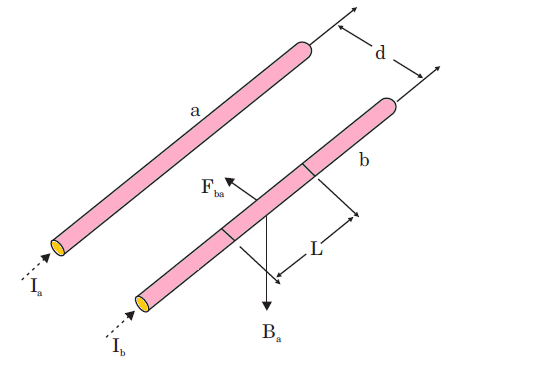
The force between two parallel currents carrying conductors.
Torque experienced by a current loop in a uniform magnetic field:
The torque experienced by a rectangular loop in uniform magnetic field B of length l, breadth b
with current I flowing through it is:

Moving coil galvanometer
• Its main use is to detect and measure small electric currents.
• The current-carrying coil is suspended in a uniform magnetic field, so it produces a torque
which is responsible for rotating the coil.
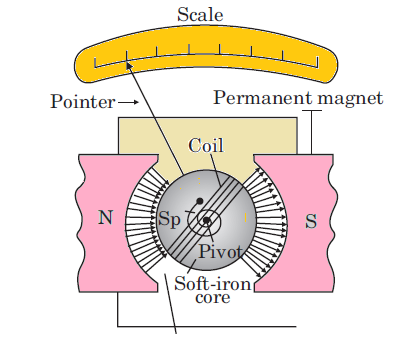
Uniform radial magnetic field
Fig.: Moving coil galvanometer
The torque is given by τ = F × b = nBIl × b = BInAsinθ
Current sensitivity of the galvanometer
• When a galvanometer produces a large deflection for a small amount of current, it is said to be
sensitive.
• The voltage sensitivity of the galvanometer is deflection per unit voltage and is given as
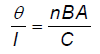
Conversion of galvanometer into ammeter
A small resistance called a Shunt resistance is attached to the galvanometer coil in parallel so that most of the current passes through the shunt resistance.
Conversion of galvanometer into voltmeter
High resistance is connected in series with the galvanometer coil so that the galvanometer acts as a voltmeter.
Magnetic Dipole and Magnetic Field Lines
Magnetism:
• Magnetic phenomena are universal in nature.
Magnetism is a physical phenomenon produced by the motion of electric charge, which results in
attractive and repulsive forces between objects.
• The magnetic field of the Earth points from the geographical south to the north.
• A bar magnet always points in the north-south direction when suspended freely.
• When the same poles of two magnets are brought close to each other, a repulsive force is experienced. When Opposite poles of two magnets are brought close, then an attractive force is experienced.
Bar Magnet:
Iron fillings sprinkled on a glass plate kept over a short bar magnet arrange themselves in a pattern. It shows that the magnet has two poles in the same way as the positive and negative charge of an electric dipole called as the North and the South pole.
Magnetic field lines: The magnetic field lines of a bar magnet form continuous closed loops. The direction of the net magnetic field at any point is determined by the tangent to the field line at that point. The magnitude of the magnetic field will be stronger for the area from which more field lines are passing. The magnetic field lines never intersect each other.
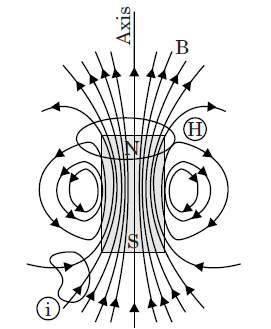
Magnetic field lines in a bar magnet
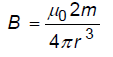
• Bar magnet as an equivalent solenoid: The magnetic field B due to bar magnet of size l and
magnetic moment m which is at a distance r from the mid-point when r >> l, is given by
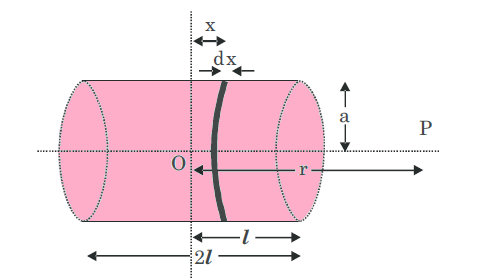
Bar magnet as an equivalent solenoid
• Dipole in a uniform magnetic field: When a bar magnet is having a dipole moment m and it is placed in uniform magnetic field B, the force acting on it is equal to 0.
The torque acting on the magnet is m × B It has a potential energy of
–m.B
Gauss’s law for magnetic fields:
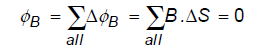
It states that the magnetic flux through any closed loop is equal to zero.
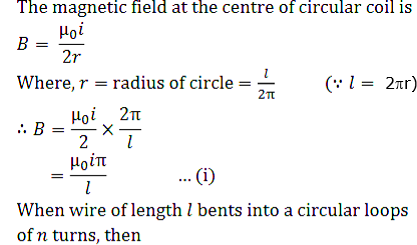
Example: A long wire carries a steady current. It is bent into a circle of one turn and the magnetic field at the centre of the coil is 𝐵. It is then bent into a circular loop of 𝑛 turns. The magnetic field at the centre of the coil will be ________.
Solution:
Key points:
- Magnetic Field: A magnetic field is a region around a magnet or a current-carrying conductor where magnetic forces can be detected. It is a vector quantity and is represented by lines of force called magnetic field lines. Magnetic field lines form closed loops, and their direction is from the north pole to the south pole outside the magnet and from the south pole to the north pole inside the magnet.
- Magnetic Poles: Every magnet has two poles, a north pole and a south pole. Like poles repel each other, while unlike poles attract each other. This behaviour is described by the magnetic force.
- Magnetic Force: The magnetic force is the force experienced by a magnetic object or a moving charged particle in a magnetic field. The force depends on the strength of the magnetic field, the charge of the particle, and its velocity. The formula for the magnetic force is given by F = q(v x B), where F is the magnetic force, q is the charge of the particle, v is its velocity, and B is the magnetic field.
- Lorentz Force: The magnetic force experienced by a charged particle in a magnetic field is known as the Lorentz force. It acts perpendicular to both the velocity of the charged particle and the magnetic field. The direction of the force is given by the right-hand rule: if the thumb of the right-hand points in the direction of the velocity and the fingers point in the direction of the magnetic field, then the palm indicates the direction of the magnetic force.
- Magnetic Materials: Certain materials, called ferromagnetic materials (e.g., iron, nickel, and cobalt), can be magnetized and exhibit strong magnetic properties. They have domains—microscopic regions where atomic magnetic moments align in the same direction. When an external magnetic field is applied, these domains align and create a macroscopic magnet.
- Electromagnets: An electromagnet is a type of magnet in which a magnetic field is produced by an electric current. It consists of a coil of wire wrapped around a magnetic core, such as iron. When electric current flows through the wire, it generates a magnetic field, and the strength of the magnetic field can be controlled by varying the current.
- Magnetic Induction: Magnetic induction, also known as electromagnetic induction, is the process of generating an electromotive force (emf) or voltage in a conductor when it is exposed to a changing magnetic field. This phenomenon is the basis for the operation of electrical generators and transformers.
- Applications: Magnetic systems and fields have numerous practical applications. Some common examples include electric motors, generators, transformers, magnetic resonance imaging (MRI) machines in medical diagnostics, magnetic storage devices (hard drives), magnetic levitation (Maglev) trains, and magnetic compasses.