Unit: Electromagnetism
Chapter: Electromagnetic Induction
Reference: AP Physics Electricity and Magnetism, Magnetic Flux, Faraday’s Law, Lenz’s Law, Induced EMF and Induced Current, Induced EMF due to Rotation of a Conducting Rod in a Uniform Magnetic Field, Induced EMF due to Rotation of a Metallic Disc in a Uniform Magnetic Field, Induced EMF, Current and Energy Conservation in a Rectangular Loop Moving in a Non – Uniform Magnetic Field with a Constant Velocity, Rotation of Rectangular Coil in a Uniform Magnetic Field
After studying this chapter, you should be able to,
- state the Magnetic flux, Faraday’s law and Lenz’s law
- explain the concepts of Self-Induction and Self-Inductance
- state the concepts of Induced EMF and Induced Current
Magnetic Flux:
Magnetic flux through a plane of area dA placed in a uniform magnetic field B

where  is the angle between magnetic field lines and the area vector of the surface.
Dimensions of magnetic flux:

SI unit: – Weber (Wb)
Faraday’s Law:
a) First Law: whenever there is a change in the magnetic flux linked with a circuit with time, an induced emf is produced in the circuit which lasts as long as the change in magnetic flux continues.
b) Second Law: The magnitude of the induced emf is directly proportional to the rate of change of magnetic flux linked with the closed circuit.

Lenz’s Law:
The direction of the induced emf or current in the circuit is such that it opposes the cause due to which it is produced i.e., it opposes the change in magnetic flux, so that-
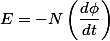
Where N is the number of turns in the coil.
Lenz’s law is based on energy conservation.
Induced EMF and Induced Current:

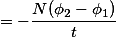
The charge depends only on net change in flux and does not depends on time.
- Induced EMF,
- Induced current,

Induced Emf due to Linear Motion of a Conducting Rod in a Uniform Magnetic Field.
The induced emf,
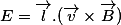
If  are perpendicular to each other, then
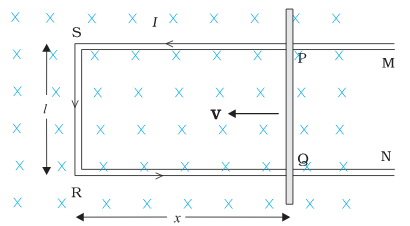
Fleming's Right Hand Rule is used to find the direction of the induced current set up in the conductor.
Induced EMF due to Rotation of a Conducting Rod in a Uniform Magnetic Field:
The induced emf,

Where n is the frequency of rotation of the conducting rod.
Induced EMF due to Rotation of a Metallic Disc in a Uniform Magnetic Field:

Induced EMF, Current and Energy Conservation in a Rectangular Loop Moving in a Non – Uniform Magnetic Field with a Constant Velocity:
- The energy supplied in this process appears in the form of heat energy in the circuit.
- The net increase in flux crossing through the coil in time Δt is,

- Induced emf in the coil is,

- If the resistance of the coil is R, then the induced current in the coil is,
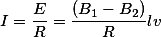
- The resultant force acting on the coil is

- The work done against the resultant force

- The energy supplied due to the flow of current I in time Δt is,


Or H = W
Rotation of Rectangular Coil in a Uniform Magnetic Field:
- Magnetic flux linked with the coil

- Induced emf in the coil

- The induced current in the coil.

- Both Emf and current induced in the coil are alternating.
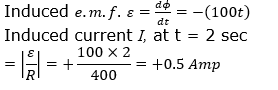
Example: A coil of resistance 400Ω is placed in a magnetic field. If the magnetic flux ϕ(wb) linked with the coil varies with time t(sec) as
𝜙 = 50𝑡2 + 4. The current in the coil at t = 2 sec is ________
Solution:
Key points:
- Electromagnetic induction is the process by which a changing magnetic field induces an electric current in a conductor.
- It was first discovered by Michael Faraday in the early 19th century.
- Faraday's law of electromagnetic induction states that the induced electromotive force (emf) in a circuit is directly proportional to the rate of change of magnetic flux through the circuit.
- Magnetic flux is the product of the magnetic field strength and the area it passes through.
- According to Faraday's law, an increase in magnetic flux induces a current in the opposite direction to oppose the change in flux, while a decrease in flux induces a current in the same direction as the change.
- The magnitude of the induced emf can be increased by increasing the rate of change of magnetic flux, increasing the number of turns in the coil, or using a stronger magnetic field.
- Lenz's law, based on the conservation of energy, states that the induced current will always oppose the change in the magnetic field that produced it.
- Electromagnetic induction is the principle behind various devices, such as electric generators, transformers, and inductive sensors.
- Electric generators convert mechanical energy into electrical energy by rotating a coil of wire in a magnetic field, inducing an alternating current.
- Transformers use electromagnetic induction to transfer electrical energy between different voltage levels efficiently.
- Inductive sensors use the principle of electromagnetic induction to detect the presence or absence of metallic objects without physical contact.
- Electromagnetic induction is a fundamental concept in electromagnetism and plays a crucial role in many areas of technology and everyday life.