Unit: Electromagnetism
Chapter: Inductance and Maxwell's Equations
Reference: AP Physics Electricity and Magnetism, Electromagnetism, Inductance and Maxwell's, Equations, Self-Induction and Self-Inductance, Mutual Induction and Mutual Inductance, Different Types of Generators, LR Circuits, Maxwell's equations in their mathematical form
After studying this chapter, you should be able to,
- state the Magnetic flux, Faraday’s law and Lenz’s law
- explain the concepts of Self-Induction and Self-Inductance
- state the concepts of Induced EMF and Induced Current
Self-Induction and Self-Inductance:
- The phenomenon in which an induced emf is produced by changing the current in a coil is called self-induction.
 where L is a constant, called self-inductance or the coefficient of self–induction.
- S.I. Unit- Henry (H)
- Dimension- [ML2T-2A-2]
- Self-inductance of a circular coil
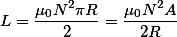
- Self-inductance of a solenoid

- Two coils of self–inductances L1 and L2, are placed far away (i.e., without coupling) from each other.
- For series combination:

Mutual Induction and Mutual Inductance:
- On changing the current in one coil, if the magnetic flux linked with a second coil changes and induced emf is produced in that coil, then this phenomenon is called mutual induction.

Or

Therefore, M12 = M21 = M
- Mutual inductance of two coaxial solenoids
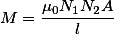
- If two coils of self-inductance L1 and L2 are wound over each other, the mutual inductance is,

Where K is called the coupling constant.
- Mutual inductance for two coils wound in the same direction and connected in series

- Mutual inductance for two coils wound in opposite directions and connected in series

- Mutual inductance for two coils in parallel
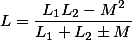
- Energy Stored in an Inductor:
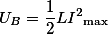
- Magnetic Energy Density:

Eddy Current: When a conductor is moved in a magnetic field, induced currents are generated in the whole volume of the conductor. These currents are called eddy currents.
- Transformer:
- It is a device which changes the magnitude of alternating voltage or current.
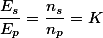
- For ideal transformer:

- In an ideal transformer:

- In step–up transformer:


- In step–down transformer:


- Efficiency
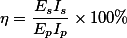
- Generator or Dynamo: It is a device by which mechanical energy is converted into electrical energy. It is based on the principle of electromagnetic induction.
Different Types of Generators:
- AC Generator- It consists of a field magnet, armature, slip rings and brushes.
- DC Generator- It consists of a field magnet, armature, commutator and brushes.
Motor
It is a device which converts electrical energy into mechanical energy.
Back emf

Current flowing in the coil, 
Where R is the resistance of the coil.
Output Power
= 
Efficiency,

LR Circuits
- A solenoid has inductance (L) and resistance (R), and each of these influences the current in the circuit.
- The inductive and resistive effects of a solenoid are shown schematically in Fig. The inductance (L) is shown in series with the resistance (R).
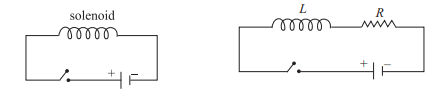
- For simplicity, we assume that total resistance in the circuit, including the internal resistance of the battery, is represented by R. Similarly, L includes the self-inductance of the connecting wires.
- A circuit such as that shown in Fig above, containing resistance and inductance in series, is called an LR circuit.
- The role of the inductance in any circuit can be understood qualitatively. As the current i(t) in the circuit increases (from i = 0 at t = 0), a self-induced emf ε = – L di/dt is produced in the inductance whose sense is opposite to the sense of the increasing current. This opposition to the increase in current prevents the current from rising abruptly.
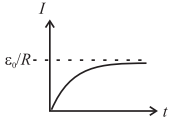
- If there had been no inductance in the circuit, the current would have jumped Magnetism immediately to the maximum value defined by ε0 /R.
- But due to an inductance coil in the circuit, the current rises gradually and reaches a steady state value of ε0 /R as t → τ.
- The time taken by the current to reach about two-thirds of its steady state value is equal to L/R, which is called the inductive time constant of the circuit.
- Significant changes in current in an LR circuit cannot occur on time scales much shorter than L/R. The plot of the current with time is shown in Fig.
Maxwell's equations in their mathematical form:
Gauss's Law for electric fields:
∇ · E = ρ / ε₀
where: ∇ · E represents the divergence of the electric field E, ρ represents the charge density, and ε₀ is the electric constant (also known as the vacuum permittivity).
Gauss's Law for magnetic fields:
∇ · B = 0
where: ∇ · B represents the divergence of the magnetic field B.
Faraday's Law of electromagnetic induction:
∇ × E = – ∂B / ∂t
where: ∇ × E represents the curl of the electric field E, ∂B / ∂t represents the partial derivative of the magnetic field B with respect to time.
Ampere's Law with Maxwell's addition:
∇ × B = μ₀J + μ₀ε₀ ∂E / ∂t
where: ∇ × B represents the curl of the magnetic field B, μ₀ is the magnetic constant (also known as the vacuum permeability), J represents the current density, and ∂E / ∂t represents the partial derivative of the electric field E with respect to time.
These equations describe the fundamental relationships between electric and magnetic fields, charges, currents, and their interactions.
Example:
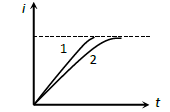
When a certain circuit consisting of a constant e.m.f. 𝐸, an inductance 𝐿 and a resistance 𝑅 is closed, and the current in it increases with time according to curve 1. After one parameter (𝐸, 𝐿 or 𝑅) is changed, the increase in current follows curve 2 when the circuit is closed a second time. Which parameter was changed and in what direction _________
Solution:
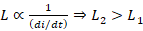
 slope of 𝑖 − 𝑡 graph; slope of graph (2) < slope of graph (1) so,

Also
 .
.
Key points:
An LR circuit is an electrical circuit that consists of an inductor (L) and a resistor (R) connected in series or parallel.
The inductor is a passive electronic component that stores energy in its magnetic field when a current flows through it. It opposes changes in current due to its self-inductance.
The resistor is a passive component that dissipates energy in the form of heat and opposes the flow of current.
When an LR circuit is connected to a direct current (DC) source, the inductor initially opposes the change in current and behaves like a short circuit. Over time, the inductor's current reaches a steady state, and it acts like an open circuit.
When an LR circuit is connected to an alternating current (AC) source, the inductor resists changes in current as the AC signal oscillates. It causes a phase shift between the voltage and current waveforms in the circuit.
The time required for the current in an LR circuit to reach approximately 63.2% of its final value (or to decay to 36.8% of its initial value) is called the time constant (τ). It is given by the formula τ = L/R, where L is the inductance and R is the resistance.
The time constant determines how quickly the current in an LR circuit reaches its steady-state value or how quickly it decays when the power source is removed.
The behaviour of an LR circuit can be analysed using differential equations or phasor analysis techniques.
LR circuits have various applications, including in power supplies, filters, and signal processing circuits.
Gauss's Law for Electric Fields: This equation states that the electric flux through a closed surface is proportional to the total electric charge enclosed by the surface, divided by the permittivity of free space.
Gauss's Law for Magnetic Fields: This equation states that the magnetic flux through a closed surface is always zero, meaning there are no magnetic monopoles. It also describes how magnetic field lines are always closed loops.
Faraday's Law of Electromagnetic Induction: This equation shows that a changing magnetic field induces an electric field. The induced electromotive force (emf) is proportional to the rate of change of magnetic flux through a loop of wire.
Ampère's Law with Maxwell's Addition: This equation relates the circulation of the magnetic field around a closed loop to the current passing through the loop and the rate of change of electric flux. Maxwell's addition incorporates a term that accounts for the displacement current, which is the contribution of changing electric fields to the magnetic field.