Unit: Kinematics | Chapter: Position, Velocity and Speed
Reference: AP Physics Algebra, Kinematics, Position Velocity and Speed, acceleration and relative velocity, Distance vs displacement, relative velocity and average velocity, position-time graph, velocity-time graph.
After studying this chapter, you should be able to,
- distinguish between distance and displacement, and speed and velocity;
- explain the terms instantaneous velocity, relative velocity and average velocity;
- define acceleration and instantaneous acceleration;
- interpret position-time and velocity-time graphs for uniform as well as non-uniform motion;
Position:
Assume you travelled from point A to point B. This means that your former position was A, but it has now migrated to B. What would you use to describe your beginning position? A reference point and a set of three mutually perpendicular axes, or the rectangular coordinate system, are used in physics to represent a position. The axes are X, Y, and Z. The origin, which is the place where the three axes connect, is used as the reference point. As a result, we use (0, 0, 0) as the reference point or origin, and B is represented by a set of coordinates on the three axes (x, y, z).
However, as motion is defined as a change in position over time, we install a clock in this system. The coordinate system along with the clock is called a frame of reference Thus if one or more coordinates of a body change with time, the body is said to be in motion.
Path Length and Displacement:
Displacement: The displacement of the object between t1 and t2 is the difference between the position vectors of the object at the two instances. Thus, the displacement
is given by

Its direction is along the line of motion of the object. Its dimensions are that of length. For example, if an object has travelled through 1 m from time t1 to t2 along the +ve x-direction, the magnitude of its displacement is 1 m and its direction is along the +ve x-axis. On the other hand, if the object travelled along the +ve y direction through the same distance in the same time, the magnitude of its displacement is the same as before, i.e., 1 m but the direction of the displacement is along the +ve y-axis.
Distance & Displacement:
Displacement: The change in the position of a body in a particular direction is known as displacement. It is a vector quantity and its unit is a meter in SI. The shortest distance between the initial and final positions of the object in a specified direction.
Distance: The total length of the actual path traversed by a body in a certain interval of time is called distance. It is the actual path travelled by an object between its initial and final positions. It is a scalar quantity and its unit in SI is a meter. Displacement may be positive, negative or zero but distance is always positive.
If a particle moves in a straight line without change in its direction, the magnitude of displacement is equal to the distance travelled. Otherwise, it is always less than it. Thus,
Displacement < = distance
Path length:
This is the actual distance travelled by the object during its motion.
It is a scalar quantity and its dimensions are also that of length. If an object travel along the x-axis from x = 2 m to x = 5 m then the distance travelled is 3 m. In this case, the displacement is also 3 m and its direction is along the +ve x-axis. However, if the object now comes back to x = 4, then, the distance through which the object has moved increases to 3 + 1 = 4 m. Its initial position was x = 2 m and the final position is now x = 4 m and thus, its displacement is  x = 4 – 2 = 2 m, i.e., the magnitude of the displacement is 2 m and its direction is along the +ve x-axis. If the object now moves to x =1, then the distance travelled, i.e., the path length increases to 4 + 3 = 7 m while the magnitude of displacement becomes 2 – 1 = 1 m and its direction are along the negative x-axis.
Average Speed and Velocity
Speed and velocity are both measures of how fast an object is moving. However, they have different meanings in physics.
Speed is a scalar quantity that only measures how fast an object is moving. It is calculated by dividing the distance travelled by the time taken to travel that distance. The SI unit for speed is meters per second (m/s).
Velocity, on the other hand, is a vector quantity that measures the speed and direction of an object. It is calculated by dividing the displacement (change in position) by the time taken. The SI unit for velocity is meters per second (m/s).
In simple terms, velocity includes direction while speed does not. For example, if a car is moving at a speed of 60 km/hour, we only know how fast it is moving, but we do not know in which direction it is moving. However, if we say the car is moving at a velocity of 60 km/hour towards the north, we know both the speed and the direction of the car's motion.
It is also worth noting that the average speed and the average velocity of an object may be different if the object has changed its direction during its motion. For example, if a car moves 100 km to the north in 2 hours, and then moves 100 km to the south in the next 2 hours, its average speed for the entire trip is (100+100)/(2+2) = 50 km/hour. However, its average velocity is zero because its displacement over the entire trip is zero (i.e., it started and ended at the same location).
In summary, while speed and velocity are related, they have different meanings in physics. Speed measures only how fast an object is moving, while velocity measures both the speed and direction of an object's motion.
Instantaneous Velocity and Speed
The average velocity tells us how fast an object has been moving over a given time interval but does not tell us how fast it moves at different instants of time during that interval. For this, we define instantaneous velocity or simply velocity v at an instant t.
Instantaneous speed and velocity are defined at a particular instant and are given by
Acceleration and Relative Velocity

Instantaneous acceleration is the limiting value of the average acceleration when the time interval goes to zero. It is given by

Time- velocity Graphs:
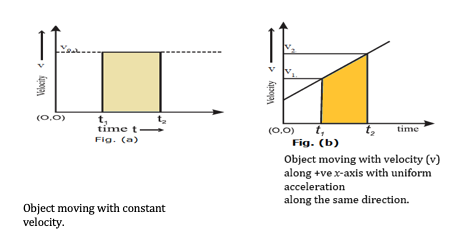
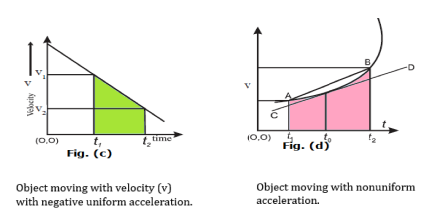
The area under the velocity-time curves in Figs. (a) to (d) can be written using the definition of integral:

= displacement of the object from t1 to t2
Relative Velocity
Relative velocity is the velocity of an object with respect to a frame of reference. It is the velocity of an object as measured by an observer in a different frame of reference.
Here are some important notes about relative velocity:
- The relative velocity between two objects depends on the reference frame.
- If two objects are moving in the same direction, the relative velocity is the difference between their velocities.
- If two objects are moving in opposite directions, the relative velocity is the sum of their velocities.
- The relative velocity of an object with respect to itself is always zero.
- The relative velocity of an object with respect to a stationary object is equal to its velocity.
- The velocity of an object in a moving frame of reference can be calculated using the velocity addition formula.
- The velocity addition formula states that the velocity of an object in one frame of reference plus the relative velocity between the two frames of reference is equal to the velocity of the object in the other frame of reference.
- The relative velocity of an object can be calculated using vector subtraction.
The relative velocity of an object with respect to another object is the rate at which it changes its position relative to the object/point taken as reference. For example, if vA and vBare the velocities of the two objects along a straight line, the relative velocity of B with respect to A will be vB– vA.
The rate of change of the relative position of an object with respect to the other object is known as the relative velocity of that object with respect to the other.
Understanding relative velocity is important in many areas of physics, including mechanics, astrophysics, and fluid dynamics.
Example 1: The position of an object moving along the x-axis is given by x = a + bt2 where a = 8.5 m, b = 2.5 m s–2 and t is measured in seconds. What is its velocity at t = 0 s and t = 2.0 s. What is the average velocity between t = 2.0 s and t = 4.0 s?
Solution:
In the notation of differential calculus, the velocity is
At t = 0 s, v = 0 m s-1 and at t = 2.0 s, v = 10 m s-1.
= 6.0 × 2.5 = 15 m s-1
Example 2. A particle moves along a semi-circle path A to B in a time T as shown in the following fig.

(a) Determine the average speed of the particle.
(b) Determine the average velocity of the particle.
Solution:
(a) The average speed of the particle =
(b) The average velocity of the particle=
Key Points:
- Speed is the distance covered in unit time whereas velocity is the displacement covered in unit time.
- Difference between distance and displacement- Distance, which is a scalar quantity deal with the total area covered by an object, whereas, displacement which is a vector quantity deals with the change in the position of the object. The distance can never be zero, whereas, displacement can become zero)
- Speed is a scalar quantity and velocity is a vector.
- Speed only determines the magnitude that is how fast is a body moving whereas velocity determines the direction also that is in which direction the body is moving.
- Speed is the rate of change of distance whereas velocity is the rate of change of displacement.
- Speed can never be zero but the velocity can be positive, negative or zero. This is the difference between speed and velocity.
- An object can possess the same speed and different velocities. Speed may or may not be equal to velocity.
- Relative Velocity:
- The relative velocity of a particle = velocity of a particle – velocity of the reference object
- If the velocity of a particle is VA and the velocity of a reference object be VB then the relative velocity of the particle

- The relative velocity of a particle while moving in the same direction.
Relative velocity 
- The relative velocity of a particle while moving in the opposite direction.
Relative velocity 