Unit: Fluids: Pressure and Forces
Chapter: Density, Pressure and Forces
Reference: AP Physics Algebra, Fluids, Pressure and Forces, Fluid System, Fluid Properties, Pressure and forces, Pascal’s Law
After studying this chapter, you should be able to,
- Understand the concept of fluid Systems
- State the density
- Know the concept of pressure and forces
Fluid System:
Fluid systems have a lot of applications: actuators and processes that involve mixing, heating, and cooling of fluids.
- Active vehicle suspensions use hydraulic and pneumatic actuators to provide forces that supplement the passive spring and damping elements.
- Water supply, waste treatment, and other chemical processing applications are examples of a general category of fluid systems called liquid-level systems, because they involve regulating the volumes, and therefore the levels of liquids in containers such as tanks.
- Another important property of fluids is their ability to exert pressure, which is the force exerted per unit area. This pressure can be measured using a variety of instruments, including manometers and barometers.
- Fluids can be characterized by their viscosity, which is a measure of their resistance to flow. Viscosity is affected by factors such as temperature, pressure, and the size and shape of the particles in the fluid.
- Fluids have many real-world applications, from the design of aeroplane wings to the operation of hydraulic systems. Engineers and scientists must consider the unique properties of fluids when designing systems that use them.
- For incompressible fluids, conservation of mass is equivalent to conservation of volume, because the fluid density is constant.
- That is
qm = ρqv,
where qm and qv are the mass and volume flow rates. (In SI system, we use kg/s and m2/s as units of qm and qv, respectively.)
Fluid Properties:
Density or Mass density (r): The density or mass density of a fluid is defined as the ratio of the mass of a fluid to its volume. Thus, mass per unit volume of a fluid is called density.
r = Mass/Volume
r=MV or dMdV
The unit of density in S.I. unit is kg/m3. The value of density for water is 1000kg/m. With the increase in temperature volume of fluid increases and hence mass density decreases in the case of fluids as the pressure increases volume decreases and hence mass density increases.
Specific weight or weight density (g): Specific weight or weight density of a fluid is the ratio between the weight of a fluid to its volume. The weight per unit volume of a fluid is called weight density.
g =Weight/Volume
g =W/V or dW/dV
he unit of specific weight in S.I. unit is N/m3. The value of the specific weight or weight density of water is 9810N/m3.
With the increase in temperature volume increases and hence specific weight decreases. With increases in pressure, volume decreases and hence specific weight increases.
Note: Relationship between mass density and weight density
We have g =Weight/Volume
g =mass × g/Volume
g = r × g
g
Specific Volume ( " ): Specific volume of a fluid is defined as the volume of a fluid occupied by a unit mass or volume per unit mass of a fluid.
" = Volume/mass =VM =dV/dM
As the temperature increases volume increases and hence specific volume increases. As the pressure increases volume decreases and hence specific volume decreases.
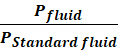
Specific Gravity(S): Specific gravity is defined as the ratio of the weight density of a fluid to the weight density of a standard fluid.
S =PfluidP/Standard fluid
Unit: It is a dimensionless quantity and has no unit. In the case of liquids water at 4oC is considered as standard liquid. rwater = 1000 kg/m3
Pressure and forces:
The fluid exerts a force on the container normal to its walls at all points.
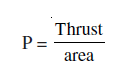
The normal force or thrust per unit area exerted by a fluid is called pressure. We denote it by P:
The SI Unit of pressure is Nm-2 and is also called Pascal (Pa) in honour of French scientist Blaise Pascal.
Hydrostatic Pressure:
The pressure exerted by a fluid at rest is known as hydrostatic pressure.
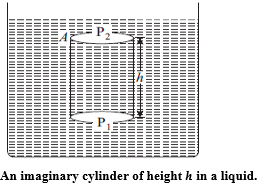
Consider a liquid in a container and an imaginary right circular cylinder of cross-sectional area A and height h, as shown in Fig. given below. Let the pressure exerted by the liquid on the bottom and top faces of the cylinder be P1, and P2, respectively. Therefore, the upward force exerted by the liquid on the bottom of the cylinder is P1A and the downward force on the top of the cylinder is P2 A.
∴ The net force in the upward direction is (P1A – P2A).
Now the mass of the liquid in the cylinder = density × volume of the cylinder
= ρ. A. h where ρ is the density of the liquid.
∴ Weight of the liquid in the cylinder = ρ. g. h. A
Since the cylinder is in equilibrium, the resultant force acting or it must be equal to zero, i.e.
P1 A – P2A – ρ g h A = 0
⇒ P1 – P2 = ρ g h
So, the pressure P at the bottom of a column of liquid of height h is given by
P = ρ g h
That is, hydrostatic pressure due to a fluid increase linearly with depth. It is for this reason that the thickness of the wall of a dam has to be increased with an increase in the depth of the dam.
Atmospheric Pressure
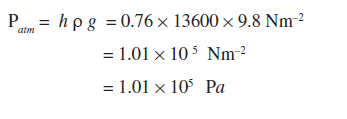
We know that the earth is surrounded by an atmosphere unto a height of about 200 km. The pressure exerted by the atmosphere is known as the atmospheric pressure.
In equilibrium, atmospheric pressure equals the pressure exerted by the mercury column. Therefore,
Pascal’s Law
Pascal's law, states that when pressure is applied at any part of an enclosed liquid, it is transmitted undiminished to every point of the liquid as well as to the walls of the container. This law is also known as the law of transmission of liquid pressure.
Hydraulic Pressure
It is a simple device based on Pascal’s law and is used to lift heavy loads by applying a small force. The basic arrangement is shown in Fig. (given below). Let a force F1 be applied to the smaller piston of area A1. On the other side, the piston of large area A2 is attached to a platform where heavy load may be placed. The pressure on the smaller piston is transmitted to the larger piston through the liquid filled in between the two pistons. Since the pressure is the same on both sides, we have
Pressure on the smaller piston,
According to Pascal’s law, the same pressure is transmitted to the larger cylinder of area A2. Hence the force acting on the larger piston.
F2= Force x Area = F1A1 x A2
x A2
It is clear from Eqn. (F2= Force x Area = F1A1 x A2
x A2 ) that force F2 > F1 by an amount equal to the ratio (A2/A1). With slight modifications, the same arrangement is used in the hydraulic press, hydraulic balance, hydraulic Jack, etc.
Example 1: A cemented wall of thickness one metre can withstand a side pressure of 105 Nm–2. What should be the thickness of the side wall at the bottom of a water dam of depth 100 m. Take the density of water = 103 kg m–3 and g = 9.8 ms–2.
Solution: The pressure on the side wall of the dam at its bottom is given by
Using the unitary method, we can calculate the thickness of the wall, which will withstand the pressure of 9.8×10⁵ Nm–2. Therefore, the thickness of the wall
Key points:
- The study of fluid dynamics is crucial in designing efficient and sustainable wind turbines. Engineers use the properties of fluids such as viscosity and flow rate to optimize the design of the blades and ensure maximum power output.
- The medical field heavily relies on the properties of fluids in various applications. For example, ultrasound technology uses the properties of fluids to produce images of internal organs and diagnose medical conditions. The knowledge of fluids' characteristics helps doctors design effective drug delivery systems that target specific areas in the body.
- In the automotive industry, the properties of fluids are the basis of designing efficient engines and fuel delivery systems. The viscosity of engine oil is optimized to reduce engine wear and improve fuel efficiency. Understanding the flow of fluids in the engine is also essential in designing effective cooling systems that keep the engine at optimal temperatures.
- The study of fluid mechanics is applied in developing hydraulic systems used in heavy machinery and construction equipment. Engineers use their knowledge of the properties of fluids to design hydraulic pumps and cylinders that transfer force efficiently, reducing energy consumption and improving performance.
- Understanding the behaviour of fluids is also crucial in the construction industry. Engineers use fluid mechanics principles to design effective drainage systems, ensure stable foundation designs, and prevent water damage in buildings during flooding or heavy rainfall.
- The study of fluid dynamics is crucial in designing efficient and sustainable wind turbines. Engineers use the properties of fluids such as viscosity and flow rate to optimize the design of the blades and ensure maximum power output.
- The medical field heavily relies on the properties of fluids in various applications. For example, ultrasound technology uses the properties of fluids to produce images of internal organs and diagnose medical conditions. The knowledge of fluids' characteristics helps doctors design effective drug delivery systems that target specific areas in the body.
- In the automotive industry, the properties of fluids are the basis of designing efficient engines and fuel delivery systems. The viscosity of engine oil is optimized to reduce engine wear and improve fuel efficiency. Understanding the flow of fluids in the engine is also essential in designing effective cooling systems that keep the engine at optimal temperatures.
- The study of fluid mechanics is applied in developing hydraulic systems used in heavy machinery and construction equipment. Engineers use their knowledge of the properties of fluids to design hydraulic pumps and cylinders that transfer force efficiently, reducing energy consumption and improving performance.
- Understanding the behavior of fluids is also crucial in the construction industry. Engineers use fluid mechanics principles to design effective drainage systems, ensure stable foundation designs, and prevent water damage in buildings during flooding or heavy rainfall.
- A glass of water is an example of a liquid fluid that takes the shape of its container. When you pour water into a glass, it fills the shape of the glass and takes up the space inside. The pressure of the water in the glass is determined by the weight of the water above it, which is equal on all sides of the glass.
- When you turn on a gas stove, the gas that flows out is a gaseous fluid that takes up the shape of its container, in this case, the air around it. The pressure of the gas in the stove is determined by the force of the gas against the walls of the stove, creating a flow of gas and heat.
- When you inflate a balloon, you are using a fluid (air) to fill the balloon. The pressure in the balloon increases as more air is added, causing the balloon to expand until it reaches a maximum pressure where it will eventually pop. This example demonstrates how pressure in a fluid can be influenced by the force applied to it.
- In a hydraulic brake system in a car, a fluid (usually brake fluid) is used to transmit force from the brake pedal to the brakes on the wheels. The pressure of the fluid in the brake system is important in this application because it determines how much force is applied to
Unit: Fluids: Pressure and Forces
Chapter: Density, Pressure and Forces
Reference: AP Physics Algebra, Fluids, Pressure and Forces, Fluid System, Fluid Properties, Pressure and forces, Pascal’s Law
After studying this chapter, you should be able to,
- Understand the concept of fluid Systems
- State the density
- Know the concept of pressure and forces
-
Fluid System:
Fluid systems have a lot of applications: actuators and processes that involve mixing, heating, and cooling of fluids.
- Active vehicle suspensions use hydraulic and pneumatic actuators to provide forces that supplement the passive spring and damping elements.
- Water supply, waste treatment, and other chemical processing applications are examples of a general category of fluid systems called liquid-level systems, because they involve regulating the volumes, and therefore the levels of liquids in containers such as tanks.
- Another important property of fluids is their ability to exert pressure, which is the force exerted per unit area. This pressure can be measured using a variety of instruments, including manometers and barometers.
- Fluids can be characterized by their viscosity, which is a measure of their resistance to flow. Viscosity is affected by factors such as temperature, pressure, and the size and shape of the particles in the fluid.
- Fluids have many real-world applications, from the design of aeroplane wings to the operation of hydraulic systems. Engineers and scientists must consider the unique properties of fluids when designing systems that use them.
- For incompressible fluids, conservation of mass is equivalent to conservation of volume, because the fluid density is constant.
- That is
-
qm = ρqv,
where qm and qv are the mass and volume flow rates. (In SI system, we use kg/s and m2/s as units of qm and qv, respectively.)
Fluid Properties:
Density or Mass density (r): The density or mass density of a fluid is defined as the ratio of the mass of a fluid to its volume. Thus, mass per unit volume of a fluid is called density.
r = MassVolume

r=MV
 or dMdV
The unit of density in S.I. unit is kg/m3. The value of density for water is 1000kg/m. With the increase in temperature volume of fluid increases and hence mass density decreases in the case of fluids as the pressure increases volume decreases and hence mass density increases.
Specific weight or weight density (g): Specific weight or weight density of a fluid is the ratio between the weight of a fluid to its volume. The weight per unit volume of a fluid is called weight density.
g =WeightVolume

g =WV
 or dWdV
he unit of specific weight in S.I. unit is N/m3. The value of the specific weight or weight density of water is 9810N/m3.
With the increase in temperature volume increases and hence specific weight decreases. With increases in pressure, volume decreases and hence specific weight increases.
Note: Relationship between mass density and weight density
We have g =WeightVolume

g =mass × gVolume

g = r ×
 g
gSpecific Volume ( " ): Specific volume of a fluid is defined as the volume of a fluid occupied by a unit mass or volume per unit mass of a fluid.
" = Volumemass
 =VM
=VM =dVdM
=dVdM
As the temperature increases volume increases and hence specific volume increases. As the pressure increases volume decreases and hence specific volume decreases.
Specific Gravity(S): Specific gravity is defined as the ratio of the weight density of a fluid to the weight density of a standard fluid.
S =PfluidPStandard fluid
Unit: It is a dimensionless quantity and has no unit. In the case of liquids water at 4oC is considered as standard liquid. rwater = 1000 kg/m3
Pressure and forces:
The fluid exerts a force on the container normal to its walls at all points.
The normal force or thrust per unit area exerted by a fluid is called pressure. We denote it by P:
The SI Unit of pressure is Nm-2 and is also called Pascal (Pa) in honour of French scientist Blaise Pascal.
Hydrostatic Pressure:
The pressure exerted by a fluid at rest is known as hydrostatic pressure.
Consider a liquid in a container and an imaginary right circular cylinder of cross-sectional area A and height h, as shown in Fig. given below. Let the pressure exerted by the liquid on the bottom and top faces of the cylinder be P1, and P2, respectively. Therefore, the upward force exerted by the liquid on the bottom of the cylinder is P1A and the downward force on the top of the cylinder is P2 A.
∴ The net force in the upward direction is (P1A – P2A).
Now the mass of the liquid in the cylinder = density × volume of the cylinder
= ρ. A. h where ρ is the density of the liquid.
∴ Weight of the liquid in the cylinder = ρ. g. h. A
Since the cylinder is in equilibrium, the resultant force acting or it must be equal to zero, i.e.
P1 A – P2A – ρ g h A = 0
⇒ P1 – P2 = ρ g h
So, the pressure P at the bottom of a column of liquid of height h is given by
P = ρ g h
That is, hydrostatic pressure due to a fluid increase linearly with depth. It is for this reason that the thickness of the wall of a dam has to be increased with an increase in the depth of the dam.
Atmospheric Pressure
We know that the earth is surrounded by an atmosphere unto a height of about 200 km. The pressure exerted by the atmosphere is known as the atmospheric pressure.
In equilibrium, atmospheric pressure equals the pressure exerted by the mercury column. Therefore,
Pascal’s Law
Pascal's law, states that when pressure is applied at any part of an enclosed liquid, it is transmitted undiminished to every point of the liquid as well as to the walls of the container. This law is also known as the law of transmission of liquid pressure.
Hydraulic Pressure
It is a simple device based on Pascal’s law and is used to lift heavy loads by applying a small force. The basic arrangement is shown in Fig. (given below). Let a force F1 be applied to the smaller piston of area A1. On the other side, the piston of large area A2 is attached to a platform where heavy load may be placed. The pressure on the smaller piston is transmitted to the larger piston through the liquid filled in between the two pistons. Since the pressure is the same on both sides, we have
Pressure on the smaller piston,
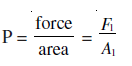
According to Pascal’s law, the same pressure is transmitted to the larger cylinder of area A2. Hence the force acting on the larger piston.
F2= Force x Area = F1A1
 x A2
x A2
It is clear from Eqn. (F2= Force x Area = F1A1
 x A2
x A2 ) that force F2 > F1 by an amount equal to the ratio (A2/A1). With slight modifications, the same arrangement is used in the hydraulic press, hydraulic balance, hydraulic Jack, etc.
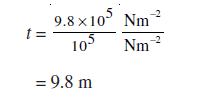
Example 1: A cemented wall of thickness one metre can withstand a side pressure of 105 Nm–2. What should be the thickness of the side wall at the bottom of a water dam of depth 100 m. Take the density of water = 103 kg m–3 and g = 9.8 ms–2.
Solution: The pressure on the side wall of the dam at its bottom is given by
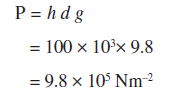
Using the unitary method, we can calculate the thickness of the wall, which will withstand the pressure of 9.8×10⁵ Nm–2. Therefore, the thickness of the wall
Key points:
- The study of fluid dynamics is crucial in designing efficient and sustainable wind turbines. Engineers use the properties of fluids such as viscosity and flow rate to optimize the design of the blades and ensure maximum power output.
- The medical field heavily relies on the properties of fluids in various applications. For example, ultrasound technology uses the properties of fluids to produce images of internal organs and diagnose medical conditions. The knowledge of fluids' characteristics helps doctors design effective drug delivery systems that target specific areas in the body.
- In the automotive industry, the properties of fluids are the basis of designing efficient engines and fuel delivery systems. The viscosity of engine oil is optimized to reduce engine wear and improve fuel efficiency. Understanding the flow of fluids in the engine is also essential in designing effective cooling systems that keep the engine at optimal temperatures.
- The study of fluid mechanics is applied in developing hydraulic systems used in heavy machinery and construction equipment. Engineers use their knowledge of the properties of fluids to design hydraulic pumps and cylinders that transfer force efficiently, reducing energy consumption and improving performance.
- Understanding the behaviour of fluids is also crucial in the construction industry. Engineers use fluid mechanics principles to design effective drainage systems, ensure stable foundation designs, and prevent water damage in buildings during flooding or heavy rainfall.
- The study of fluid dynamics is crucial in designing efficient and sustainable wind turbines. Engineers use the properties of fluids such as viscosity and flow rate to optimize the design of the blades and ensure maximum power output.
- The medical field heavily relies on the properties of fluids in various applications. For example, ultrasound technology uses the properties of fluids to produce images of internal organs and diagnose medical conditions. The knowledge of fluids' characteristics helps doctors design effective drug delivery systems that target specific areas in the body.
-
- In the automotive industry, the properties of fluids are the basis of designing efficient engines and fuel delivery systems. The viscosity of engine oil is optimized to reduce engine wear and improve fuel efficiency. Understanding the flow of fluids in the engine is also essential in designing effective cooling systems that keep the engine at optimal temperatures.
- The study of fluid mechanics is applied in developing hydraulic systems used in heavy machinery and construction equipment. Engineers use their knowledge of the properties of fluids to design hydraulic pumps and cylinders that transfer force efficiently, reducing energy consumption and improving performance.
- Understanding the behavior of fluids is also crucial in the construction industry. Engineers use fluid mechanics principles to design effective drainage systems, ensure stable foundation designs, and prevent water damage in buildings during flooding or heavy rainfall.
- A glass of water is an example of a liquid fluid that takes the shape of its container. When you pour water into a glass, it fills the shape of the glass and takes up the space inside. The pressure of the water in the glass is determined by the weight of the water above it, which is equal on all sides of the glass.
- When you turn on a gas stove, the gas that flows out is a gaseous fluid that takes up the shape of its container, in this case, the air around it. The pressure of the gas in the stove is determined by the force of the gas against the walls of the stove, creating a flow of gas and heat.
- When you inflate a balloon, you are using a fluid (air) to fill the balloon. The pressure in the balloon increases as more air is added, causing the balloon to expand until it reaches a maximum pressure where it will eventually pop. This example demonstrates how pressure in a fluid can be influenced by the force applied to it.
- In a hydraulic brake system in a car, a fluid (usually brake fluid) is used to transmit force from the brake pedal to the brakes on the wheels. The pressure of the fluid in the brake system is important in this application because it determines how much force is applied to the brakes, allowing the car to slow down or stop.
-
the brakes, allowing the car to slow down or stop.