Unit: Fluids: Pressure and Forces
Chapter: Free-body Diagrams and Buoyancy
Reference: AP Physics Algebra, Fluids, Free-body Diagrams and Buoyancy, Archimedes’ Principle (Buoyancy), Free-body diagrams
After studying this chapter, you should be able to,
- Understand the concept of Buoyancy
- to draw free body diagram of the object
Archimedes’ Principle (Buoyancy)
It is a common experience that lifting an object in water is easier than lifting it in air. It is because of the difference in the upward forces exerted by these fluids on these objects.
The upward force, which acts on an object when submerged in a fluid, is known as buoyant force. The nature of the buoyant force that acts on objects placed inside a fluid was discovered by Archimedes Based on his observations, he enunciated a law now known as the Archimedes principle.
It states that when an object is submerged partially or fully in a fluid, the magnitude of the buoyant force on it is always equal to the weight of the fluid displaced by the object.
The buoyant force can be calculated from the following equation:
FB = mdg = ρVdg
Free-body diagrams
Here are the steps for drawing a free-body diagram (FBD) for a fluid problem:
- Identify the object of interest. This is the object for which you are trying to draw the FBD.
- Identify the forces acting on the object. These may include the weight of the object, the buoyant force acting on the object, and any other forces that are applied to the object, such as friction or tension.
- Draw a reference line to represent the object. This should be a horizontal line, as the object is in a fluid.
- Draw a vector to represent each force acting on the object. The vectors should be drawn in the direction in which the force is applied, and their length should be proportional to the magnitude of the force.
- Label each force vector with the symbol and magnitude of the force. For example, you might label the weight of the object as "W" and the buoyant force as "Fb."
- Add any necessary notes or annotations to the FBD. For example, you might include the density of the fluid or the volume of the object.
- Check the FBD to ensure that it is complete and accurate. Make sure that all forces acting on the object are represented, and that the forces are balanced (the sum of the forces is zero).
The different conditions of an object under buoyant force is shown in Fig:
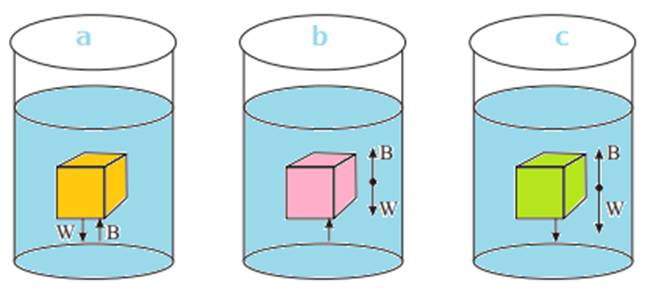
(a): The magnitude of buoyant force B on the object is exactly equal to its weight in equilibrium.
(b): A totally submerged object of density less than that of the fluid experiences a net upward force.
(c): A totally submerged object denser than the fluid sinks
If the object floats, there is no net force, which means the weight of the object is equal to the buoyant force. This means:
Fg =Fb
=Fb
mg =ρVdg
Cancelling g from both sides gives m =ρVd , which can be rearranged to give the equation for density:
ρ=mVd
If the object sinks, the weight of the object is greater than the buoyant force. This means Fb = ρVdg, Fg = mg, and the weight of the submerged object is Fnet = Fg – Fb
 .
.
Note that if the object is resting on the bottom of the container, the net force must be zero, which means the normal force and the buoyant force combine to supply the total upward force. I.e., for an object resting on the bottom:
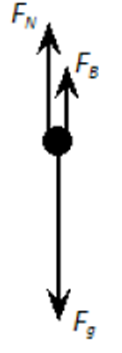
Fnet =0=Fg –(FB + FN)
Which means
Fg =FB + FN
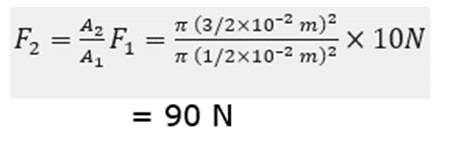
Example 1: Two syringes of different cross-sections (without needles) filled with water are connected with a tightly fitted rubber tube filled with water. The diameters of the smaller piston and larger piston are 1.0 cm and 3.0 cm respectively. (a) Find the force exerted on the larger piston when a force of 10 N is applied to the smaller piston. (b) If the smaller piston is pushed in through 6.0 cm, how much does the larger piston move out?
Answer:
- Since pressure is transmitted undiminished throughout the fluid,
- Water is considered to be perfectly incompressible. The volume covered by the movement of the smaller piston inwards is equal to the volume moved outwards due to the larger piston.
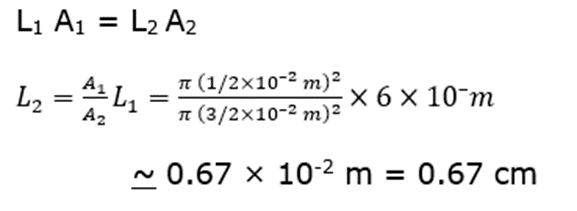
Note, atmospheric pressure is common to both pistons and has been ignored.
Key points:
- Archimedes' principle is a fundamental law of physics that governs the behaviour of objects in fluids. The principle states that any object that is fully or partially submerged in a fluid experience an upward force that is equal in magnitude to the weight of the fluid that the object displaces. Here are some key points about Archimedes' principles:
- Buoyant force: The upward force experienced by a submerged object is called the buoyant force. This force is the result of the pressure difference between the top and bottom of the object, with the greater pressure at the bottom pushing the object upward.
- Displacement: The amount of fluid that is displaced by an object is equal to the volume of the object that is submerged in the fluid. This means that the buoyant force is directly proportional to the volume of the submerged part of the object.
- Density: The density of the object and the density of the fluid also play a role in determining whether the object floats or sinks. If the density of the object is greater than the density of the fluid, the object sinks. If the density of the object is less than the density of the fluid, the object floats.
- Applications: Archimedes’ principle has numerous applications in various fields such as naval architecture, engineering, and biology. For example, it is used to design ships, submarines, and hot air balloons.
- Formula: The formula for calculating the buoyant force is Fb = Vg, where Fb is the buoyant force, V is the volume of the fluid displaced, and g is the acceleration due to gravity. This formula can be used to determine whether an object will float or sink in a given fluid.