Unit: Fluids: Pressure and Forces
Chapter: Conservation of Energy and mass in fluid flow
Reference: AP Physics Algebra, Fluids, Conservation of Energy and mass in fluid flow, Streamline Motion, Equation of Continuity Critical Velocity and Reynolds’s Number, Bernoulli’s principle, Applications of Bernoulli’s Theorem
After studying this chapter, you should be able to,
- Understand the concept of Buoyancy
- to draw free body diagram of the object
Streamline Motion
- The path followed by fluid particles is called the line of flow. If every particle passing through a given point of the path follows the same line of flow as that of preceding particles, the flow is said to be streamlined.
- A streamline can be represented as the curve or path whose tangent at any point gives the direction of the liquid velocity at that point. In steady flow, the streamlines coincide with the line of flow.
- When the velocity of flow is less than the critical velocity of a given liquid flowing through a tube, the motion is streamlined.
- If the velocity of flow exceeds the critical velocity, the mixing of streamlines takes place and the flow path becomes zig-zag. Such a motion is said to be turbulent.
Let A1 and A2 denote the areas of cross-section of the tube where the fluid is entering and leaving, as shown in Fig. given below. If v1 and v2 are the speeds of the fluid at the ends A and B respectively, and ρ is the density of the fluid, then the liquid entering the tube at A covers a distance v1 in one second. So, the volume of the liquid entering per second= A1 × v1. Therefore
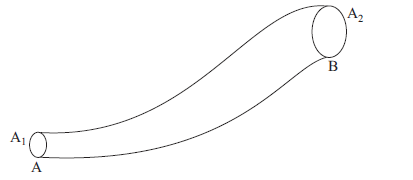
Mass of the liquid entering per second at point A = A1v1 ρ Similarly, the mass of the liquid leaving per second at point B = A2v2 ρ Since there is no accumulation of fluid inside the tube, the mass of the liquid crossing any section of the tube must be same. Therefore, we get
A1v1 ρ = A2v2 ρ
or A1v1 = A2v2
This expression is called an equation of continuity.
Critical Velocity and Reynolds’s Number
The value of the critical velocity of any liquid depends on the
- nature of the liquid, i.e. coefficient of viscosity ( η ) of the liquid;
- diameter of the tube (d) through which the liquid flows; and
- the density of the liquid (ρ).
Hence, we can write
vc = R.η/ρd
Where R is the constant of proportionality and is called Reynolds's Number. It has no dimensions. Experiments show that if R is below 1000, the flow is laminar. The flow becomes unsteady when R is between 1000 and 2000 and the flow becomes turbulent for R greater than 2000.
Bernoulli’s principle:
Bernoulli’s Principle states that where the velocity of a fluid is high, the pressure is low and where the velocity of the fluid is low, pressure is high.
- The energy of a Flowing Fluid
Flowing fluids possess three types of energy. We are familiar with the kinetic and potential energies. The third type of energy possessed by the fluid is pressure energy. It is due to the pressure of the fluid. The pressure energy can be taken as the product of pressure difference and its volume. If an element of liquid of mass m, and density d is moving under a pressure difference p, then Pressure energy = p × (m/d) joule
Pressure energy per unit mass = (p/d) J kg–1
2. Bernoulli’s Equation
Bernoulli developed an equation that expresses this principle quantitatively. Three important assumptions were made to develop this equation:
1. The fluid is incompressible, i.e. its density does not change when it passes from a wide bore tube to a narrow bore tube.
2. The fluid is non-viscous or the effect of viscosity is not to be taken into
account.
3. The motion of the fluid is streamlined.
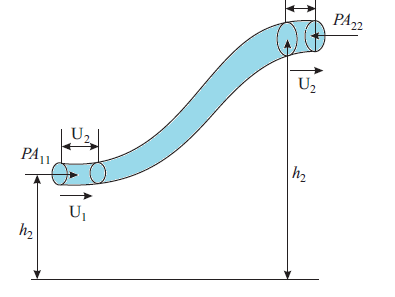
We consider a tube of varying cross-sections shown in Fig. given above. Suppose at point A the pressure is P1, the area of cross-section A1, the velocity of flow v1, height above the ground h1 and at B, the pressure is P2, area of cross-section A2 velocity of flow = v2, and height above the ground h2.
Since points A and B can be any two points along a tube of flow, we write
Bernoulli’s equation
P + 1/2 dv2 + h dg = Constant.
That is, the sum of pressure energy, kinetic energy and potential energy of a fluid
remains constant in streamlined motion.
Applications of Bernoulli’s Theorem
Bernoulli’s theorem finds many applications in our lives. Some commonly observed phenomena can also be explained on the basis of Bernoulli’s theorem.
It is a device used to measure the rate of flow of liquids through pipes. The device is inserted in the flow pipe, as shown in the Fig. below.
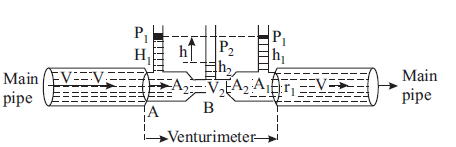
It consists of a manometer, whose two limbs are connected to a tube having two different cross-sectional areas say A1 and A2 at A and B, respectively. Suppose the main pipe is horizontal at a height h above the ground. Then applying Bernoulli’s theorem for the steady flow of liquid through the venturi meter at A and B, we can write
Total Energy at A = Total Energy At B

On rearranging terms, we can write,

It shows that points of higher velocities are the points of lower pressure (because of the sum of pressure energy and K.E. remain constant). This is called Venturi’s
Principle.
For steady flow through the venturi meter, the volume of liquid entering per second at A = liquid volume leaving per second at B. Therefore
A1v1 = A2v2
(The liquid is assumed incompressible i.e., velocity is more at narrow ends and
vice versa.
Using this result in Eqn.

we conclude that pressure is lesser at the narrow ends;
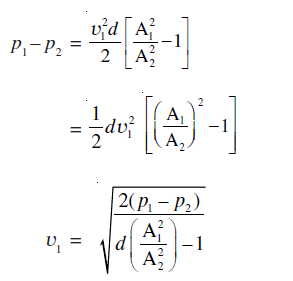
If h denotes the level difference between the two limbs of the venturi meter, then
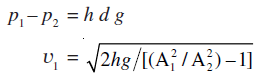
From this, we note that v1 h since all other parameters are constant for a
given venturi meter. Thus
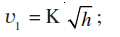
where K is constant.
The volume of liquid flowing per second is given by
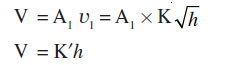
where K’ = K A1 is another constant.
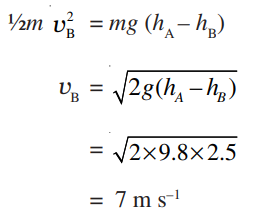
Example 1: Water flows out of a small hole in the wall of a large tank near its bottom (Fig. given below). What is the speed of efflux of water when the height of the water level in the tank is 2.5m?
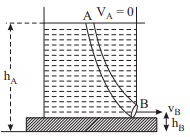
Solution: Let B be the hole near the bottom. Imagine a tube of flow A to B for the water to flow from the surface point A to hole B. We can apply Bernoulli's theorem to points A and B for the streamlined flow of small mass m. Total energy at B = Total energy at A
At A, vA= 0, pA= p = atmospheric pressure, h = height above the ground.
At B, vB = v = ?, pB = p, hB = height of the hole above the ground.
Let hA – hB = H = height of the water level in the vessel = 2.5m and d = density of the water. Applying Bernoulli's Principle and substituting the values we get,
Key points:
Bernoulli's Principle:
Bernoulli's principle states that as the speed of a fluid (such as air or water) increases, its pressure decreases, and vice versa.
This principle is based on the idea that energy in a fluid is conserved, and is expressed mathematically as P + (1/2)ρv2 + ρgh = constant, where P is the pressure, ρ is the density, v is the velocity, h is the height above a reference point, and g is the acceleration due to gravity.
Bernoulli's principle can be used to explain a wide range of phenomena, from how aeroplanes fly to how perfume sprayers work.
Equation of Continuity:
The Equation of Continuity is a mathematical expression of the principle of conservation of mass for fluids.
This principle states that the mass flow rate of a fluid is constant through any cross-section of a pipe or duct, regardless of changes in the fluid's velocity or density.
The Equation of Continuity is expressed mathematically as A1v1 = A2v2, where A is the cross-sectional area of the pipe or duct, and v is the fluid velocity.
The Equation of Continuity is used in many practical applications, including designing piping systems, measuring fluid flow rates, and understanding the behaviour of blood flow in the human body.