Unit: Electric Circuits
Chapter: Definition and Conservation of electric charge
Reference: AP Physics Algebra,Electric Circuits, Definition and Conservation of electric charge, Electric Charge, Conductors and Insulators, Charging by Induction, Three basic properties of electric charge, Coulomb’s law, Facts about Coulomb’s law, Electric current
After studying this chapter, you should be able to,
- state the basic properties of electric charges;
- explain the concepts of quantisation and conservation of charge;
- explain Coulomb’s law of force between electric charges;
- state the electric current
Electric Charge:
• Electrostatic charge is a fundamental property of matter due to which it produces and experiences electrical and magnetic effects.
• Properties of atoms, molecules and bulk matter are determined by electric and magnetic forces.
• It can be inferred from simple experiments based on frictional electricity that there are two types of charges in nature: negative and positive; and like charges repel and unlike charges attract.
• By convention, the charge on the electron is considered as negative and the charge on the proton is considered as positive and the charge present is equal. The S.I. unit of electric charge is the coulomb. Its C.G.S unit is stat coulomb.
• The nature and amount of electric charge present in a charged body is detected by a Gold-leaf electroscope.
• Total charge on a body is expressed as q = ± ne.
Conductors and Insulators
• Objects that allow charges to flow through them are called Conductors (metals) and objects that do not allow charges to flow through are called Insulators (rubber, wood, and plastic).
• Objects that behave as an intermediate between conductors and insulators are called semiconductors, for example- silicon.
• The process of sharing charges with the earth, when we bring a charged body in contact with the earth is called grounding or earthing.
Charging by Induction
• Charging by induction means charging without contact.
• If a plastic comb is rubbed with wool, it becomes negatively charged.
Three basic properties of electric charge
• Quantization: When the total charge of a body is an integral multiple of a basic quantum of charge, this is known as quantization of electric charge. i.e., q = ne where n = ±1, ±2, ±3, ……………..
• Additivity: It means that the total charge of a system is the algebraic sum (adding taking into account negative and positive signs) of all the charges in the system.
• Conservation of charge: Conservation of electric charges means that there will be no change in the total charge of the isolated system with time. There is the transfer of the electric charge from one body to another, but no charge will be created or destroyed.
Coulomb’s law:
The force between two-point charges q1 and q2 is directly proportional to the product of the two charges (q1 q2) and inversely proportional to the square of the distance between them (r2) and it acts along the straight line joining the two charges.
F = force on q2 due to q1 =Kq1q2/r2
where K = 14πϵ0
The experimental value of the constant ε0 is 8.854 × 10⁻¹²C2 N–1m–2 Therefore, the approximate value of k is 9 × 10⁹ Nm2 C–2
Facts about Coulomb’s law:
• Coulomb's law is not valid for charges in motion; it should only be used for point charges in a vacuum at rest.
• The electrostatic force obeys Newton’s third law of motion and acts along the line joining the two charges.
• Presence of other charges in the neighbourhood does not affect Coulomb’s force.
• The ratio of electric force and the gravitational force between a proton and an electron is represented by
ke2Gmemp ≅ 2.4 x 1039
Electric current:
When the net amount of charge flowing through the area in the time interval is defined as the electric current across the area.
The current is the rate of flow of charge through a surface area placed perpendicular to the direction of flow. If charge Δq flows in time Δt, the average current is defined
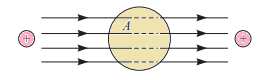
The motion of charges inside a conductor of surface area A
If the rate of flow of charge varies with time, the current also varies with time. The instantaneous current is expressed as:
I =dq/dt
The electric current through a conductor is the rate of transfer of charge across a surface placed normally to the direction of flow.
The SI unit of current is ampere. Its symbol is A:
1 Ampere = 1 coulomb/1 second
Example: A total of 6.0 × 10¹⁶ electrons pass through any cross-section of a conducting wire per second. Determine the value of the current in the wire.
Solution: Total charge passing through the cross-section in one second is ΔQ = ne = 6.0 × 1016 × 1.6 × 10–19 C = 9.6 × 10⁻³C
I= ∆Q/∆t = 9.6 × 10⁻³C1s
= 9.6 × 10⁻³ A = 9.6 mA
Key point:
- Currents are not always steady
- SI unit of current is ampere.
- The smaller units of current are milliampere, 1 mA = 10–3A, and microampere,
1μA = 10–6 A.
- The current can arise due to the flow of negative charges (electrons), as in metals
- The electron charge is usually represented by the symbol e or q. This is the basic physical constant used to represent 1.1602 × 10⁻¹⁹ coulomb.
- The electric charge has three basic properties: quantisation, additivity and conservation.
- The additivity of electric charges means that the total charge of a system is the algebraic sum (i.e., the sum taking into account proper signs) of all individual charges in the system.
- Conservation of electric charges means that the total charge of an isolated system remains unchanged with time.
- Electric and magnetic forces determine the properties of atoms, molecules and bulk matter.
- The quantisation of electric charge means that the total charge (q) of a body is always an integral multiple of a basic quantum of charge (e) i.e., q = n e, where n = 0, ±1, ±2, ±3, …. Proton and electron have charges +e, –e, respectively.
- Coulomb’s law is a short-range force (about 10-10).
- Coulomb is a large unit of charge. For the small amount, we can use micro coulomb and milli coulomb.
- Here ϵ0 is the permittivity of free space, when we place the charge in any medium then we have to use ϵ as the permittivity of the medium.
- The value of ϵ is depend on the medium.
- Conservation of the total charge of an isolated system is a property independent of the scalar nature of the charge
- Force on one charge due to another charge is unaffected by the presence of other charges, and there are no additional three-body, four-body, etc., forces which arise only when there are more than two charges.