Unit: Geometric and Physical Optics
Chapter: Wave
Reference: AP Physics Algebra, Geometric and Physical Optics, Wave, Periodic waves, Electromagnetic Waves, its Types & Properties, Properties of EM Waves, Types of EM Waves
After studying this chapter, you should be able to,
- state the type of wave
- explain the concepts of Electromagnetic Waves, their Types & Properties
- state the concept of the periodic wave
Wave:
A wave typically consists of oscillations or vibrations that propagate through a medium or space. The medium can be a material substance like air, water, or solids, or it can even be a field, as in the case of electromagnetic waves.
Waves are characterized by several key properties:
Amplitude: The maximum displacement or distance from the equilibrium position of a wave. It indicates the wave's intensity or energy.
Wavelength: The distance between two consecutive points in a wave that is in phase, such as crest to crest or trough to trough. It represents the spatial extent of one complete cycle of the wave.
Frequency: The number of complete cycles or oscillations of a wave that occur per unit of time. It is typically measured in hertz (Hz) and is inversely proportional to the wavelength.
Period: The time it takes for one complete cycle of a wave to pass a given point. It is the reciprocal of the frequency.
Speed: The rate at which a wave propagates through a medium. It is determined by the properties of the medium and is calculated as the product of wavelength and frequency.
There are several types of waves that can be classified based on various properties and characteristics. Here are some common types of waves:
Mechanical Waves: These waves require a medium (substance) to travel through. Examples include sound waves, water waves, and seismic waves (earthquakes).
Electromagnetic Waves: These waves can travel through a vacuum (empty space) and do not require a medium. They consist of oscillating electric and magnetic fields. Examples include radio waves, microwaves, infrared waves, visible light, ultraviolet waves, X-rays, and gamma rays.
Transverse Waves: In these waves, the oscillations of particles are perpendicular (at right angles) to the direction of wave propagation. Examples include water waves and electromagnetic waves such as light.
Longitudinal Waves: In these waves, the oscillations of particles are parallel to the direction of wave propagation. Examples include sound waves and seismic waves.
Surface Waves: These waves travel along the boundary between two different mediums. They have characteristics of both transverse and longitudinal waves. Examples include ocean waves and seismic surface waves.
Standing Waves: These waves result from the interference of two waves travelling in opposite directions. They appear to be "standing" and do not propagate through space. Examples include waves on a string or in a musical instrument.
Electromagnetic Spectrum: This refers to the entire range of electromagnetic waves, ordered by increasing frequency or decreasing wavelength. It includes radio waves, microwaves, infrared waves, visible light, ultraviolet waves, X-rays, and gamma rays.
Periodic waves:
Periodic waves are a type of wave motion that repeat themselves over time. They are characterized by a regular pattern of oscillations, where the wave shape repeats at regular intervals called the period. The equation used to describe periodic waves depends on the type of wave, but a general form can be given as:
y(x, t) = A sin(kx – ωt + φ)
In this equation:
- y(x, t) represents the displacement of the wave at a point x and time t.
- A is the amplitude of the wave, which determines the maximum displacement from the equilibrium position.
- k is the wave number, defined as 2π divided by the wavelength (k = 2π/λ). It represents the spatial frequency of the wave.
- x is the position along the wave's direction.
- ω is the angular frequency, defined as 2π divided by the period (ω = 2π/T). It represents the temporal frequency of the wave.
- t is the time.
- φ is the phase constant, which determines the initial phase of the wave.
This equation describes a sinusoidal wave, where the displacement varies sinusoidally as a function of both position and time. The wave propagates in the positive x direction with a velocity given by v = ω/k.
Electromagnetic Waves, its Types & Properties
Displacement Current:
- It is defined as the rate of change of electric displacement.
- It is given by Id
 = ε0d∅/ϵdt Where ε0
 is the permittivity of the free space and ∅s is the amount of electric flux.
Properties of EM Waves
• The electric and magnetic fields Ex and By are always perpendicular to each other, and also to the direction z of propagation. Ex and By are given by:
Ex = E0 sin (kz-ωt)
By = B0 sin (kz-ω t)
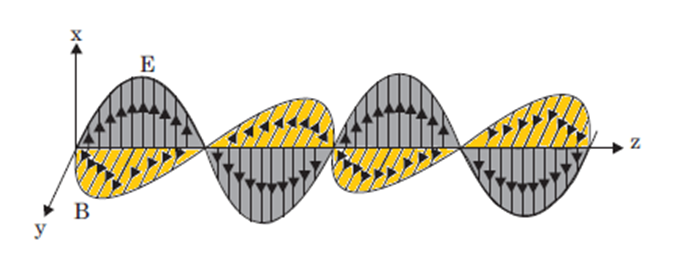
Electromagnetic Waves
Where,
“k” is the magnitude of the wave vector (or propagation vector) and can be calculated as;
K=2πλ
• w is the angular frequency,
• "k" is direction that describes the direction of propagation of the wave. The speed of propagation
of the wave is ωk
The frequency of EM waves can be from 0 to ∞ . Ampere Circuital Law is given by:
B.dl =μ0 i(t)
i(t)
An electric charge oscillating harmonically with a frequency produces electromagnetic waves of the same frequency. The frequency of the electromagnetic wave naturally equals the frequency of oscillation of the charge.
An electric dipole is a basic source of electromagnetic waves.
From Maxwell's equations, it can be seen that the magnitude of the electric and the magnetic fields in an electromagnetic wave are related as B0 =ε0C
=ε0C
Properties of EM Waves
• Oscillations of electric and magnetic fields sustain in free space or vacuum. So, electromagnetic waves can travel in a vacuum.
• An electromagnetic wave carries momentum and energy. Since an electromagnetic wave
carries momentum, it also exerts pressure, called radiation pressure.
• Let the total energy transferred to a surface in time t is U, so the magnitude of the total momentum of an electromagnetic wave delivered to the surface (for complete absorption) is,
P =UC
The energy of electromagnetic waves is shared equally by the electric and magnetic fields.
Types of EM Waves
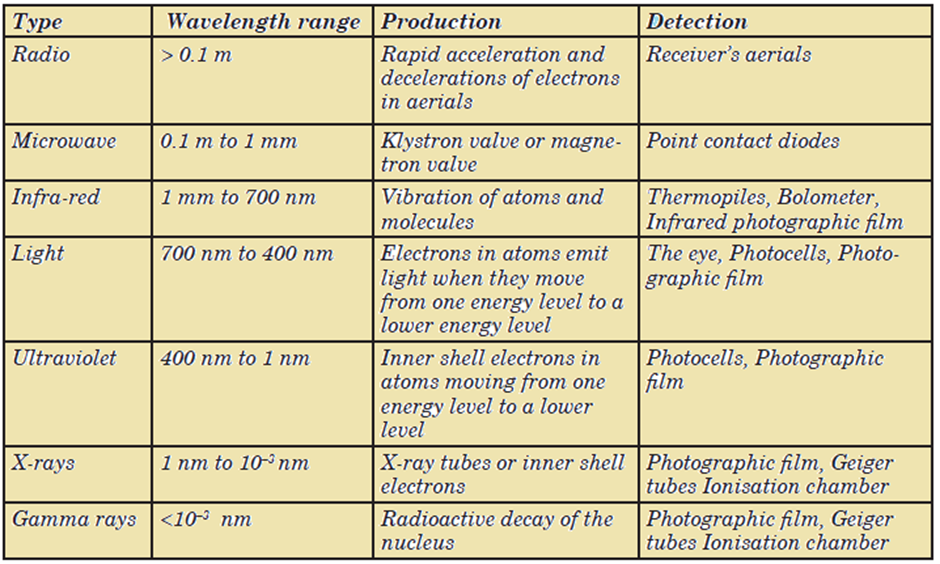
• Radio waves are produced by the accelerated motion of charges in conducting wires. They are used in radio and television communication systems. The radio waves generally lie in the frequency range from 500 kHz to about 1000 MHz
• Microwaves have a frequency in the range of gigahertz and are used in aircraft navigation.
• Infrared waves are also referred to as heat waves as they are produced by hot bodies and molecules.
• Visible rays can be detected by the human eye. They lie between a frequency range of about
4 × 10¹⁴ Hz to about 7 × 10¹⁴ Hz or a wavelength range of about 700 –400 nm.
• Ultraviolet radiation or UV radiation is produced by special lamps and very hot bodies.
• X-rays lie beyond the UV region and are used as a diagnostic tool in medicine and for treating various kinds of cancer.
• Gamma rays are emitted by radioactive nuclei and also are produced in nuclear reactions and are used in destroying the cancer cells.
The properties of different types of EM Waves are:
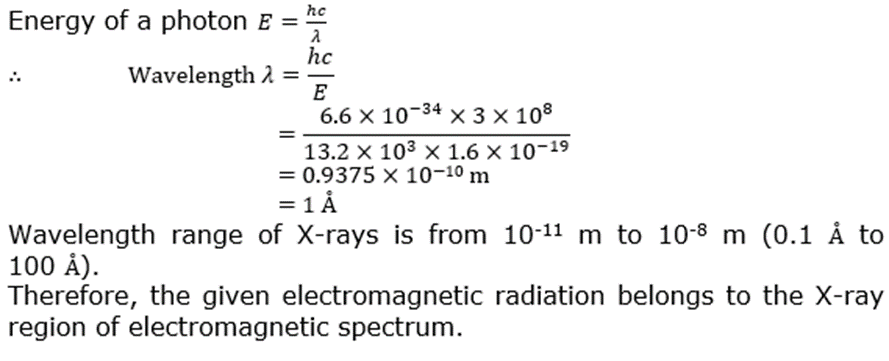
Example: Electromagnetic radiation has an energy of 13.2 keV. Then the radiation belongs to the region of ________
Solution:
Key points:
- Types of Electromagnetic Waves: Electromagnetic waves span a broad spectrum, commonly known as the electromagnetic spectrum, which includes various types of waves, listed in order of increasing frequency and energy:
- Radio Waves: Longest wavelength and lowest frequency electromagnetic waves. They are used for communication, such as radio and television broadcasting.
- Microwaves: Have shorter wavelengths and higher frequencies than radio waves. They are used for cooking, radar systems, and wireless communications.
- Infrared Waves: These have wavelengths longer than visible light but shorter than microwaves. They are responsible for heat transfer and are used in applications like remote controls and thermal imaging.
- Visible Light: The portion of the electromagnetic spectrum that is visible to the human eye. It consists of different colors ranging from red (longest wavelength) to violet (shortest wavelength).
- Ultraviolet Waves: Have wavelengths shorter than visible light and are responsible for tanning, and vitamin D synthesis, and can cause sunburn or damage to the skin.
- X-rays: Have higher energy and shorter wavelengths than ultraviolet waves. They are used in medical imaging and security scanning.
- Gamma Rays: The highest energy and shortest wavelength electromagnetic waves. They are produced in nuclear reactions and radioactive decay and are used in cancer treatment and sterilization.
- Properties of Electromagnetic Waves:
- Wavelength: The distance between two consecutive crests or troughs of the wave.
- Frequency: The number of wave cycles passing a given point per unit of time, measured in Hertz (Hz).
- Speed: Electromagnetic waves travel at the speed of light in a vacuum, denoted as "c" and approximately equal to 3 x 10⁸ meters per second.
- Amplitude: The maximum displacement of the wave from its equilibrium position.
- Electromagnetic waves do not require a medium to propagate. They can travel through a vacuum as well as through various mediums like air, water, and solids.
- Electromagnetic waves can be reflected, refracted, diffracted, and absorbed, depending on the properties of the medium they encounter.
- Electromagnetic waves are transverse waves, meaning the electric and magnetic fields oscillate perpendicular to the direction of wave propagation.