Unit: Geometric and Physical Optics
Chapter: Interference and Diffraction
Reference: AP Physics Algebra, Geometric and Physical Optics, Huygens Principle, Interference of Light, Diffraction and Polarisation of Light, Diffraction and Polarisation of Light
After studying this chapter, you should be able to,
- state the type of wave
- explain the concepts of Electromagnetic Waves, their Types & Properties
- state the concept of the periodic wave
Huygens Principle
• The effects which depend on the wave nature of light are included under wave optics. Interference and diffraction of light show that light behaves as a wave and not as a stream of particles.
• Huygens principle: It states that each point of the wavefront is the source of a secondary disturbance. Also, the wavelets emanating from these points spread out in all directions with the speed of the wave which are referred to as secondary wavelets and if we draw a common tangent to all these spheres, a new position of the wavefront is obtained at a later time.
• When a wave gets refracted into a denser medium the wavelength and the speed of propagation decrease but the frequency remains the same.
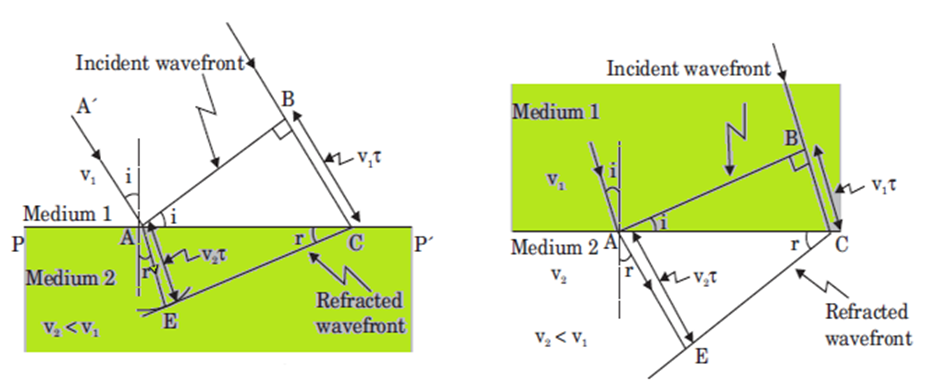
Huygens Principle
n1 sin i = n2 sin r is Snell’s law of refraction.
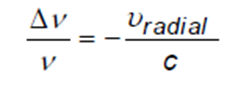
Doppler Effect is defined as the change in wavelength or frequency of a wave in relation to the observer who is moving relative to the wave source. The Doppler shift is expressed as:
Interference of Light
• Superposition principle states that at a particular point in the medium, the resultant displacement produced by a number of waves is the vector sum of the displacements produced by each of the waves.
• The resultant displacement at a point from two coherent sources will be equal to the sum of the individual displacement at that point.
y = 2a cos wt
The resultant intensity is four times the intensity produced by each source.
I = 4I0 and I0 ∝ a2
a2
• Constructive interference: It is observed in cases when two coherent sources are vibrating in phase having path difference for a point P as
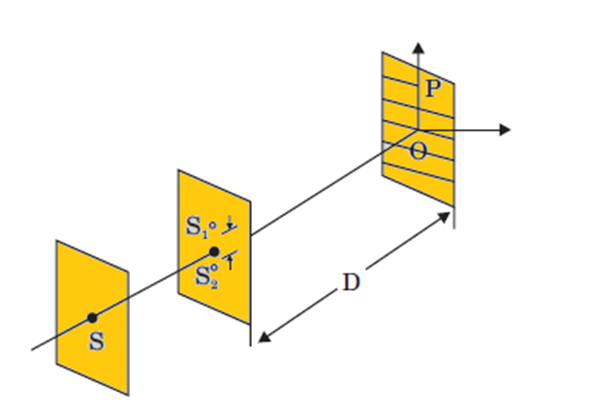
S1P – S2P = nl(n = 0, 1, 2, ….) and resultant intensity is 4I0
Destructive interference: It is observed in cases when two coherent sources are vibrating in phase having path difference for a point P as

And resultant intensity is zero.
• Young’s double slit of length d gives equally spaced fringes which are at angular separation λd . The midway point of the slits, the central bright fringe and the source, all lie in a straight line. But this fringe gets destroyed by an extended source, if the angle subtended is more than λd .at the slits.
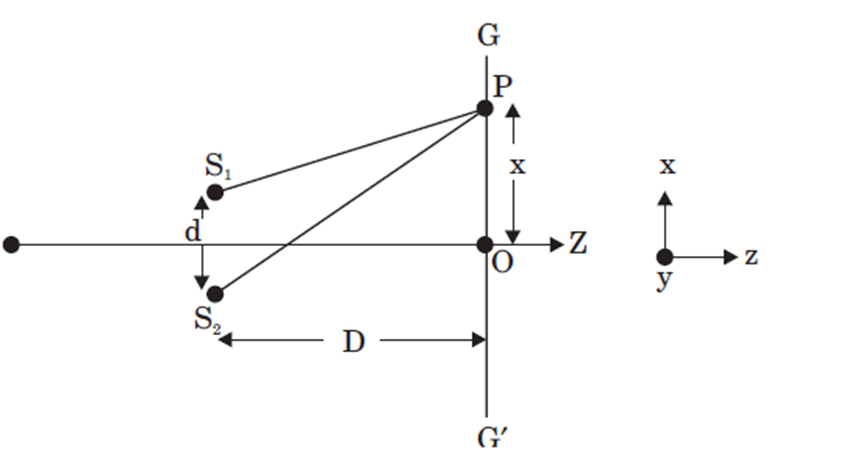
Young’s Double Slit Experiment
• Path difference, nλ/Dd
• Fringe width: Distance between two consecutive bright and dark fringes represented by λD/d
Diffraction and Polarisation of Light
• Diffraction: Bending of light around corners of an obstacle into the region where the shadow of the obstacle is expected.
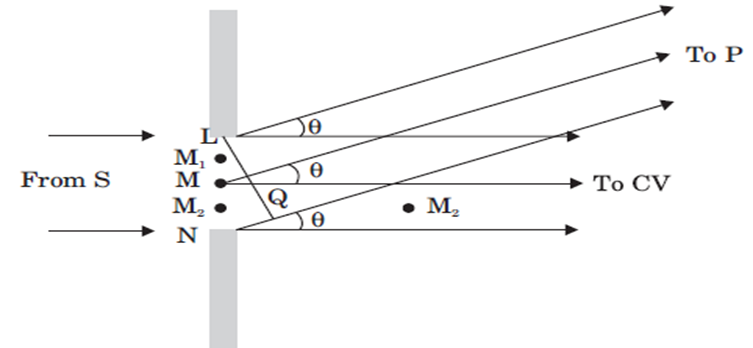
Diffraction Phenomenon
• Light energy is redistributed in interference and diffraction. When it reduces in one region, emitting a dark fringe, it increases in another region, emitting a bright fringe. In this process the energy remains constant i.e., neither energy is gained nor lost, with the principle of conservation of light.
• The resolving power of the microscope is given by the reciprocal of the minimum separation of two points seen as distant. The resolving power can be increased by choosing a medium with a higher refractive index.
dmin =1.22λ/2sinβ
• Resolving power of telescope: For two stars to be just resolved,
f∆θ ≈ 0.61λ/fa
So, ∆θ ≈ 0.61λa
The telescope will have better resolving power if a is large.
• A diffraction pattern with a central maximum is given by a single slit of width a. At angles of ±λa , ±2/a etc., along with successively weaker secondary maxima in between, the intensity reduces to zero. The angular resolution of a telescope is limited to λd
 , due to diffraction where D is the diameter. Strongly overlapping images are formed when two stars are closer to this angle. Similarly, in a medium of refractive index n, a microscope objective subtending angle 2b at the focus, will just separate two objects spaced at a distance λ2n/sinβ, which is the resolution limit of a microscope.
• The Fresnel distance is given by the formula Zp =a2λ
=a2λ , where a is the size of the aperture and λ
 is the wavelength.
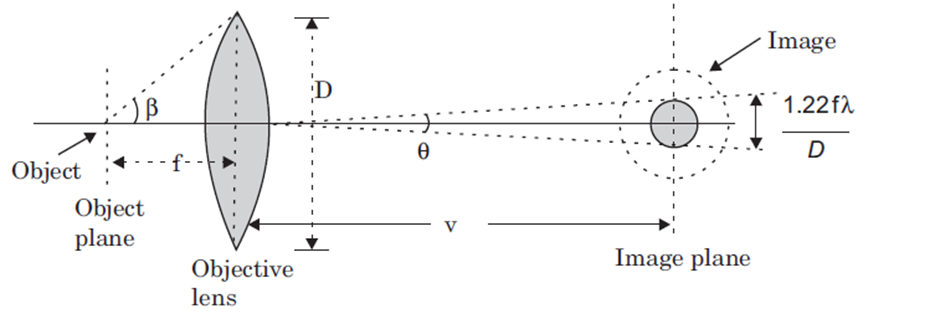
Resolving power of the microscope
• Polarized wave: A long string is held horizontally, the other end of which is assumed to be fixed. If the end of the string is moved up and down in a periodic manner, a wave propagating in the +x direction will be generated. Each point on the string moves on a straight line, the wave is also referred to as a linearly polarised wave. The linearly polarized waves are transverse waves; i.e., the displacement of each point of the string is always at right angles to the direction of propagation of the wave.
• Unpolarized wave: When the plane of vibration of the string is changed randomly in very short intervals of time, then we have what is known as an unpolarised wave. Thus, for an unpolarised wave, the displacement will be randomly changing with time though it will always be perpendicular to the direction of propagation.
• A Polaroid consists of long chain molecules aligned in a particular direction. The electric vectors along the direction of the aligned molecules
get absorbed. Thus, if an unpolarised light wave is an incident on such a Polaroid, then the light wave will get linearly polarized with the electric vector oscillating along a direction perpendicular to the aligned molecules; this direction is known as the pass-axis of the Polaroid.
• If I is the intensity of polarized light after passing through the first polariser P1 then the intensity of the light after passing through the second
polarizer P2 will be I = Icosθ. This is called Malus’ Law.
• Natural light from the sun is unpolarised which means that the electric vector takes all possible random directions in the transverse plane. A polaroid transmits only one component of these vectors, which is parallel to a special axis. Therefore, the light wave is called plane polarised. When this kind of light is viewed through another polaroid which is rotated through an angle 2p, we can see two maxima and minima of the same
intensity.
• Plane polarised light can also be produced by reflection at a special angle known as the Brewster angle and by scattering through π2  in the earth’s atmosphere.
Example: A beam of light of wavelength 600 nm from a distant source fall on a single slit 1 mm wide and the resulting diffraction pattern is observed on a screen 2 m away. The distance between the first dark fringes on either side of the central bright fringe is _______.
Solution:
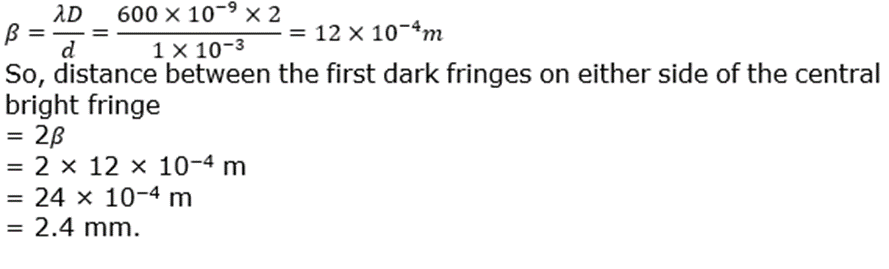
Key points
Interference:
- Interference is the phenomenon that occurs when two or more waves overlap and combine to form a resultant wave.
- It can occur with any type of wave, including light waves, sound waves, and water waves.
- Interference can be classified into two types: constructive interference and destructive interference.
- Constructive interference occurs when two waves combine to produce a larger amplitude resulting in an amplified wave.
- Destructive interference occurs when two waves combine to produce a smaller amplitude or cancel each other out, resulting in a reduced or even zero amplitude.
- Interference patterns are formed by the superposition of waves and can exhibit regions of constructive and destructive interference.
- The conditions for interference to occur include coherent sources (sources with a constant phase relationship) and waves with similar frequencies and amplitudes.
- Interference is commonly observed in double-slit experiments, where light or other waves passing through two closely spaced slits create an interference pattern on a screen.
Diffraction:
- Diffraction is the bending or spreading of waves as they encounter an obstacle or pass through an aperture.
- It occurs when waves encounter an object with a size on the order of their wavelength.
- Diffraction can occur with various types of waves, including light waves, sound waves, and water waves.
- Diffraction causes waves to spread out, resulting in patterns of alternating light and dark regions known as diffraction patterns.
- The amount of diffraction depends on the wavelength of the wave and the size of the obstacle or aperture.
- The narrower the aperture or the larger the obstacle compared to the wavelength, the more pronounced the diffraction effects.
- Diffraction can be observed in various situations, such as when light passes through a narrow slit, when sound waves bend around obstacles, or when water waves encounter a breakwater.