Unit: Dynamics
Chapter: Newton’s laws
Reference: AP Physics Algebra, Dynamics, Newton’s laws, Force, Newton’s First Law of Motion, Concept of Momentum, Newton’s Second Law of Motion, Newton’s Third Law of Motion
After studying this chapter, you should be able to:
- state Newton’s laws
- solve the problem related to Newton’s laws
Force:
A force is a push or pull acting on a body. It is a vector quantity i.e.; it has both magnitude and direction.
Unit of Force: Its unit is Newton in the SI system and Dyne in the CGS system.
Dimension: MLT –2
(a)Contact Forces: Tension, Normal Reaction, Friction etc. Forces that act between bodies in contact.
(b)Field forces (non-contact forces): Weight, electrostatic forces, etc. Forces that act between bodies separated by a distance without any actual contact.
Newton’s First Law of Motion:
Isaac Newton generalized Galileo’s conclusions in the form of a law known as Newton’s first law of motion, which states that a body continues to be in a state of rest or of uniform motion in a straight line unless it is acted upon by a net external force.
The first law, also known as the law of inertia, states that an object at rest will remain at rest, and an object in motion will continue to move in a straight line at a constant speed unless acted upon by an external force. In other words, objects tend to resist changes in their state of motion.
Concept of Momentum
You must have seen that a fielder finds it difficult to stop a cricket ball moving with a large velocity although its mass is small. Similarly, it is difficult to stop a truck from moving with a small velocity because its mass is large. These examples suggest that both, the mass and velocity of a body, are important when we study the effect of force on the motion of the body. The product of mass m of a body and its velocity v is called its linear momentum p. Mathematically,
we, write p = mv
In SI units, momentum is measured in kg ms–1. Momentum is a vector quantity. The direction of the momentum vector is the same as the direction of the velocity vector. The momentum of an object, therefore, can change on account of a change in its magnitude or direction or both. The following examples illustrate this point.
Newton’s Second Law of Motion:
Newton’s second law states that the rate of change of momentum of a body is directly proportional to the applied force.
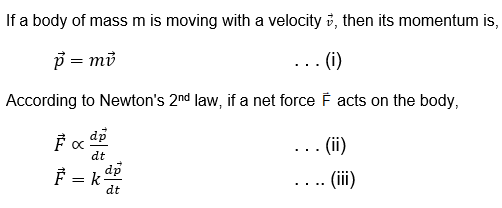
Where k is the constant of proportionality.
Unit force is now defined as that force which produces a unit rate of change of momentum in a body
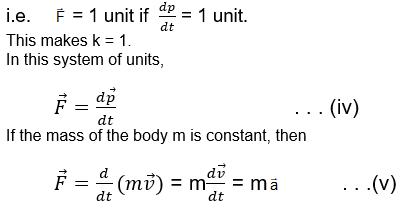
Note that the second law of motion gives us a unit for measuring force. The SI unit of force i.e., a newton may thus, be defined as the force which will produce an acceleration of 1 ms–2 in a mass of 1 kg.
Newton’s Third Law of Motion:
The third law states that for every action, there is an equal and opposite reaction. This means that whenever one object exerts a force on another object, the second object exerts an equal and opposite force back on the first object. Every action has an equal and opposite reaction
If F12 is the force which object 1 experiences due to object 2 and F21 is the force which object 2 experiences due to object 1, then according to Newton’s third law of motion, we can write
F12 = –F21
Example 1: A block of mass m = 10 kg is pulled by a force F = 100 N at an angle q = 30o with the horizontal along a smooth horizontal surface. What is the acceleration of the block? (g = 10 m/s2)
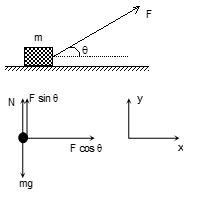
Solution: The forces that act on the body can be decomposed along x and y axis.
As there is no acceleration along y-axis, the net force acting along the vertical or y-axis should be zero i.e.
åFY = N + Fsinq – mg = 0 . . . (1)
The body accelerates along the x-axis. Therefore
The acceleration of the block is 53 m/s2
Directed towards right. Since F sinq < mg & the surface is rigid, the block remains in equilibrium along y-axis.
Key points:
Isaac Newton's laws of motion are the foundation of classical mechanics and describe the behaviour of objects in motion. They are as follows:
- The first law, also known as the law of inertia, states that an object at rest will remain at rest, and an object in motion will continue to move in a straight line at a constant speed unless acted upon by an external force. In other words, objects tend to resist changes in their state of motion.
- The second law states that the force applied to an object is directly proportional to its mass and acceleration. This law is expressed mathematically as F=ma, where F is the force, m is the mass of the object, and a is the acceleration.
- The third law states that for every action, there is an equal and opposite reaction. This means that whenever one object exerts a force on another object, the second object exerts an equal and opposite force back on the first object.
Together, these laws provide a framework for understanding the motion of objects and the forces that affect them.