Unit: Circular Motion and Gravitation
Chapter: Centripetal Acceleration vs. Centripetal Force
Reference: AP Physics Algebra, Circular Motion and Gravitation, moving in a Circle, Centripetal force, Uniform and Non-Uniform Circular Motion, Free Body Diagram, how to draw FBD of Figure, Apparent Weight of a Body in a Lift, Free-Body Diagram for Circular Motion, Free-Body Diagram for Vertical Circular Motion
After studying this chapter, you should be able to:
- State the centripetal force, Uniform and Non-Uniform Circular Motion:
- Analyse the Centripetal Acceleration
- to draw free body diagram of Figure:
Moving in a Circle
For an object to continue to move in a circle a force is needed that acts on the object towards the centre of the circle. This is called the centripetal force and is provided by a number of things:
For a satellite orbiting the Earth, it is provided by gravitational attraction.
For a car driving around a roundabout, it is provided by the friction between the wheels and the road. For a ball on a string being swung in a circle it is provided by the tension in the string.
Centripetal force
The centripetal force acts from the body to the centre of a circle.
Centripetal force is the corresponding force (resultant force) which causes the centripetal acceleration.
Properties:
Direction: Pointing towards the centre of the circle/perpendicular to the instantaneous velocity
Since F=ma the object must accelerate in the same direction as the resultant force. The object is constantly changing its direction towards the centre of the circle.
Uniform and Non-Uniform Circular Motion:
Uniform circular motion: In a uniform circular motion, a particle moves in a circular path of a constant radius with constant speed. The velocity of a particle varies continuously as the direction changes. Thus, uniform circular motion is uniformly accelerated motion. Since the acceleration produces a change only in the direction of the velocity vector, therefore, it must always be at right angles to the direction of motion. Otherwise, a component in the direction of motion would produce a change in the speed of the particle.
Centripetal Acceleration: The acceleration of a particle in uniform circular motion is directed towards the centre of the circular path. This radially inward acceleration is called centripetal acceleration (which means centre-seeking). Its magnitude is given by
ac=v2/r
Where v is the speed of the particle, and r is the radius of the circular path. In terms of angular speed ω=v/r, we may write ac = w2 r
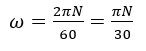
If a body makes N revolutions per minute, then its angular speed is given by
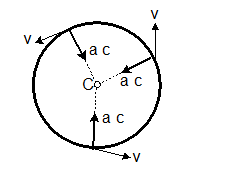
In a uniform circular motion
(i) Velocity remains constant in magnitude but varies in direction
(ii) The acceleration is always normal to the velocity vector.
(iii) The acceleration is always directed towards the centre of the circular path.
Non-uniform circular motion:
(i) The velocity changes both in magnitude as well as in direction
(ii) The velocity vector is always tangential to the path
(iii) The acceleration vector is not perpendicular to the velocity vector
(iv) The acceleration vector has two components
(a) Tangential acceleration at changes the magnitude of the velocity vector, i.e. at = dv/dt
(b) Normal acceleration or centripetal acceleration ac changes the direction of the velocity vector, i.e., ac = v2/r
(v) The total acceleration is the vector sum of the tangential and centripetal acceleration
Free Body Diagram:
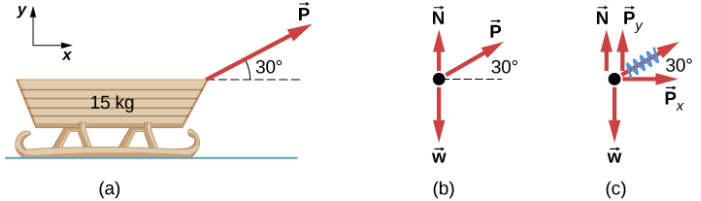
Free Body Diagram In this diagram the object of interest is isolated from its surroundings and the interactions between the object and the surroundings are represented in terms of forces.
A diagram showing all the forces acting on a body is called a free-body diagram.
How to draw FBD of Figure:
Steps:
- Free the body (remove all the contacting surfaces, ropes etc.) but remember where they were attached.
- Show the contact forces.
- Show the non-contact forces.
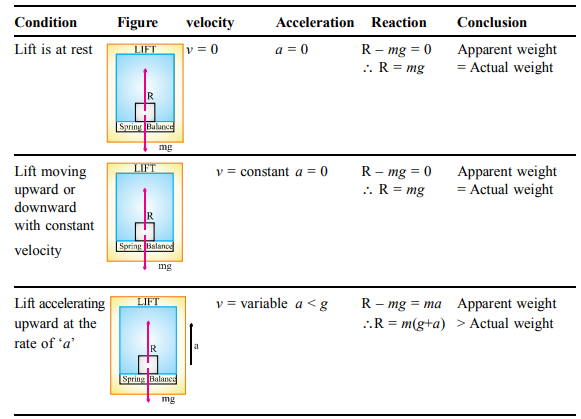
Apparent Weight of a Body in a Lift
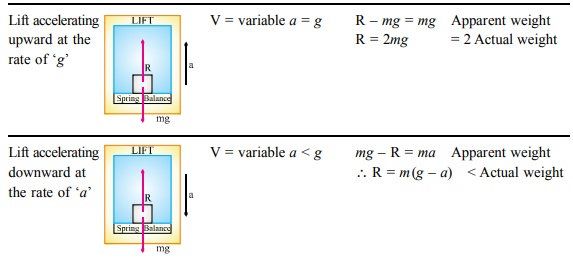
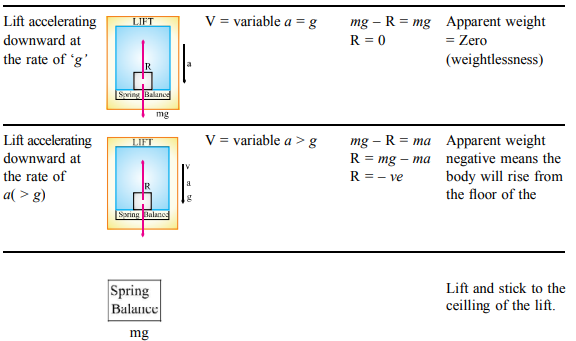
When a body of mass m is placed on a weighing machine which is placed in a lift, then the actual weight of the body is mg. This acts on a weighing machine which offers a reaction R given by the reading of the weighing machine. The reaction exerted by the surface of contact on the body is the apparent weight of the body.
Free-Body Diagram for Circular Motion
Now that we know how to make a free-body diagram, let's look at free-body diagrams for objects moving in a uniform circular motion. Consider a satellite in geosynchronous orbit circling the Earth. The satellite is seen in the graphic below travelling in a uniform circle around the Earth. What is the force that keeps the satellite in orbit? Gravity! The satellite's great speed would cause it to fly in a straight line if gravity did not exist. Because of gravity, the satellite is constantly descending towards the Earth. The great velocity and gravity of the spacecraft keep it in a circular orbit.
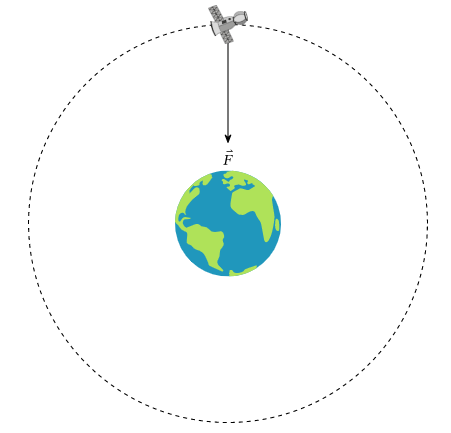
The satellite's free-body diagram is straightforward because gravity is the only force acting on it. The force of gravity is represented as a vector. The vector's axis is oriented towards the centre of the Earth.
Free-Body Diagram for Vertical Circular Motion
Consider the figure below, which depicts a ball being swung in a vertical circular motion. At positions 1, 2, and 3, we will draw three free-body diagrams for the ball.
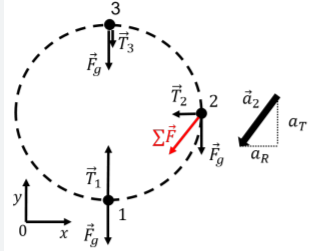
The ball is constantly under the influence of two forces: gravity and tension. The force of gravity is downward in all three positions; however, the tension force points down in position 1, right in position 2, and up in position 3. We must additionally consider the magnitude of the vectors. The magnitude of the gravity force is determined by the constant mass of the ball. As a result, the magnitude of gravity is the same in all three positions.
The magnitude of the tension force will differ in each of the three positions. The ball's velocity must grow along the lowest section of the circle for it to remain in a circular motion. The ball slows down owing to gravity at the top of the circle, so the string isn't tugging it as strongly. It is vital to notice that because the ball's velocity changes, it is not in a uniform circular motion in this scenario. If the ball's velocity goes too low, the string will become limp and the tension force will be zero.
The ball will then exit its circular motion. For this problem, we will assert that the ball maintains sufficient velocity to keep it from falling out of circular motion. The tension force will be the least at position 1 and will build to the greatest magnitude at position 3.
Newton's second law Fnet = ma, can be used to describe the motion of the ball at each position. Even if the ball is not moving in a straight line, we may utilise the equation ac=v2/r for centripetal acceleration at each location, where r is the radius of the circle.
Let us begin with position 1. To begin, we multiply the mass by the centripetal acceleration to get the centripetal force. Because the net force in this equation is the centripetal force, we must add all of the forces that contribute to it. We have the following candidates for position 1:
Fnet= mac
T1 + mg =m(v1)/2r
For position 2, we shall define the positive direction as the direction to the right of the ball. Because gravity is perpendicular to tension, it has no components that contribute to centripetal force. Our force equations for this place are as follows:
T2=m(v2)2/r
Finally, we define the upward direction as positive for position 3.
Example 1. A particle is moving in a circular path of radius 10 cm. Its linear speed is given by cm/s. Find the angle between acceleration and radius at t = 2s.
Solution: Radial explanation aR=6.4cm/s2
Tangential acceleration at=dv/dt=4cm/s2
∴tanθ=ataR=46.4
θ=tan-15/8
Key Points:
Centripetal acceleration has a direction from the body to the centre of the circle
The centripetal force acts from the body to the centre of a circle.
Centripetal force is the corresponding force (resultant force) which causes the centripetal acceleration.
In a uniform circular motion
(i) Velocity remains constant in magnitude but varies in direction
(ii) The acceleration is always normal to the velocity vector.
(iii) The acceleration is always directed towards the centre of the circular path.
Non-uniform circular motion:
(i) The velocity changes both in magnitude as well as in direction
(ii) The velocity vector is always tangential to the path
(iii) The acceleration vector is not perpendicular to the velocity vector
(iv) The acceleration vector has two components
In a circular motion, the only force acting on the object is the centripetal force, which is directed towards the centre of the circle.
The free-body diagram for circular motion will only show the centripetal force acting on the object.
The length of the arrow representing the centripetal force indicates the magnitude of the force.
The direction of the centripetal force will change as the object moves along the circular path, and so will the free-body diagram.