Unit: Momentum
Chapter: Representations of Changes and Conservation in Momentum
Reference: AP Physics Algebra, Momentum, Conservation of momentum, A Few Illustrations of Conservation of Momentum, Linear momentum of a system of particles, Rigid Body, Centre of mass, The motion of centre of mass, Open and Closed Systems
After studying this chapter, you should be able to:
- Know the concept of conservation of momentum
- State the concept of Linear momentum of a system of particles
- Solve the problem of the centre of mass
- Know the concept of Open and Closed Systems
Conservation of momentum
If no external force acts on a system (called isolated) of constant mass, the total momentum of the system remains constant with time.
- According to this law for a system of particles
F =dp/dt
In the absence of external force F = 0 then P = constant.
(2) Law of conservation of linear momentum is independent of the frame of reference through linear momentum depends on the frame of reference.
(3) Practical applications of the law of conservation of linear momentum
- When a man jumps out of a boat on the shore, the boat is pushed slightly away from the shore,
- A person left on a frictionless surface can get away from it by blowing air out of his mouth or by throwing some object in a direction opposite to the direction in which he wants to move,
- Recoiling of a gun-Tor bullet and gun system, the force exerted by the trigger will be internal so the momentum of the system remains unaffected.
A Few Illustrations of Conservation of Momentum
- Recoil of a gun:
When a bullet is fired from a gun, the gun recoils. The velocity v2 of the recoil of the gun can be found by using the law of conservation of momentum. Let m be the mass of the bullet being fired from a gun of mass M. If v1 is the velocity of the bullet, then momentum will be said to be conserved if the velocity v2 of the gun is given by
mv1 + Mv2 =0
or mv1 =- Mv2
Or v2=-mv1/M
Here, a negative sign shows that v2 is in a direction opposite to v1 . Since m << M, the recoil velocity of the gun will be considerably smaller than the velocity of the bullet.
Collision: In a collision, we may regard the colliding bodies as forming a system. In the absence of any external force on the colliding bodies, such as the force of friction, the system can be considered to be an isolated system. The forces of interaction between the colliding bodies will not change the total momentum of the colliding bodies. Collision of the striker with a coin of carrom or collision between the billiard balls may be quite instructive for the study of collision between elastic bodies.
The explosion of a bomb: A bomb explodes into fragments with the release of huge energy. Consider a bomb at rest initially which explodes into two fragments A and B. As the momentum of the bomb was zero before the explosion, the total momentum of the two fragments formed will also be zero after the explosion. For this reason, the two fragments will fly off in opposite directions. If the masses of the two fragments are equal, the velocities of the two fragments will also be equal in magnitude.
Rocket propulsion: The flight of a rocket is an important practical application of the conservation of momentum. A rocket consists of a shell with a fuel tank, which can be considered as one body. The shell is provided with a nozzle through which high-pressure gases are made to escape. On firing the rocket, the combustion of the fuel produces gases at very high pressure and temperature. Due to their high pressure, these gases escape from the nozzle at a high velocity and provide thrust to the rocket to go upward due to the conservation of momentum of the system. If M is the mass of the rocket and m is the mass of gas escaping per second with a velocity v, the change in momentum of the gas in t second = m vt. If the increase in velocity of the rocket in t second is V, the increase in its momentum = MV. According to the principle of conservation of momentum,
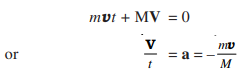
i.e., the rocket moves with an acceleration

Linear momentum of a system of particles:
P=M/V
Thus, the total momentum of a system of particles is equal to the product of the total mass of the system and the velocity of its centre of mass.
Differentiating it w.r.t time we get-(Newton’s 2nd law of motion)
dPdt=MdVdt=MA
As we know internal forces of the body do not affect the velocity of COM so as the linear momentum. So, we can write-
Now suppose the sum of an external force acting on the body is zero then,
dP/dt=0
Thus, when the total external force acting on a system of particles is zero, the total linear momentum of the system is constant. This is the law of conservation of the total linear momentum of a system of particles.
This means velocity of COM remain constant as we assume total mass is also constant.
Rigid Body:
A rigid body is one in which the separation between the constituent particles does not change with its motion.
This definition implies that the shape of a rigid body is preserved during its motion. However, like a point mass, a rigid body is also an idealisation because, if we apply large forces, the distances between particles do change, maybe infinitesimally. Therefore, in nature, there is nothing like a perfectly rigid body.
For most purposes, a solid body is a good enough approximation to a rigid body. A cricket ball, a wooden block, a steel disc, or even the Earth and the moon could be considered rigid bodies in this lesson.
Can water in a bucket be considered a rigid body? Obviously, water in a bucket cannot be a rigid body because it changes shape as the bucket is pushed around. You may now like to check what you have understood about a rigid body.
Centre of mass:
Suppose that the two particles are at heights
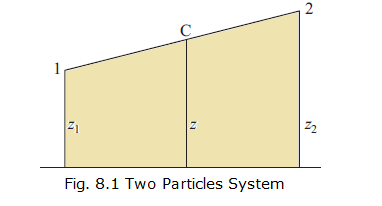
z1 and z2 from a horizontal surface (Fig. Given below). Suppose further that the gravitational force is uniform in the small region in which the two particles move about. The force on each particle will be mg. The total force acting on the system is therefore 2mg. We have now to find a point C somewhere in the system so that if a force 2mg acts at that
point located at a height z from the horizontal surface, the motion of the system would be the same as with two forces. The potential energies of particles 1 and 2 are mgz1 and mgz2, respectively. The potential energy of the particle at C is 2mgz. Since this must be equal to the combined potential energy of the two particles, can write
2mgz1 = mgz1 + mgz2——————————–(1)
Or z=z1+z22 ——————————————(2)
Note that the point C lies midway between the two particles. If the two masses were unequal, this point would not have been in the middle. If the mass of particle 1 is m1 and that of particle 2 is m2, Eqn. (1) modifies to
(m1 + m2) gz = m1gz1 + m2 gz2 —————————–(3)
The point C is called the centre of mass (CM) of the system. As such, it is a mathematical tool and there is no physical point as CM.
To grasp this concept, study the following example carefully.
The motion of centre of mass
Recall that the rate of change of displacement is velocity, and the rate of change of velocity is acceleration. If a1x denotes the component of acceleration of particle 1 along the x-axis and so on,
Max = m1 a1x + m2 a2x +… (1)
where ax is the acceleration of the centre of mass along the x-axis. Similar equations can be written for accelerations along y- and z-axes. These equations can, however, be combined into a single equation using vector notation:
M a = m1 a1 + m2 a2 +… (2)
But the product of mass and acceleration is force. m1 a1 is therefore the sum of all forces acting on particle 1. Similarly, m2a2 gives the net force acting on particle 2. The right-hand side is, thus, the total force acting on the body.
The forces acting on a body can be of two kinds. Some forces can be due to sources outside the body. These forces are called the external forces. A familiar example is the force of gravity. Some other forces arise due to the interaction among the particles of the body. These are called internal forces. A familiar example is cohesive force.
In the case of a rigid body, the sum of the internal forces is zero because they cancel each other in pairs. Therefore, the acceleration of individual particles of the body is due to the sum or resultant of the external forces. In the light of this,
we may write Eqn. (2) as
Ma = Fext —————(3)
Open and Closed Systems
In physics, momentum is a measure of an object's motion and is defined as the product of its mass and velocity. The momentum of an object can be conserved in both open and closed systems, but the way in which it is conserved can be different.
In an open system, momentum can be transferred in and out of the system, meaning that the total momentum of the system can change over time. For example, a rocket in space is an open system because it can exchange momentum with its surroundings by expelling exhaust gases. As the rocket expels gases, it gains momentum in one direction, while the gases gain momentum in the opposite direction.
In a closed system, on the other hand, no momentum is transferred in or out of the system. Therefore, the total momentum of the system remains constant over time. For example, a billiard ball collision is a closed system because no momentum is transferred in or out of the system during the collision. The total momentum of the system before and after the collision must be the same.
In summary, while momentum can be conserved in both open and closed systems, the way in which it is conserved can differ. In an open system, momentum can be transferred in and out of the system, while in a closed system, the total momentum remains constant.
This shows that the CM of a body moves as though the entire mass of the body were located at that point and it was acted upon by the sum of all the external forces acting on the body.
Example 1:
A person is sitting in the compartment of a train moving with uniform velocity on a smooth track. How will the linear momentum of the centre of mass of the compartment change if the person begins to run in the compartment?
Solution: We know that the linear momentum of the centre of mass of a system changes only when an external force acts on it. The person and the compartment form one system on which no external force is applied when the person begins to run. Therefore, there will be no change in the linear momentum of the centre of mass of the compartment.
Example 2:
Suppose four masses, 1.0 kg, 2.0 kg, 3.0 kg and 4.0 kg are located at the corners of a square of side 1.0 m. Locate its centre of mass?
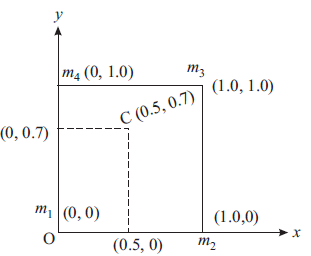
Fig. 8.4: Locating CM of four masses
placed at the corners of a square
Solution:
We can always make the square lie in a plane. Let this plane be the (x, y) plane. Further, let us assume that one of the corners coincides with the origin of the coordinate system and the sides are along the x and y axes. The coordinates of the four masses are m1 (0,0), m2 (1.0,0), m3 (1.0,1.0) and m4 (0, 1.0), where all distances are expressed in metres (Fig.8.4). From Eqns. (8.5) and (8.6), we get
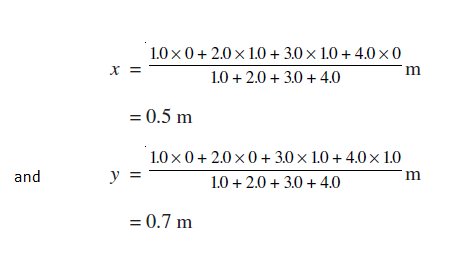
The CM has coordinates (0.5 m, 0.7 m) and is marked C in Fig.8.4. Note that the CM is not at the centre of the square although the square is a symmetrical figure. What could be the reason for the CM not being at the centre? To discover an answer to this question, calculate the coordinates of CM if all masses are equal.
Key Points:
- Representations of changes in momentum and the conservation of momentum are fundamental concepts in physics that explain the behaviour of objects in motion. Some key points regarding these concepts are:
- Momentum is a vector quantity that is defined as the product of an object's mass and velocity. It describes the amount of motion an object has.
- The change in momentum of an object is equal to the force acting on it multiplied by the time interval during which the force is applied. This is known as the impulse-momentum theorem.
- When a force is applied to an object, its momentum changes. If the force is in the same direction as the motion of the object, the momentum increases; if the force is in the opposite direction, the momentum decreases.
- The conservation of momentum states that the total momentum of a system of objects remains constant if no external forces act on the system. This principle is based on Newton's third law of motion, which states that for every action, there is an equal and opposite reaction.
- In an isolated system where there are no external forces acting, the total momentum before a collision is equal to the total momentum after the collision. This is known as the law of conservation of momentum.
- The conservation of momentum is used to analyze collisions between objects. There are two types of collisions: elastic and inelastic. In elastic collisions, the total kinetic energy of the objects is conserved, while in inelastic collisions, some kinetic energy is converted to other forms of energy such as heat or sound.
- The conservation of momentum is also used to analyze the motion of rockets and other propulsion systems. These systems work by expelling mass in one direction, which results in a change in the momentum of the system in the opposite direction.
- Understanding these key points is crucial for solving problems related to changes in momentum and the conservation of momentum in various physical systems.
- The centre of mass (COM) of an object or a system of objects is the point where the mass of the system is concentrated and can be considered as the "average" position of all the mass in the system. The position of the centre of mass can be calculated using the mass and positions of all the individual particles that make up the system.
Some key points about the centre of mass include:
- The centre of mass of a symmetric object is located at the geometric centre of the object. For example, the centre of mass of a sphere is located at its centre.
- The centre of mass of a system of particles can be calculated using the formula:
- COM = (m1r1 + m2r2 + … + mnrn) / (m1 + m2 + … + mn)
- where m1, m2, …, mn are the masses of the particles, and r1, r2, …, rn are their respective positions.
- The centre of mass of a system of particles always lies on a line connecting two or more particles.
- The motion of a system of particles can be described in terms of the motion of its centre of mass. If the net external force acting on the system is zero, the centre of mass will move with a constant velocity.
- The centre of mass of a system of particles can be used to simplify complex motion problems, by treating the entire system as a single particle with a mass equal to the total mass of the system, located at the centre of mass.
- Open and closed systems are terms used in physics to describe different types of systems based on their interaction with their surroundings.
- Here are some key points about open and closed systems and momentum:
- Open systems: These are systems that can exchange both matter and energy with their surroundings. Examples of open systems include living organisms, ecosystems, and open containers.
- Closed systems: These are systems that cannot exchange matter with their surroundings, but can exchange energy. Examples of closed systems include sealed containers and some types of machines.
- Conservation of momentum: In physics, momentum is the product of an object's mass and velocity. The law of conservation of momentum states that the total momentum of a closed system is conserved, meaning that the total momentum before a collision or interaction is equal to the total momentum after the collision or interaction.
- Momentum in open systems: In open systems, momentum can be conserved within the system, but the total momentum of the system and its surroundings may not be conserved. For example, when a rocket launches, it gains momentum by expelling exhaust gases out the back, but the total momentum of the rocket and the exhaust gases is not conserved because momentum is transferred to the Earth's atmosphere.
- Applications of momentum: Understanding the principles of momentum is essential in many areas of physics, including mechanics, thermodynamics, and electromagnetism. Momentum conservation is also used in designing and analyzing collisions in fields such as engineering and automotive safety.