Unit: Simple Harmonic Motion
Chapter: Period of simple harmonic oscillators
Simple Harmonic Motion, Period of simple harmonic oscillators, Periodic and oscillatory motions, Displacement as a Function of Time Periodic Motion, Simple harmonic motions, Equation of Simple Harmonic motion, Characteristics of Simple Harmonic Motion, Uniform circular motion, Velocity and Acceleration in Simple Harmonic Motion, Force Law for Simple Harmonic Motion
After studying this chapter, you should be able to:
- show that an oscillatory motion is periodic but a periodic motion may not be necessarily oscillatory;
- define simple harmonic motion and represent it as a projection of uniform circular motion on the diameter of a circle;
- derive expressions of the time period of a given harmonic oscillator;
Periodic and oscillatory motions
A motion which repeats itself after a fixed interval of time is called periodic motion.
There are two types of periodic motion:
(i) Non–oscillatory, and (ii) Oscillatory.
The motion of the hands of the clock is non-oscillatory but the motion of the pendulum bob is oscillatory. However, both motions are periodic. It is important to note that an oscillatory motion is normally periodic but a periodic motion is not necessarily oscillatory. Remember that a motion which repeats itself in equal intervals of time is periodic and if it is about a mean position, it is oscillatory.
We know that the earth completes its rotation about its own axis in 24 hours and days and nights are formed. It also revolves around the sun and completes its revolution in 365 days. This motion produces a sequence of seasons. Similarly, all the planets move around the Sun in elliptical orbits and each completes its revolution in a fixed interval of time. These are examples of periodic non-oscillatory motion.
Suppose that the displacement y of a particle, executing simple harmonic motion,
is represented by the equation:
y = a sin θ ———————————–(1)
or y = a cos θ——————————–(2)
Displacement as a Function of Time Periodic Motion
When an object repeats its motion after a definite interval of time, its motion is said to be periodic.
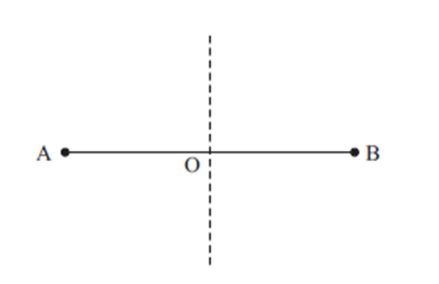
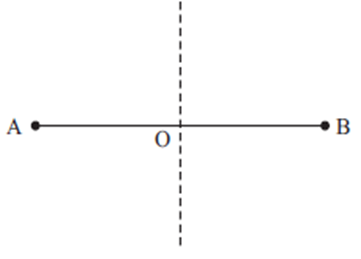
Let the position of an object change from O to B, from B to O; then from O to A and finally, from A to O, after a fixed interval of time T.
Then, the changes in the position or displacement of the object can be expressed as a function of time:
x = af(t + T)
where a is a constant and T is the time after which the value of x is repeated for each time interval T:
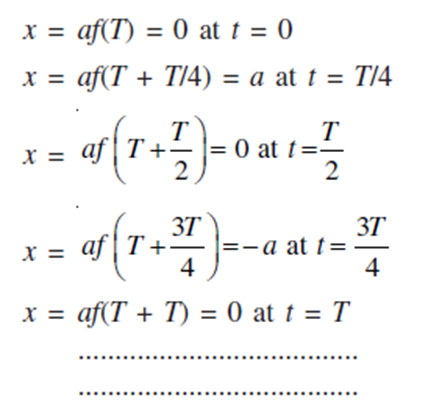
Thus, x is the function of t and it repeats its motion after an interval T. Hence, the motion is periodic.
Simple harmonic motions
Any motion which repeats itself after a regular interval of time is called periodic or harmonic motion.
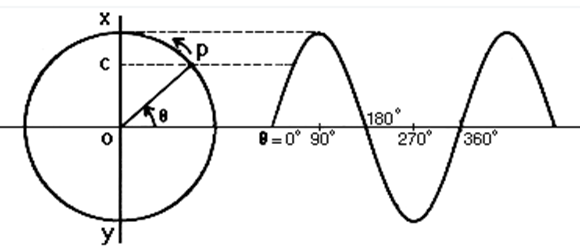
If a particle in periodic motion moves back and forth (or to and from) over the same path, then its motion is called oscillatory or vibratory. Examples of oscillatory or vibratory motion are:
1. the motion of a pendulum
2. the motion of a spring fixed at one end, which is stretched or compressed and then released
3. the motion of a violin string
4. the motion of atoms in molecules or in a solid lattice
5. If a sound wave is moving from left to right through the air, then particles of air will be displaced both rightward and leftward as the energy of the sound wave passes through it. The motion of the particles is parallel to the direction of the energy transport.
Conditions of Simple Harmonic Motion
For SHM is to occur, three conditions must be satisfied.
1. There must be a position of stable equilibrium
At the stable equilibrium, potential energy is minimum.
2. There must be no dissipation of energy
3. The acceleration is proportional to the displacement and opposite in direction.
Equation of Simple Harmonic motion:
Characteristics Of Simple Harmonic Motion:
(i) Amplitude: It is the maximum value of displacement of the particle from its equilibrium position.
(ii) Time period (T): The smallest time interval after which the oscillatory motion gets repeated is called a Time period.
(iii) Frequency (f): The number of oscillations competed in a unit time interval is called the frequency of oscillations, f=1T=ω/2π its units is sec–1 or Hz.
(iv) Angular Frequency (w): The quantity is called the angular frequency of the oscillating system. As we know that second order differential equation of simple harmonic motion
(v) Phase: The physical quantity which represents the state of motion of the particle (e.g. its position and direction of motion (orientation) at any instant.
In the solution of second order differential equation of SHM, is called the phase of the motion.
(vi) Displacement (x)
If time is measured from the equilibrium position, displacement x from the equilibrium point at any instant of time t is given by x = Asinwt
(a) Velocity is minimum at extreme positions and is zero.
At x = A, v = vmin = zero.
(b) Velocity is maximum at the equilibrium position and is wA.
At x = 0, v = vmax = wA
(c) Direction of velocity is either towards or away from the equilibrium position.
(viii) Acceleration
(a) The minimum value of acceleration is zero and it occurs at equilibrium.
(b) The maximum value of acceleration is w2A and it occurs at extreme positions.
(c) Acceleration is always directed towards the equilibrium position and so it is always opposite to the direction of the displacement.
Uniform circular motion:
The oscillations of a harmonic oscillator can be represented by terms containing sine and cosine of an angle. If the displacement of an oscillatory particle from its mean position can be represented by an equation y = a sinθ or y = a cosθ or y = A sinθ + B cosθ, where a, A and B are constants, the particle executes simple harmonic motion. We define simple harmonic motion as under:
A particle is said to execute simple harmonic motion if it moves to and from about a fixed point periodically, under the action of a force F which is directly proportional to its displacement x from the fixed point and the direction of the force is opposite to that of the displacement. We shall restrict our discussion to linear oscillations. Mathematically, we express it as
F = – kx
where k is constant of proportionality.
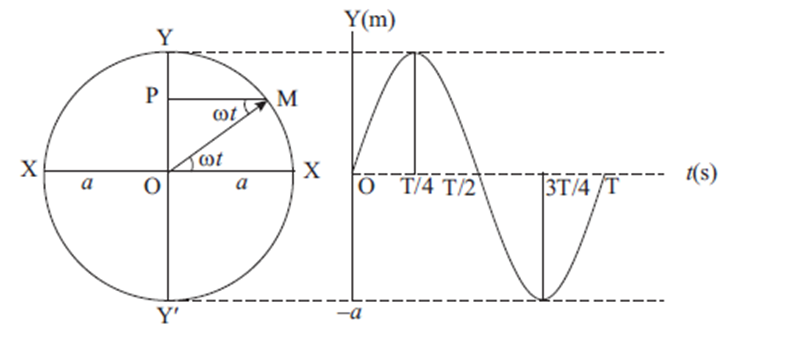
To derive the equation of simple harmonic motion, let us consider a point M moving with a constant speed v in a circle of radius a (Fig. given above) with centre O.
At t = 0, let the point be at X. The position vector OM specifies the position of the moving point at time t, it is obvious that the position vector OM, also called the phaser, rotates with a constant angular velocity ω = v /a. The acceleration of the point M is v2/a = a ω2 towards the centre O. At time t, the component of this acceleration along OY = aω2 sin ωt. Let us draw MP perpendicular to YOY′.
Then P can be regarded as a particle of mass m moving with an acceleration aω2 sin ωt. The force on the particle P towards O is therefore given by
F = maω2 sin ωt
But sin ωt = y/a. Therefore F = mω2y
The displacement is measured from O towards P and force is directed towards O.
Therefore, F = – mω2y
Since this force is directed towards O, and is proportional to displacement ‘y’ of P from O. we can say that the particle P is executing simple harmonic motion.
Let us put mω2 = k, a constant. Then Eqn. (F = – mω2y takes the form
F = – k y
The constant k, which is force per unit displacement, is called force constant.
The angular frequency of oscillations is given by
ω2 = k / m
In one complete rotation, OM describes an angle 2π and it takes time T to complete one rotation. Hence
ω = 2π/T
On combining Eqns. (ω2 = k / m) and (ω = 2π/T), we get an expression for the time period :
T = 2π k / m
This is the time taken by P to move from O to Y, then through O to Y′ and back to O. During this time, the particle moves once on the circle and the foot perpendicular from its position is said to make an oscillation about O as shown in the Fig. below.
Velocity And Acceleration in Simple Harmonic Motion
The speed of a particle v in uniform circular motion is its angular speed
w times the radius of circle A.
v = wA
The direction of velocity v at a time t is along the tangent to the circle at the point where the particle is located at that instant. From the geometry of Fig. given below,
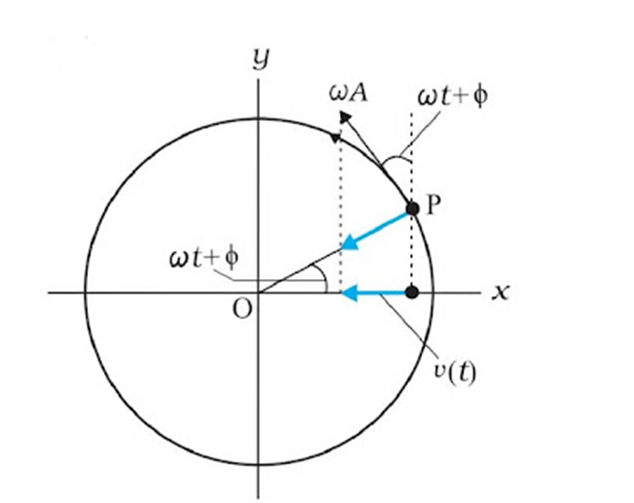
it is clear that the velocity of the projection particle P’ at time t is
v(t) = –wA sin (wt + f)
where the negative sign shows that v (t) has a direction opposite to the positive direction of the x-axis. Eq. (v(t) = –wA sin (wt + f)) gives the instantaneous velocity of a particle executing SHM, where displacement is given by Eq. (x (t) = A cos (w t + f )). We can, of course, obtain this equation without using geometrical argument, directly by differentiating (x (t) = A cos (w t + f )) with respect of t
The method of reference circle can be similarly used for obtaining the instantaneous acceleration of a particle undergoing SHM. We know that the centripetal acceleration of a particle P in uniform circular motion has a magnitude v2/A or w2A, and it is directed towards the centre i.e., the direction is along PO. The instantaneous acceleration of the projection particle P’ is then (See Fig. below)
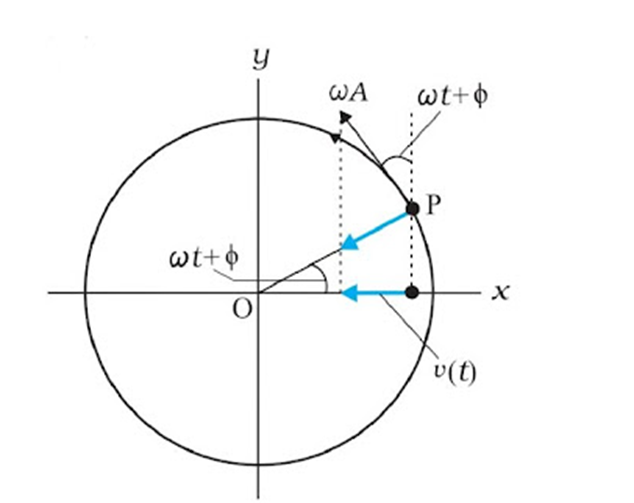
a (t) = –w2A cos (wt + f)
= –w2x (t)
Eq. (–w2x (t)) gives the acceleration of a particle in SHM. The same equation can again be obtained directly by differentiating velocity
v(t) given by Eq. (v(t) = –wA sin (wt + f)) with respect to time:
at=ddtv/(t)
We note from Eq. (–w2x (t)) the important property that the acceleration of a particle in SHM is proportional to displacement. For x(t) > 0, a(t) < 0 and for x(t) < 0, a(t) > 0. Thus, whatever the value of x between –A and A, the acceleration a(t) is always directed towards the centre.
For simplicity, let us put f = 0 and write the expression for x (t), v (t) and a(t)
x(t) = A cos wt, v(t) = – w Asin wt, a(t)= –w2 A cos wt
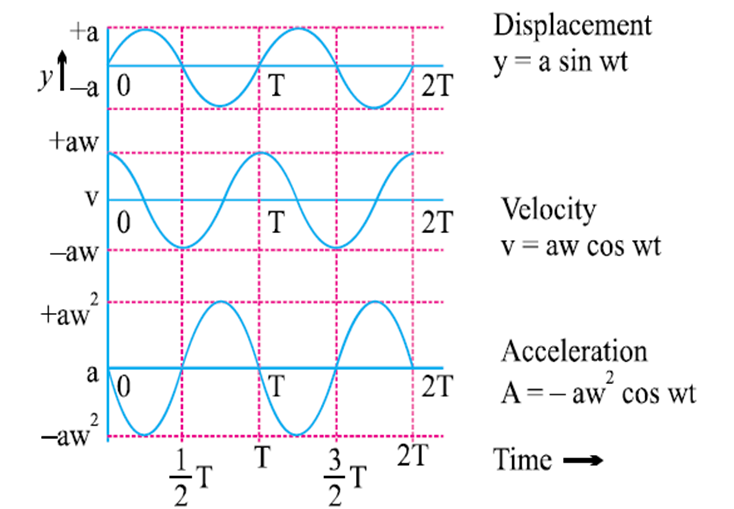
The corresponding plots are shown in Fig. above. All quantities vary sinusoidally with time; only their maxima differ and the different plots differ in phase. x varies between –A to A; v(t) varies from –wA to wA
and a(t) from –w2A to w2A. With respect to the displacement plot, the velocity plot has a phase difference of p/2 and the acceleration plot has a phase difference of p.
Force Law for Simple Harmonic Motion
Using Newton’s second law of motion, and the expression for acceleration of a particle undergoing SHM, the force acting on a particle of mass m in SHM is
F (t) = ma
= –mw2 x (t)
i.e., F (t) = –k x (t)
where k = mw2
or w = km
Like acceleration, force is always directed towards the mean position—hence it is sometimes called the restoring force in SHM.
Example 1:
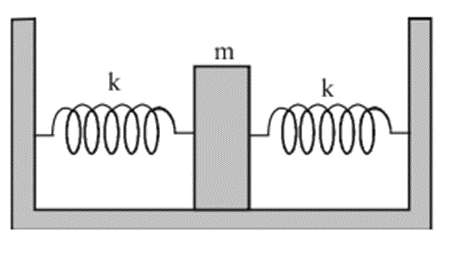
Two identical springs of spring constant k are attached to a block of mass m and to fixed supports as shown in Fig. given below. Show that when the mass is displaced from its equilibrium position on either side, it executes a simple harmonic motion. Find the period of oscillations.
Answer
Let the mass be displaced by a small distance x to the right side of the equilibrium position, as shown in Fig. given below.
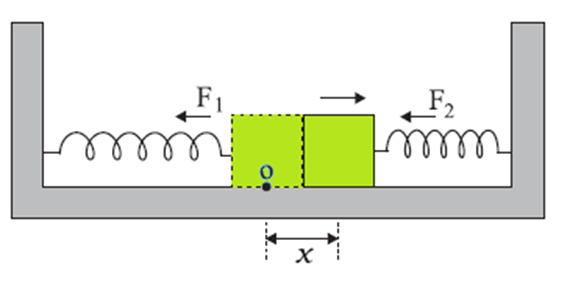
Under this situation the spring on the left side gets elongated by a length equal to x and that on the right side gets compressed by the same length. The forces acting on the mass are then,
F1 = –k x (force exerted by the spring on the left side, trying to pull the mass towards the mean position)
F2 = –k x (force exerted by the spring on the right side, trying to push the mass towards the mean position)
The net force, F, acting on the mass is then given by,
F = –2kx
Hence the force acting on the mass is proportional to the displacement and is directed towards the mean position; therefore, the motion executed by the mass is simple harmonic. The time period of oscillations is,
T=2π/m2k
Key points:
A particle is said to execute simple harmonic motion if it moves to and from about a fixed point periodically, under the action of a force F which is directly proportional to its displacement x from the fixed point and the direction of the force is opposite to that of the displacement.
If a particle in periodic motion moves back and forth (or to and from) over the same path, then its motion is called oscillatory or vibratory. Examples of oscillatory or vibratory motion are:
- the motion of a pendulum
- the motion of a spring fixed at one end, which is stretched or compressed and then released
- the motion of a violin string
- the motion of atoms in molecules or in a solid lattice
All three quantities displacement, velocity and acceleration show
-
- harmonic variation with time having the same period.
- The velocity amplitude is ω
 times the displacement amplitude
 - The acceleration amplitude is ω2 times the displacement amplitude
- In S.H.M. the velocity is ahead of displacement by a phase angle
- In S.H.M. the acceleration is ahead of velocity by a phase angle
- The acceleration is ahead of displacement by a phase angle.
- A simple harmonic oscillator is a type of periodic motion where the force acting on the object is proportional to the displacement of the object from its equilibrium position, and the object oscillates back and forth around this position.
- The motion of a simple harmonic oscillator is described by a sinusoidal function, such as sine or cosine.
- The period of a simple harmonic oscillator is the time it takes for the oscillator to complete one full cycle of its motion. It is given by the formula T = 2π√(m/k), where m is the mass of the object and k is the spring constant.
- The frequency of a simple harmonic oscillator is the number of cycles it completes in one second.
- The amplitude of a simple harmonic oscillator is the maximum displacement of the object from its equilibrium position during its motion.
- The energy of a simple harmonic oscillator is a constant sum of its kinetic and potential energies, and it remains constant throughout its motion.
- Simple harmonic motion is found in many physical systems, such as pendulums, springs, and waves.