Unit: Simple Harmonic Motion
Chapter: Energy of a simple harmonic oscillator
Reference: AP Physics Algebra, Simple Harmonic Motion, Energy of a simple harmonic oscillator, The energy of a Body in SHM, Simple Harmonic Motion in Spring-Mass System, Series and Parallel Combinations of Springs, Superposition of Two SHM, Compound Pendulum, Torsional Pendulum
After studying this chapter, you should be able to:
- derive expressions for the potential and kinetic energies of a simple harmonic oscillator;
- distinguish between free, damped and forced oscillations.
The energy of a Body in SHM
(i) Potential Energy
The linear restoring force acting on the harmonic oscillator
Now if the oscillator is displaced through a further displacement dx against the force, work done in displacing the particle is given by
dW = k´ dx
Hence the total work done in displacing the particle from the mean position (x=0) to (x=x)
By convention P.E. at the mean position is taken as zero. Hence, the above equation gives the values of P.E. of the harmonic oscillator at a displacement x from the mean position.
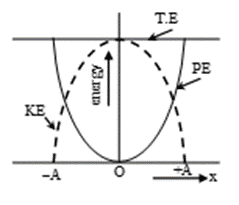
This shows the P.E. is proportional to the square of the displacement and the graph showing the variation of potential energy with the displacement will be a parabola given by a continuous line in the figure. P.E. is maximum at maximum displacement.
Thus, the total energy is independent of the displacement; it remains constant throughout the motion of the oscillator. Also, the total energy is equal to the maximum value of either P.E. or K.E.
(iii) Average Value of P.E. and K.E.
By equation (1) P.E. at distance x is given by
Because the average value of sine or of cosine function for the complete cycle is equal to zero.
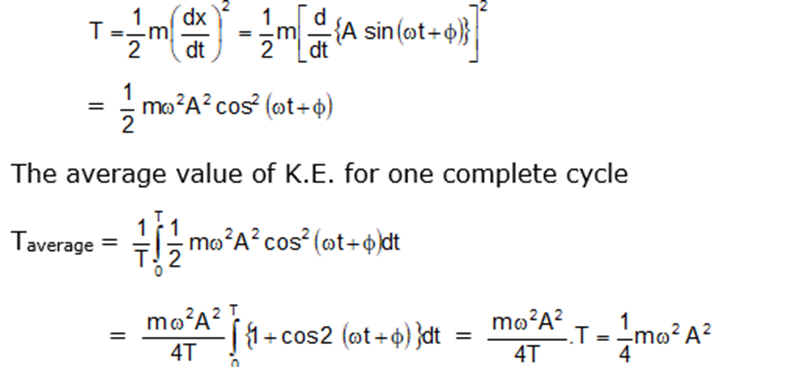
Now K.E. at x is given by
Thus, the average values of K.E. and P.E. of the harmonic oscillator are equal and each is equal to half of the total energy.
Simple Harmonic Motion in Spring-Mass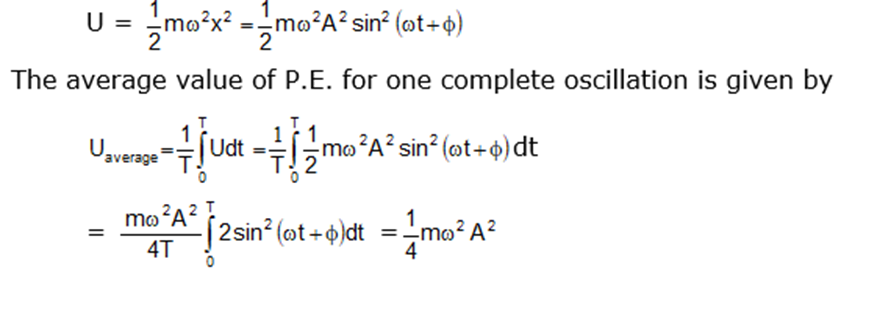 System
Let us find out the time period of a spring-mass system oscillating on a smooth horizontal surface as shown in the figure.
At the equilibrium position, the spring is relaxed. When the block is displaced through a distance x towards the right, it experiences a net restoring force F = –kx towards the left.
The negative sign shows that the restoring force is always opposite to the displacement. That is, when x is positive, F is negative; the force is directed to the left. When x is negative, F is positive; the force is directed to the right. Thus, the force always tends to restore the block to its equilibrium position x = 0.
Series and Parallel Combinations of Springs
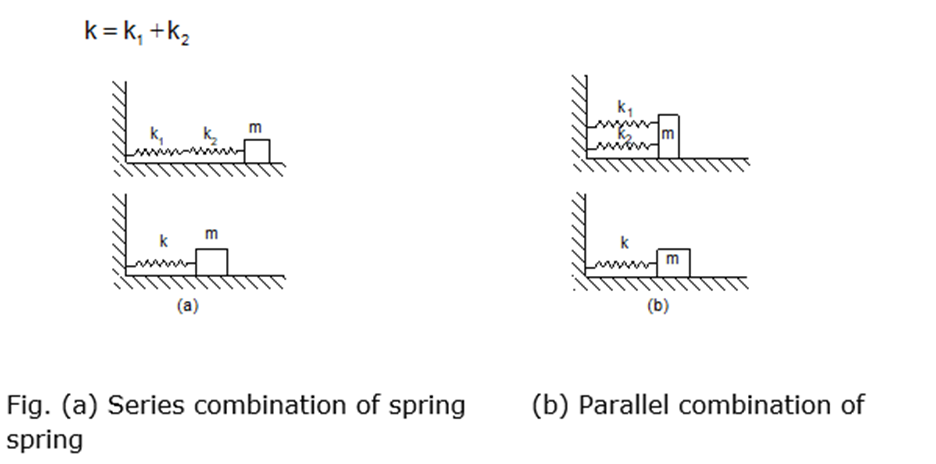
When two springs are joined in series, the equivalent stiffness of the combination may obtain
When two springs are joined in parallel, the equivalent stiffness of the combination is given by
Compound Pendulum
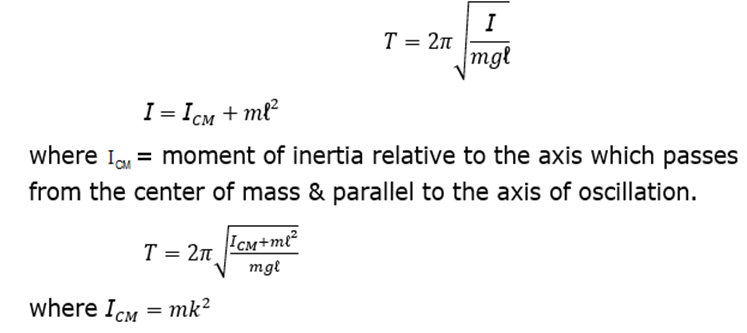
When a rigid body is suspended from an axis and made to oscillate about that then it is called a compound pendulum.

C = Initial position of centre of mass
C' = Position of centre of mass after time t
S = Point of suspension
 = Distance between the point of suspension and centre of mass (it remains constant during motion)
Torsional Pendulum
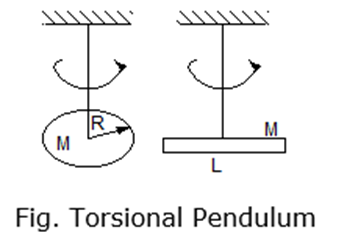
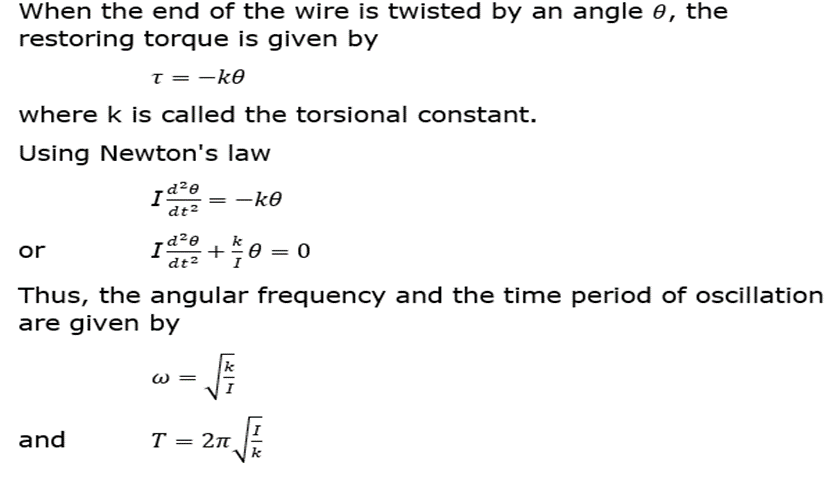
Consider a body, such as a disc or a rod, suspended at the end of a wire, as shown in fig.
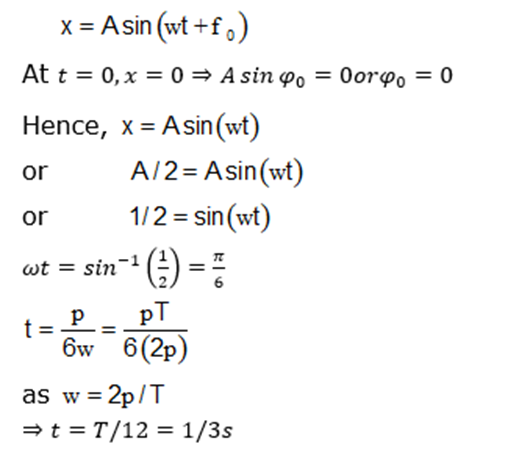
Exmaple1: A particle executes S.H.M. with time period 4s find the time taken by the particle to go directly from its mean position to half its amplitude.
Solution:
Example 2: For the arrangement shown in the figure, find the period of oscillation.
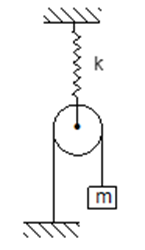
Solution: Obviously, when the block is displaced down by x, the spring will stretch
Key points:
In simple harmonic motion, there is a continuous interchange of kinetic energy and potential energy. At maximum displacement from the equilibrium point, potential energy is maximum while kinetic energy is zero. At the equilibrium point, the potential energy is zero and the kinetic energy is a maximum. At other points in the motion, the oscillating body has differing values of both kinetic and potential energy.
- The energy of a simple harmonic oscillator is proportional to the square of its amplitude.
- The energy of a simple harmonic oscillator is proportional to the frequency of its motion.
- The total energy of a simple harmonic oscillator is the sum of its kinetic energy and potential energy.
- The kinetic energy of a simple harmonic oscillator is maximum at the equilibrium position and minimum at the maximum displacement from equilibrium.
- The potential energy of a simple harmonic oscillator is maximum at the maximum displacement from equilibrium and minimum at the equilibrium position.
- The total energy of a simple harmonic oscillator remains constant, as long as there is no external force acting on the system.
- The energy of a simple harmonic oscillator can be calculated using the equation: E = (1/2) kA2, where E is the total energy, k is the spring constant, and A is the amplitude of the motion.