Unit: Limits & Continuity
Chapter: Definition & Properties of Limits
Reference: – Limit laws, Epsilon-delta notation, Algebraic properties of limits, Limits functions, Continuous & Discontinuous limits, Infinite & Asymptote limits, Intermediate value theorem, L-Hospital Rule, Squeeze theorem, Exponential limits, Logarithmic limits, Concept of limits, Behaviour of limits
After studying this chapter, you should be able to:
- The fundamental concept of a limit in Calculus.
- To evaluate limits by applying various techniques.
- Important Properties of limit in Calculus
Fundamental Concept of Limit
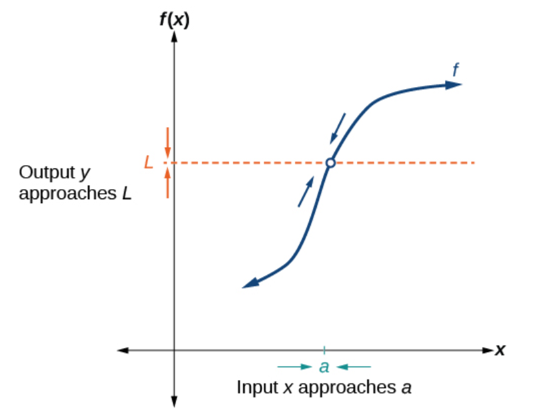
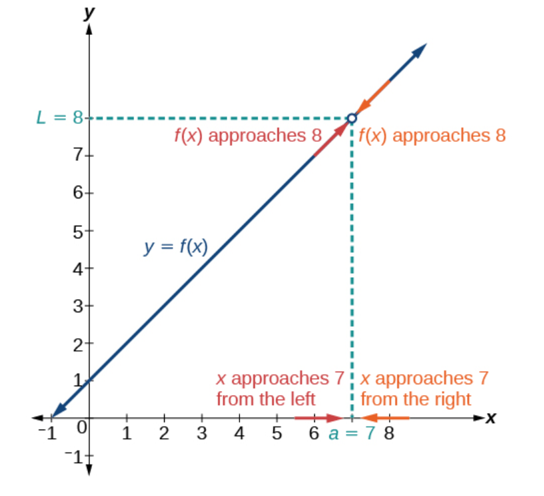
Limit: A limit is a fundamental concept in calculus that describes the behavior of a function as it approaches a particular value or as the input values get arbitrarily close to a certain point. The limit of a function f(x) as x approaches a specific value, often denoted as lim(x→a) f(x), represents the value that f(x) gets closer to as x gets arbitrarily close to a. Limits allow us to analyze the behavior of functions and determine their values at points where they may not be defined.
Additional Concept for Calculus
The fundamental concept of limits lies at the heart of calculus and is crucial for understanding the behavior of functions. Here are some additional details about this concept: –
- The intuition behind limits: The concept of a limit captures the idea of what happens to a function as its input approaches a particular value. It focuses on the behavior of the function near a specific point, rather than its value at that point.
- Formal definition of a limit: The formal definition of a limit involves two main components: the function f(x) and the point a. We say that the limit of f(x) as x approaches a, denoted as lim(x→a) f(x), is L if for every positive number ε (epsilon), there exists a positive number δ (delta) such that whenever 0 < |x – a| < δ (i.e., x is within a certain distance of a), then |f(x) – L| < ε (i.e., f(x) is within a certain distance of L).
- Nonexistence of limits: It's important to note that limits may not always exist. If a function's values fluctuate wildly or exhibit oscillatory behavior as x approaches a, the limit may not exist. Alternatively, if the function approaches different values from the left and right sides of a, the two-sided limit will not exist.
Properties of Limits: –
Limits possess several important properties that make them useful in calculus. These properties include the limit laws, which state that the limit of a sum/difference, product, or quotient of two functions is equal to the sum/difference, product, or quotient of their respective limits, under certain conditions. Other properties include the limit of a constant, the limit of the identity function, the limit of a power of x, and the limit of a composite function. Understanding and applying these properties correctly can simplify limit calculations and help determine the behavior of functions in different scenarios.
Important properties: –
Limit of a Sum/Difference:
Property: lim(x→a) [f(x) ± g(x)] = lim(x→a) f(x) ± lim(x→a) g(x)
Explanation: The limit of a sum or difference of two functions is equal to the sum or difference of their respective limits, provided that the individual limits exist.
Limit of a Product:
Property: lim(x→a) [f(x) * g(x)] = lim(x→a) f(x) * lim(x→a) g(x)
Explanation: The limit of a product of two functions is equal to the product of their respective limits, provided that the individual limits exist.
Limit of a Quotient:
Property: lim(x→a) [f(x) / g(x)] = [lim(x→a) f(x)] / [lim(x→a) g(x)], given lim(x→a) g(x) ≠ 0
Explanation: The limit of a quotient of two functions is equal to the quotient of their respective limits, provided that the individual limits exist and the limit of the denominator is nonzero.
Limit of a Constant:
Property: lim(x→a) c = c, where c is a constant
Explanation: The limit of a constant function is equal to the constant itself.
Limit of the Identity Function:
Property: lim(x→a) x = a
Explanation: The limit of the identity function (f(x) = x) is equal to the value it approaches (a).
Limit of a Power:
Property: lim(x→a) [f(x)]n = [lim(x→a) f(x)]n, where n is a constant
Explanation: The limit of a function raised to a constant power is equal to the limit of the function raised to that power.
Limit of a Composite Function:
Property: lim(x→a) [g(f(x))] = lim(t→L) g(t), where lim(x→a) f(x) = L
Explanation: If the limit of f(x) as x approaches a exists and is equal to L, and the limit of g(t) as t approaches L exists, then the limit of the composite function g(f(x)) as x approaches a is equal to the limit of g(t) as t approaches L.
These properties are valuable tools for evaluating limits and understanding the behavior of functions. They provide algebraic rules that allow us to simplify limit calculations and establish relationships between the limits of different functions. It's important to keep in mind the conditions and limitations associated with each property to ensure their proper application.
Example:
l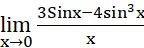
Solution: –
To solve the given limit, we will use trigonometric identity.
Key Points
- Definition of a Limit: The limit of a function f(x) as x approaches a particular value c is denoted as lim(x→c) f(x). It is defined as the value that f(x) approaches as x gets arbitrarily close to c.
- Existence of a Limit: A limit exists if and only if the left-hand limit (the limit as x approaches c from the left) and the right-hand limit (the limit as x approaches c from the right) are equal.
- Limit Laws: Several laws govern the calculation of limits. These include the laws of addition, subtraction, multiplication, division, and composition of functions.
- Squeeze Theorem: The Squeeze Theorem states that if f(x) ≤ g(x) ≤ h(x) for all x in a neighborhood of c (except possibly at c itself), and the limits of f(x) and h(x) as x approaches c exist and are equal to L, then the limit of g(x) as x approaches c also exists and is equal to L.
- Continuity: A function f(x) is continuous at point c if the limit of f(x) as x approaches c exists, and the value of f(c) is equal to the limit.
- One-Sided Limits: One-sided limits are used when approaching a point from only one direction. The left-hand limit is denoted as lim(x→c-) f(x), and it represents the behavior of f(x) as x approaches c from the left.
- Infinite Limits: A limit is said to be infinite if the value that f(x) approaches as x approaches c becomes arbitrarily large (positive or negative). It can be denoted as lim(x→c) f(x) = ∞ or lim(x→c) f(x) = -∞.
- Limit at Infinity: The limit of a function as x approaches infinity (or negative infinity) represents the behavior of the function as x becomes arbitrarily large (positive or negative).
These key points provide a foundation for understanding the definition and properties of limits in calculus.