Unit: Differentiation-Composite, Implicit & Inverse function
Chapter: General Inverse Functions
Reference: -Inverse functions, One to-one functions, Invertibility, Inverse algebraically, Graphing the inverse functions, Equations & Graphs, Composition of inverse functions, Domain & Range of Inverse functions, Derivatives of Inverse functions, Applications & Properties.
After studying this chapter, you should be able to:
- Introduction & Verification of Inverses.
- Notation & Representation.
- Composition of Functions.
- Properties & their applications
Introduction to General Inverse Functions
- Inverse Function: -If a function f has an inverse, it is denoted as f-1.
- One-to-One Functions: In order, for a function to have an inverse, it must be a one-to-one function. Students learn the concept of one-to-one functions and how they relate to the existence of an inverse.
- Verifying Inverses: Students learn methods to verify whether a function has an inverse. This includes checking for horizontal line tests, using algebraic techniques to determine if a function is a one-to-one, and analyzing the graph of the function.
- Finding the Inverse Function: Once it is determined that a function has an inverse, students learn techniques to find the inverse function. This typically involves algebraic manipulation, solving for the original variable in terms of the dependent variable.
- Notation and Representation: Students learn how to properly notate and represent inverse functions, including understanding the notation f-1(x) and the relationship between the original function f and its inverse f-1.
- Composition of Functions: Students explore the composition of functions and how it relates to inverse functions. They learn that the composition of a function and its inverse results in the identity function, and vice versa.
- Properties of Inverse Functions: Students investigate the properties of inverse functions, such as the symmetry of their graphs for the line y = x, and how the domain and range of a function and its inverse are interchanged.
- Applications: Inverse functions have various applications in calculus, such as solving equations involving exponential and logarithmic functions, and solving optimization problems using inverse trigonometric functions.
(General Inverse Functions)
Verifying Inverses:
Determining if a function has an inverse involves verifying that it is one-to-one. There are various methods to check if a function is one-to-one:
- Algebraic Method: To test if a function is one-to-one algebraically, students often use the method of comparing inputs. They assume two inputs, say x1 and x2, and compare their corresponding outputs, f(x1) and f(x2). If x1 ≠ x2 and f(x1) = f(x2), then the function is not one-to-one. However, if f(x1) ≠ f(x2) for all x1 ≠ x2, then the function is one-to-one.
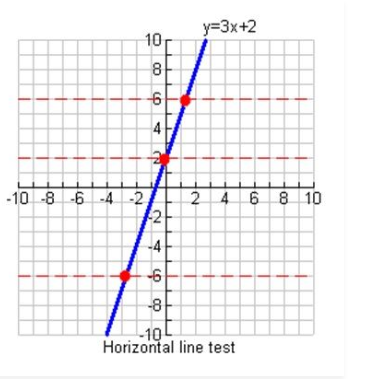
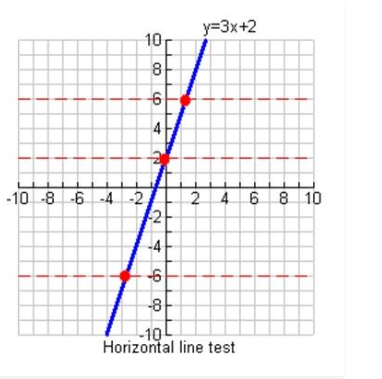
- Horizontal Line Test: The graphical method of checking for one-to-one functions is by performing the horizontal line test. Students examine the graph of the function and observe whether any horizontal line intersects the graph at more than one point. If such intersections occur, the function does not have an inverse.
- Derivatives: In AP Calculus, students can also use calculus concepts to analyze the behavior of a function and determine if it is one-to-one. For example, if the derivative of a function is always positive or always negative on an interval, then the function is one-to-one on that interval.
Notation & Representation:
- Notation:
- The notation used for inverse functions is crucial for clarity and consistency. In AP Calculus, the notation f-1 x is commonly used to represent the inverse function of f. It is important to note that the "-1" in the notation does not imply an exponent or reciprocal; it specifically denotes the inverse function. It is read as "f inverse of x" or "the inverse function of f evaluated at x."
- For example, if the original function is f(x) = 2x, the inverse function notation would be f-1 x=x2
 . This notation emphasizes the relationship between the original function and its inverse and helps distinguish between the two functions.
- Representation:
Inverse functions can be represented in various ways, depending on the context and purpose. Here are a few common methods of representing inverse functions:
- Algebraic Representation: One way to represent the inverse function is by expressing it algebraically. Starting with the original function f(x), the inverse function f^{-1}(x) can be found by interchanging the roles of x and y in the equation and solving for y. This results in an equation that represents the inverse function explicitly in terms of x.
- Graphical Representation: Graphs can provide a visual representation of the relationship between a function and its inverse. The graph of a function and its inverse are symmetric for the line y = x. This means that if you reflect the graph of the original function over the line y = x, you will obtain the graph of the inverse function. The symmetry helps visually demonstrate the inverse relationship between the functions.
- Tables and Values: In some cases, inverse functions can be represented using tables or specific input-output values. Students might be asked to find specific values of the inverse function or complete a table showing corresponding input and output values for both the original function and its inverse.
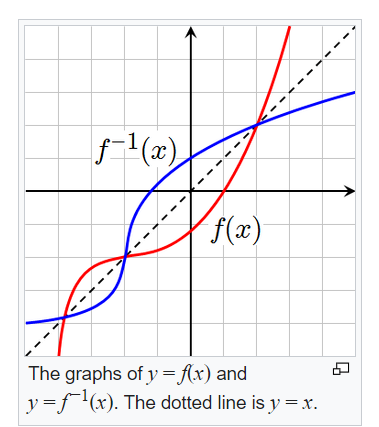
(Representation of Notation in General Function)
Composition of Functions: –
- Composition of Functions: Composition of functions refers to combining two functions to form a new function. Given two functions, f and g, the composition of f and g is denoted as (f ∘ g)(x) or f(g(x)). The composition involves applying the function g to the input x and then applying the function f to the result. In other words, the output of g(x) serves as the input for f(x).
For example, let's consider the functions f(x) = 2x and g(x) = x + 3. To compute the composition f(g(x)), we substitute g(x) = x + 3 into f(x), resulting in f(g(x)) = 2(x + 3) = 2x + 6. The composition f(g(x)) is a new function that represents the combination of the two original functions.
- Inverse Functions and Composition: Inverse functions and composition have a special relationship. When we compose a function with its inverse, we obtain the identity function, which returns the input unchanged. Symbolically, f(f^{-1}(x)) = x and f^{-1}(f(x)) = x for all x in the appropriate domain.
This property can be proven using algebraic manipulation or by considering the graphs of the functions. The composition of a function with its inverse "undoes" the action of the original function, resulting in the original input value.
For example, if we have the function f(x) = 2x and its inverse f-1 x= x2 , we can demonstrate the composition property:
f(f-1)x = f(x2 ) = 2(x2
 ) = x
) = x
Similarly,
f-1 x(f(x)) = f-1 2x= 2x/2 = x
This property of composition with inverse functions is a key concept in calculus and helps establish the relationship between a function and its inverse.
Example: – Find 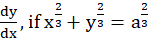
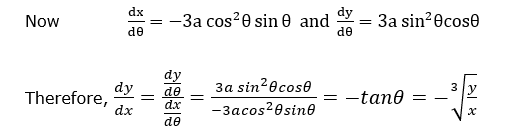
Solution: Let x = a cos3 θ , y = a sin3 θ
 +
+ 

Hence, x = a cos3θ , y = a sin3 θ is parametric equation of 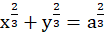
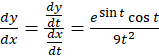
Example: Find dy/dx for y = esin t and x = 3t3.
Solution: y = esin t
dy/dt = esin t (cos t)
x = 3t3
dx/dt = 9t2
Key Points
- Inverse Function Definition: An inverse function undoes the action of another function. If a function f has an inverse, it is denoted as f-1.
- One-to-One Functions: For a function to have an inverse, it must be a one-to-one function. This means each output corresponds to a unique input.
- Horizontal Line Test: A function is one-to-one if no horizontal line intersects its graph at more than one point.
- Algebraic Verification: To determine if a function has an inverse, compare the outputs of two different inputs. If the outputs are different, the function is one-to-one.
- Inverse Function Notation: The notation f-1(x) represents the inverse function of f. It is read as "f inverse of x."
- Symmetry: The graphs of a function and its inverse are symmetric for the line y = x.
- Composition Property: Composing a function with its inverse results in the identity function. f(f-1(x)) = x and f-1(f(x)) = x.
- Finding the Inverse Function: To find the inverse function, interchange the roles of x and y in the equation and solve for y.
- Domain and Range Interchange: The domain of a function becomes the range of its inverse, and vice versa.