Unit: Differentiation-Composite, Implicit & Inverse function
Chapter: Chain Rule for Composite Functions
Reference: – Composite Functions, Differentiation of composite functions, Chain rule, Power functions, Exponential functions, Logarithmic functions, Hyperbolic functions, Implicit, Multiple compositions, Parametric equations, Higher Dimensions, Partial Derivatives.
After studying this chapter, you should be able to:
- Composite functions & its Differentiation.
- Nested function & Multiple variables.
- Implicit differentiation & High Order Derivatives.
Introduction to Composite Functions
The chain rule is a fundamental concept in calculus that deals with the differentiation of composite functions. When applying the chain rule, you are essentially differentiating one function from another function. The topics covered under the chain rule for composite functions include:-
- Composite Functions: Understanding the concept of composite functions, which are functions formed by combining two or more functions.
- Chain Rule Statement: Learning the formal statement of the chain rule, which provides a method to differentiate composite functions.
- Notation: Understanding the different notations used to express composite functions, such as Leibniz notation (dy/dx), prime notation (f'(x)), or function composition notation (f(g(x))).
- Differentiation of Composite Functions: Applying the chain rule to find the derivative of a composite function. The chain rule states that if y = f(g(x)), then dy/dx = f'(g(x)) * g'(x).
- Basic Examples: Solving simple examples to illustrate the application of the chain rule, involving functions like polynomials, exponentials, logarithms, trigonometric functions, etc.
- Nested Functions: Understanding the chain rule in the context of nested functions, where multiple functions are composed together in a sequence.
- Chain Rule for Multiple Variables: Extending the chain rule to functions with multiple variables. In this case, partial derivatives are used to express the chain rule.
- Implicit Differentiation: Applying the chain rule in implicit differentiation problems, where the dependent and independent variables are not explicitly separated.
- Applications: Exploring real-world applications of the chain rule, such as physics, economics, engineering, and other scientific fields.
- Higher Order Derivatives: Discuss the application of the chain rule in finding higher-order derivatives of composite functions.
Composite Functions & its Differentiation:
- Composite Functions: Composite functions are formed by combining two or more functions.
- Chain Rule Statement: The chain rule provides a method to differentiate composite functions.
- Formal Statement: If y = f(g(x)), where g(x) is the inner function and f(u) is the outer function, then dy/dx = f'(g(x)) * g'(x).
- f'(g(x)): Represents the derivative of the outer function f(u) evaluated at the inner function g(x).
- g'(x): Represents the derivative of the inner function g(x) with respect to x.
- dy/dx: Denotes the derivative of the composite function y = f(g(x)) for x.
- Multiplicative Relationship: The chain rule states that the derivative of a composite function is found by multiplying the derivative of the outer function with the derivative of the inner function.
- Simplification: The chain rule allows us to break down complex functions into simpler functions and differentiate each part separately.
- Applications: The chain rule is widely used in various branches of mathematics, science, and engineering to solve problems involving composite functions.
- Handling Different Functions: The chain rule can be applied to functions like exponentials, logarithms, trigonometric functions, and more.
Remembering and correctly applying the chain rule is crucial when differentiating composite functions, as it simplifies the process of finding derivatives and enables us to tackle more intricate functions effectively.
Nested function & Multiple Variables: –
- Nested Functions: Nested functions refer to functions that are composed together in a sequence, where the output of one function becomes the input of another.
- Function Composition: When functions are nested, the output of the inner function serves as the input to the outer function. This composition allows for more complex transformations of variables.
- Inner Function: The inner function refers to the function that is placed inside another function. It typically takes an independent variable as its input and produces an output.
- Outer Function: The outer function refers to the function that contains the inner function. It takes the output of the inner function as its input and produces the final output of the nested function.
- Variables in Nested Functions: When dealing with nested functions, it's important to consider the variables involved at different levels.
- Independent Variable: The independent variable is typically associated with the innermost function. It represents the input to the nested function and is usually denoted as x.
- Intermediate Variables: In a nested function, there can be intermediate variables between the inner and outer functions. These variables are generated during the evaluation of the inner function and serve as inputs to the outer function.
- Dependent Variable: The dependent variable represents the final output of the nested function and is typically denoted as y.
- Differentiation of Nested Functions: When differentiating a nested function, the chain rule is applied iteratively. The derivative of the outer function for its input is multiplied by the derivative of the inner function to its input, which can involve additional intermediate variables.
- Order of Evaluation: When differentiating a nested function, it's important to evaluate the derivatives in the correct order, starting from the innermost function and moving outward.
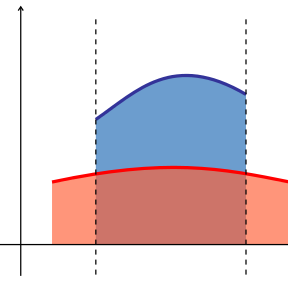
(Nested variable graph)
Implicit Differentiation & High Order Derivatives: –
- Implicit Functions: An implicit function is a function where the dependent and independent variables are not explicitly separated. In other words, the equation defining the function does not express y explicitly in terms of x.
- Implicit Differentiation: Implicit differentiation is a technique used to find the derivatives of implicitly defined functions.
- Procedure: To perform implicit differentiation, you treat the dependent variable y as a function of x and differentiate both sides of the equation for x. However, when differentiating y for x, you also need to consider the chain rule since y is not explicitly expressed in terms of x.
- Chain Rule in Implicit Differentiation: When differentiating y for x, you apply the chain rule to the terms involving y. This involves multiplying the derivative of y for x (dy/dx) by the derivative of the term inside the brackets for y.
- Simplification: After applying implicit differentiation, you can simplify the resulting equation to solve for dy/dx, which represents the derivative of the implicitly defined function.
- Applications: Implicit differentiation is commonly used in various mathematical fields, such as physics and engineering, where relationships between variables are defined implicitly.
Example: – Show that the differential equation (x – y) dy/dx = x + 2y is homogeneous and solve it.
Solution: (x – y) dy/dx = x + 2y
 … (1)
… (1)
Let F(x, y) = 
Now, F(lx, ly) = l(x+2y)l(x-y)=l0.f(x, y)
Therefore, F(x, y) is a homogenous function of degree zero. So, the given differential equation is a homogenous differential equation.
Put y = vx … (2)
Differentiating equation (2) for, x we get
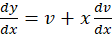 … (3)
… (3)
Substituting the value of y and dy/dx in equation (1) we get
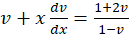
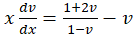
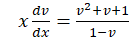
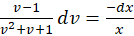
Integrating both sides of equation (5), we get
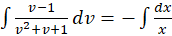



Replacing v by y/x , we get

which is the general solution of the given differential equation.
Key Points
- The chain rule is fundamental in calculus used to differentiate composite functions.
- It provides a method to find the derivative of a function that is composed of multiple functions.
- The chain rule states that if y = f(g(x)), then dy/dx = f'(g(x)) * g'(x).
- f'(g(x)) represents the derivative of the outer function f(u) evaluated at the inner function g(x).
- g'(x) represents the derivative of the inner function g(x) to x.
- The chain rule allows us to break down complex functions into simpler functions and differentiate them separately.
- It is essential to apply the chain rule when the function involves compositions of functions like exponentials, logarithms, or trigonometric functions.
- The chain rule can be extended to functions with multiple variables using partial derivatives.
- Implicit differentiation uses the chain rule to find derivatives of implicitly defined functions.
- Understanding and correctly applying the chain rule is crucial for solving differentiation problems and has various applications in mathematics, science, and engineering.