Unit: Differentiation-Composite, Implicit & Inverse function
Chapter: Implicit Differentiation
Reference: – Implicit Functions, Implicit equations, Derivatives of Implicit relations, Chain rules, Slope of tangent lines, Equation of tangent line, Implicit differentiation, Higher order derivatives, vertical & Horizontal Tangent lines, Curve sketching, Optimization, Trigonometric Functions.
After studying this chapter, you should be able to:
- Differentiation Rule & Finding Derivatives.
- High-order Derivatives.
- Tangent & Normal lines, Related rates.
- Second derivatives & Concavity
Introduction to Implicit Differentiation
- Definition of Implicit Differentiation:
- Implicit differentiation is a technique used to find the derivative of an implicitly defined function.
- An implicitly defined function is given in the form of an equation that may involve multiple variables.
- Unlike explicit functions, which are solved explicitly for a dependent variable, implicit functions do not isolate the dependent variable.
- Differentiation Rules:
- Implicit differentiation involves applying the basic rules of differentiation to both sides of the equation.
- These rules include the power rule, product rule, quotient rule, and chain rule.
- When differentiating for a particular variable, all other variables are treated as constants.
- Finding Derivatives of Implicit Equations:
- To find the derivative of an implicitly defined function, you differentiate both sides of the equation for the independent variable.
- When differentiating terms that involve the dependent variable, you apply the chain rule.
- The derivative of the dependent variable is represented using the notation dy/dx.
- Higher-Order Derivatives:
- Implicit differentiation can be extended to find higher-order derivatives of implicitly defined functions.
- To find the second derivative, you differentiate the first derivative obtained through implicit differentiation.
- Tangent Lines and Normal Lines:
- Implicit differentiation allows you to find the equations of tangent lines and normal lines to curves defined implicitly.
- To find the slope of the tangent line at a given point, you substitute the coordinates of the point into the derivative expression obtained through implicit differentiation.
- The slope of the tangent line is used to find the equation of the tangent line using point-slope form.
- The normal line is perpendicular to the tangent line and has a slope that is the negative reciprocal of the tangent line's slope.
- Related Rates:
- Implicit differentiation is useful for solving related rate problems.
- Related rates problems involve finding the rate at which one variable changes for another variable.
- Implicit differentiation allows you to differentiate both sides of an equation for time (or another variable) and solve for the desired rate.
- Second Derivative and Concavity:
- Implicit differentiation can be used to find the second derivative of implicitly defined functions.
- The second derivative provides information about the concavity and points of inflection of the curve defined implicitly.
- Optimization:
- Implicit differentiation can be applied to optimization problems, where you need to find the maximum or minimum values of a quantity given certain constraints.
- By setting the derivative of the implicitly defined function equal to zero and solving for the independent variable, you can find critical points that correspond to extreme values.
Differentiation Rule & Finding Derivatives:
- Power Rule:
- If you have a function of the form f(x) = xn, where n is a constant, the derivative is given by f'(x) = nx(n-1).
- For example, if f(x) = x2, the derivative is f'(x) = 2x.
- Product Rule:
- If you have two functions, u(x) and v(x), the derivative of their product is given by (u(x)v(x))' = u'(x)v(x) + u(x)v'(x).
- For example, if f(x) = x2 * sin(x), then f'(x) = (2x * sin(x)) + (x2 * cos(x)).
- Quotient Rule:
- If you have two functions, u(x) and v(x), the derivative of their quotient is given by (u(x)/v(x))' = (u'(x)v(x) – u(x)v'(x))/(v(x))2.
- For example, if f(x) = (x2 + 1) / x, then f'(x) = ((2x * x) – (x2 + 1))/(x2)2.
- Chain Rule:
- The chain rule is used when you have a composition of functions.
- If you have a function y = f(g(x)), where g(x) is an inner function and f(u) is an outer function, the derivative is given by dy/dx = f'(g(x)) * g'(x).
- For example, if f(x) = sin(2x), then f'(x) = 2 * cos(2x).
- Trigonometric Functions:
- The derivatives of common trigonometric functions are:
- d/dx (sin(x)) = cos(x)
- d/dx (cos(x)) = -sin(x)
- d/dx (tan(x)) = sec2(x)
- Similarly, you can find the derivatives of other trigonometric functions using the chain rule and the quotient rule.
- The derivatives of common trigonometric functions are:
- Exponential and Logarithmic Functions:
- The derivatives of exponential and logarithmic functions are:
- d/dx (ex) = ex
- d/dx (ln(x)) = 1x

- For other exponential and logarithmic functions, you can use the chain rule to find their derivatives.
- The derivatives of exponential and logarithmic functions are:
Tangent, Normal lines & Related rates: –
Implicit Differentiation & High Order Derivatives: –
- Implicit Functions: An implicit function is a function where the dependent and independent variables are not explicitly separated. In other words, the equation defining the function does not express y explicitly in terms of x.
- Implicit Differentiation: Implicit differentiation is a technique used to find the derivatives of implicitly defined functions.
- Procedure: To perform implicit differentiation, you treat the dependent variable y as a function of x and differentiate both sides of the equation for x. However, when differentiating y for x, you also need to consider the chain rule since y is not explicitly expressed in terms of x.
- Chain Rule in Implicit Differentiation: When differentiating y for x, you apply the chain rule to the terms involving y. This involves multiplying the derivative of y for x (dy/dx) by the derivative of the term inside the brackets for y.
- Simplification: After applying implicit differentiation, you can simplify the resulting equation to solve for dy/dx, which represents the derivative of the implicitly defined function.
- Applications: Implicit differentiation is commonly used in various mathematical fields, such as physics and engineering, where relationships between variables are defined implicitly.
Example: – Show that the differential equation (x – y) dy/dx = x + 2y is homogeneous and solve it.
Solution: (x – y) dy/dx = x + 2y
 … (1)
… (1)
Let F(x, y) = 
Now,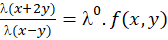
Therefore, F(x, y) is a homogenous function of degree zero. So, the given differential equation is a homogenous differential equation.
Put y = vx … (2)
Differentiating equation (2) with respect to, x we get
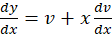 … (3)
… (3)
Substituting the value of y and dy/dx in equation (1) we get
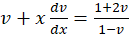
Integrating both sides of equation (5), we get
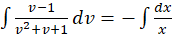



which is the general solution of the given differential equation.
Key Points
- The chain rule is fundamental in calculus and used to differentiate composite functions.
- It provides a method to find the derivative of a function that is composed of multiple functions.
- The chain rule states that if y = f(g(x)), then dy/dx = f'(g(x)) * g'(x).
- f'(g(x)) represents the derivative of the outer function f(u) evaluated at the inner function g(x).
- g'(x) represents the derivative of the inner function g(x) for x.
- The chain rule allows us to break down complex functions into simpler functions and differentiate them separately.
- It is essential to apply the chain rule when the function involves compositions of functions like exponentials, logarithms, or trigonometric functions.
- The chain rule can be extended to functions with multiple variables using partial derivatives.
- Implicit differentiation uses the chain rule to find derivatives of implicitly defined functions.
- Understanding and correctly applying the chain rule is crucial for solving differentiation problems and has various applications in mathematics, science, and engineering.