Unit: Contextual Application of Differentiation
Chapter: Differentiation with Rate of Change
Reference: – Differentiation, its types, Implicit differentiation, Related rates, Local extrema, Critical points, Increasing & Decreasing functions, Concavity, Points of inflection, Linear Approximation, Mean value theorem, Newton's method, Antiderivatives, Indefinite integrals, Applications.
After studying this chapter, you should be able to:
- Introduction, Notation & Terminology.
- Basic Rules, Related rates & Rate of change.
- Implicit Differentiation & High Order Derivatives.
Introduction to Differentiation with Rate of Change
It is a fundamental concept in calculus that focuses on determining the rate at which a quantity changes concerning another variable.
- Differentiation with a rate of change is a fundamental concept in calculus that deals with determining how a quantity changes about another variable.
- It involves finding the derivative of a function, which represents the instantaneous rate of change of the function at a specific point.
- The derivative is defined as the limit of the difference quotient as the interval approaches zero, providing the slope of the tangent line to the function's graph at that point.
- Notations and terminologies are introduced, such as the derivative symbol (d/dx or f'(x)), prime notation (f'(x)), and Leibniz notation (dy/dx), to express the derivative.
- Basic rules of differentiation, including the power rule, constant rule, sum and difference rule, product rule, quotient rule, and chain rule, help in finding derivatives efficiently.
- By differentiating a function, we can determine the rate at which the function is changing concerning its independent variable, interpreting it as the slope of the tangent line.
- Higher-order derivatives can be obtained by applying differentiation multiple times, providing information about rates of change of rates of change and the curvature of a function's graph.
- Implicit differentiation is used when the dependent and independent variables are not explicitly defined in terms of each other, treating the derivative of the dependent variable as an implicit function of the independent variable.
- Related rates problems involve finding the rate of change of one variable concerning another based on their relationship, requiring the application of differentiation and the chain rule.
- Differentiation is also applied to optimization problems, where we seek to find maximum and minimum values of functions by identifying critical points and applying the first or second derivative test.
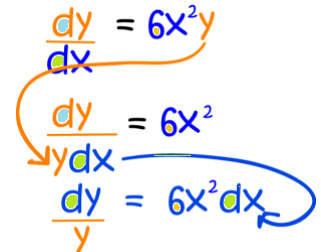
Basic Rules & Related Rates:
- Composite Functions: Composite functions are formed by combining two or more functions.
- Chain Rule Statement: The chain rule provides a method to differentiate composite functions.
- Formal Statement: If y = f(g(x)), where g(x) is the inner function and f(u) is the outer function, then dy/dx = f'(g(x)) * g'(x).
- f'(g(x)): Represents the derivative of the outer function f(u) evaluated at the inner function g(x).
- g'(x): Represents the derivative of the inner function g(x) with respect to x.
- dy/dx: Denotes the derivative of the composite function y = f(g(x)) for x.
- Multiplicative Relationship: The chain rule states that the derivative of a composite function is found by multiplying the derivative of the outer function with the derivative of the inner function.
- Simplification: The chain rule allows us to break down complex functions into simpler functions and differentiate each part separately.
- Applications: The chain rule is widely used in various branches of mathematics, science, and engineering to solve problems involving composite functions.
- Handling Different Functions: The chain rule can be applied to functions like exponentials, logarithms, trigonometric functions, and more.
Remembering and correctly applying the chain rule is crucial when differentiating composite functions, as it simplifies the process of finding derivatives and enables us to tackle more intricate functions effectively.
Nested function & Multiple Variables: –
- Nested Functions: Nested functions refer to functions that are composed together in a sequence, where the output of one function becomes the input of another.
- Function Composition: When functions are nested, the output of the inner function serves as the input to the outer function. This composition allows for more complex transformations of variables.
- Inner Function: The inner function refers to the function that is placed inside another function. It typically takes an independent variable as its input and produces an output.
- Outer Function: The outer function refers to the function that contains the inner function. It takes the output of the inner function as its input and produces the final output of the nested function.
- Variables in Nested Functions: When dealing with nested functions, it's important to consider the variables involved at different levels.
- Independent Variable: The independent variable is typically associated with the innermost function. It represents the input to the nested function and is usually denoted as x.
- Intermediate Variables: In a nested function, there can be intermediate variables between the inner and outer functions. These variables are generated during the evaluation of the inner function and serve as inputs to the outer function.
- Dependent Variable: The dependent variable represents the final output of the nested function and is typically denoted as y.
- Differentiation of Nested Functions: When differentiating a nested function, the chain rule is applied iteratively. The derivative of the outer function concerning its input is multiplied by the derivative of the inner function for its input, which can involve additional intermediate variables.
- Order of Evaluation: When differentiating a nested function, it's important to evaluate the derivatives in the correct order, starting from the innermost function and moving outward.
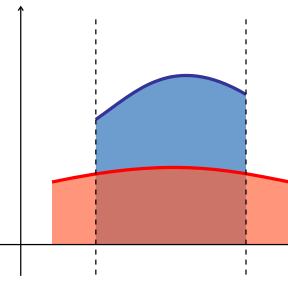
(Nested variable graph)
Implicit Differentiation & High Order Derivatives: –
- Implicit Functions: An implicit function is a function where the dependent and independent variables are not explicitly separated. In other words, the equation defining the function does not express y explicitly in terms of x.
- Implicit Differentiation: Implicit differentiation is a technique used to find the derivatives of implicitly defined functions.
- Procedure: To perform implicit differentiation, you treat the dependent variable y as a function of x and differentiate both sides of the equation for x. However, when differentiating y from x, you also need to consider the chain rule since y is not explicitly expressed in terms of x.
- Chain Rule in Implicit Differentiation: When differentiating y from x, you apply the chain rule to the terms involving y. This involves multiplying the derivative of y for x (dy/dx) by the derivative of the term inside the brackets for y.
- Simplification: After applying implicit differentiation, you can simplify the resulting equation to solve for dy/dx, which represents the derivative of the implicitly defined function.
- Applications: Implicit differentiation is commonly used in various mathematical fields, such as physics and engineering, where relationships between variables are defined implicitly.
Example: – Find the general solution of the differential equation.

Solution:
Before starting to solve the differential equation, we should know the type of differential equation.
This is the linear type differential equation,
y dx – (x + 2y2)dy = 0
It is of the form dx/dy + Rx = S where R and S are either constants or functions of y.
To solve these types of equations, we need first to find the integrating factor, which is =  and multiply both sides of the general form of the equation and, after that integrate the whole equation.
First, convert the given equation into a general form equation,
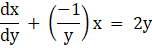
R = -1 /y and S = 2y
Now find the I.F. =

Multiplying both sides by I.F. we get,
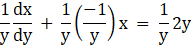
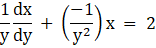
Integrating both sides concerning y, we get,

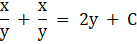
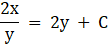
Key Points
- Differentiation in calculus is the process of finding the rate at which a function changes at a specific point.
- The derivative of a function represents the rate of change of the function concerning its independent variable.
- The derivative of a constant is zero because a constant value does not change.
- The power rule is a basic rule in differentiation that states if a function is raised to constant power, the derivative is found by multiplying the constant by the original function raised to the power minus one.
- The derivative of a sum or difference of functions is equal to the sum or difference of the derivatives of the individual functions.
- The product rule states that the derivative of the product of two functions is equal to the first function times the derivative of the second function, plus the second function times the derivative of the first function.
- The quotient rule is used to find the derivative of a quotient of two functions. It states that the derivative of the quotient is equal to the denominator times the derivative of the numerator, minus the numerator times the derivative of the denominator, all divided by the square of the denominator.
- The chain rule is a fundamental rule in differentiation that allows us to find the derivative of composite functions. It states that the derivative of a composite function is equal to the derivative of the outer function evaluated at the inner function, multiplied by the derivative of the inner function.
- The derivative of a trigonometric function can be found using specific rules, such as the derivative of sine is cosine, the derivative of cosine is negative sine, and so on.
- The derivative can be used to determine critical points, where the derivative is zero or undefined, and to analyze the behaviour of a function, such as finding maximum and minimum values or determining concavity.