Unit: Contextual Application of Differentiation
Chapter: L’Hospital’s rule
Reference: – Statement & Condition, Rule for limits, Rule for Exponential & logarithmic functions, Hyperbolic functions, Limits at Infinity, Indeterminate form involving power, Factorial & rational functions, Limits involving sequences, Applications & Mathematical analysis.
After studying this chapter, you should be able to:
- Indeterminate forms-Statement & Condition.
- Applying Rule & Related Applications.
- Other Indeterminate forms.
- Discontinuities & Limits at Infinity
Introduction & Indeterminate Forms
Indeterminate forms:
- An indeterminate form is an expression in which the value cannot be determined just by evaluating it directly. The most common indeterminate forms encountered are "0/0" and "∞/∞".
- When evaluating a limit and encountering an indeterminate form, it implies that further analysis is required to determine the actual limit value.
"0/0" indeterminate form:
- If the limit of a function f(x) as x approaches a certain value (c) results in the form "0/0", it indicates that the numerator approaches zero and the denominator also approaches zero as x approaches c.
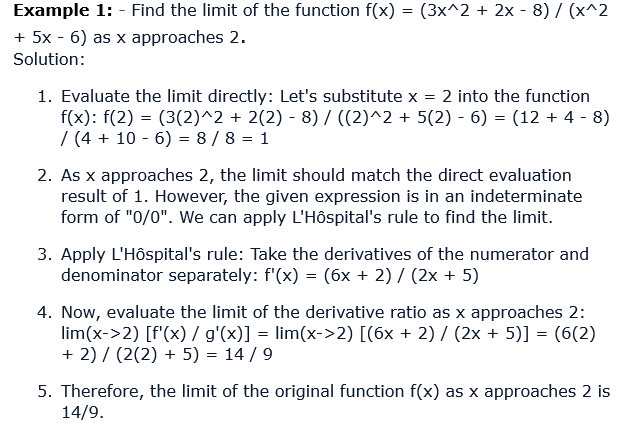
- L'Hôspital's rule can be applied in this case to evaluate the limit by taking the derivatives of the numerator and denominator separately, forming the ratio of their derivatives, and then evaluating the limit of this ratio.
"∞/∞" indeterminate form:
- If the limit of a function f(x) as x approaches a certain value (c) results in the form "∞/∞", it indicates that both the numerator and the denominator tend to infinity as x approaches c.
- L'Hôspital's rule can be applied in this case by taking the derivatives of the numerator and denominator separately, forming the ratio of their derivatives, and then evaluating the limit of this ratio.
Other indeterminate forms:
- L'Hôspital's rule primarily addresses the "0/0" and "∞/∞" indeterminate forms. However, other indeterminate forms can be transformed into these forms to apply L'Hôspital's rule. These include ∞ – ∞, 0 * ∞, ∞^0, 1^∞, and 0^0.
- By manipulating the original expression algebraically or using limit properties, these indeterminate forms can be transformed into "0/0" or "∞/∞" forms, allowing the application of L'Hôspital's rule.
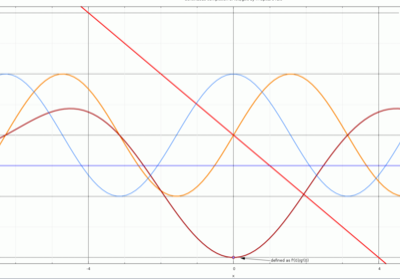
(L Hospital Rule Graph)
Applying Rules & Related Applications:-
Application of L'Hôpital's rule:
- When encountering an indeterminate form of "0/0" or "∞/∞" in evaluating a limit, L'Hôspital's rule allows us to find the limit by taking the derivatives of the numerator and denominator separately.
- To apply L'Hôspital's rule, compute the derivatives of both f(x) and g(x) to obtain f'(x) and g'(x), respectively.
- From the ratio of the derivatives: f'(x)/g'(x).
- Evaluate the limit of this new ratio as x approaches the given value (c).
- If the limit of the ratio exists, it is the same as the original limit of f(x)/g(x).
Conditions for applying L'Hôpital's rule:
- Differentiability condition: L'Hôspital's rule applies when both f(x) and g(x) are differentiable in an open interval containing the given value (c), except possibly at c itself.
- Determining differentiability: Check if the functions f(x) and g(x) are continuous at c and differentiable in the neighborhood of c, excluding c.
- Verify the conditions separately for the numerator and the denominator.
The case of a removable discontinuity:
- If f(x) and g(x) have a common factor that cancels out at c, resulting in an indeterminate form, the discontinuity may be removable.
- In such cases, before applying L'Hôspital's rule, factor out the common factor and simplify the expression. This might resolve the indeterminate form, and L'Hôspital's rule may not be necessary.
Repeated applications:
- If the initial application of L'Hôspital's rule still yields an indeterminate form, it's possible to apply the rule repeatedly.
- Repeated applications involve taking derivatives of the numerator and denominator successively until the indeterminate form is resolved or until an application form for L'Hôspital's rule is obtained.
- Exercise caution when applying L'Hôspital's rule repeatedly, as it may not always lead to a determinate form or the correct limit value.
Derivatives of Position & Other Indeterminate rule: –
- Complexity: Topic modeling in calculus can be challenging due to the complexity of mathematical concepts and techniques involved, requiring a solid understanding of calculus principles and their application to particle motion and accumulation problems.
- Data Interpretation: Interpreting and analyzing the results of topic modeling in calculus requires expertise in understanding the mathematical relationships and patterns within the data, which can be complex and nuanced.
- Data Availability and Quality: The success of topic modeling in calculus relies on the availability and quality of data. Insufficient or noisy data can hinder the accuracy and reliability of the models and analysis.
- Model Selection: Choosing the appropriate topic modeling techniques and models in calculus for particle motion and accumulation can be challenging. Different models may be suitable for different scenarios, and selecting the most appropriate one requires careful consideration.
- Computational Requirements: Topic modeling in calculus often involves computationally intensive calculations, especially when dealing with large datasets or complex models. Adequate computational resources and efficient algorithms are necessary to handle these demands.
Discontinuities & Limits at Infinity: –
- Particle Trajectory Analysis: Topic modeling in calculus can be used to analyze and predict the trajectories of particles, including their velocity, acceleration, and position functions. This has applications in fields such as physics, robotics, and aerospace engineering.
- Accumulation and differentiation Problems: Calculus-based topic modeling enables the analysis of particle accumulation, such as calculating accumulated quantities (e.g., mass, volume) using integrals. This is relevant in areas like environmental science, material science, and fluid dynamics.
Example 2: – Find out the particular solution of the differential equation ln dy/dx = 4y + ln x, given that for x = 0, y = 0.
Solution: ln dy/dx = 4y + ln x
dy/dx = e4y × eln x
dy/dx = e4y × (x)
1/e4ydy = x dx
e-4ydy = x dx
Integrating both sides for y and x respectively we get,
 =
=  + c
+ c
y(0) = 0 [Given]
–1/4 = 0 + c
c = –1/4
Therefore,
 e-4y =

e-4y = -2x2 + 1
Key Points
- L'Hôspital's rule is a technique used to evaluate limits involving indeterminate forms.
- It specifically applies to limits of the form "0/0" or "∞/∞".
- If the limit of the ratio of two functions f(x)/g(x) is an indeterminate form, L'Hôspital's rule states that the limit of their derivatives f'(x)/g'(x) will be the same.
- Both the numerator and the denominator must be differentiable in an open interval around the given value, except possibly at the value itself.
- L'Hôspital's rule can be used to evaluate limits at specific points or infinity.
- The rule involves taking the derivatives of the numerator and denominator separately.
- To apply L'Hôspital's rule, simplify the expression as much as possible before taking the derivatives.
- If the derivatives of f(x) and g(x) are also indeterminate forms, the rule can be applied repeatedly.
- It is important to exercise caution when applying L'Hôspital's rule repeatedly, as it may not always lead to a determinate form or the correct limit.
- L'Hôspital's rule can also be used to evaluate limits involving other indeterminate forms like ∞ – ∞, 0 * ∞, ∞^0, 1^∞, and 0^0.
- The conditions for applying L'Hôspital's rule should be verified before using the rule.
- L'Hôspital's rule is a powerful tool, but it is not applicable in all situations, and alternative methods may be needed to evaluate limits.