Unit: Application of Integrations
Chapter: Area between Curves & Different Methods
Reference: – Behaviour of a function, Different types of Asymptotes, Continuity of a function, Piecewise functions, Existence of Root Methods, Infinite & Asymptote limits, Bisection methods, Oblique Functions, Vertical Asymptotes, Exponential functions, Logarithmic limits, Squeeze theorem, Intermediate value theorem, Rational Functions
After studying this chapter, you should be able to:
- Introduction & Basic Approach
- Area Under Simple & Different Curve
- Intersection & Polar coordinates
Introduction & Basic Approach
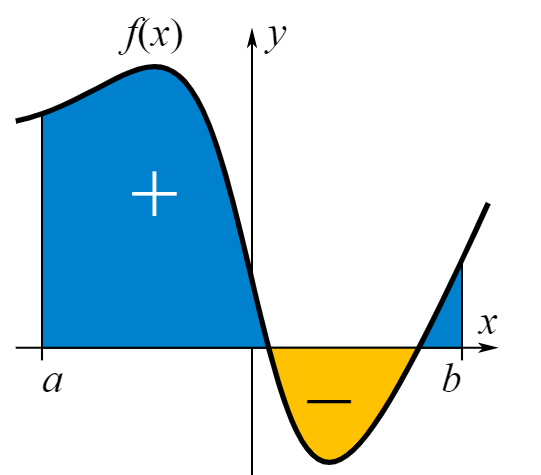
The most important topic of Integral calculus is the Calculation of area. Integration in general is considered to be a tough topic and area calculation tests a person's Integration and that too definite integral which is all the more difficult. Integration including both Definite and Indefinite integrals lays the groundwork for the questions of area calculation in Integral calculus.
In this chapter, we have discussed the basic concepts of area under curves followed by the working rule of finding the area. The concepts have been explained in detail along with supportive illustrations wherever required. We have also included 'the concept of definite integration and its application for calculation of area of the regions bounded by specific curves.
Some of the basic points to be kept in mind while dealing with the questions of this topic are:
- A graph is of utmost importance in these questions. The bounding region provides the limits of integration and it is not easy to do that without a graph.
- It is very confusing to determine which function is an upper function and which is lower without a graph. So to avoid any mistake, students are advised to first draw a graph to the question to have a clear picture of what exactly is being asked.
- The area between the graph y= f(x) and the x-axis is given by the definite integral as given below. This formula gives a positive answer for a graph above the x-axis and a negative answer for the one below the x-axis. In case, the graph is partly below and partly above the x-axis, the formula gives the net resultant area i.e. the area above minus the area below the x-axis.
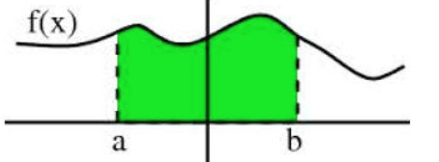
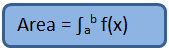
Before we try attempting questions on the area under curves, it is important to have an idea about the concepts related to curves. We first throw some light on such concepts:
(i) Let us assume the curve y = f(x) and its ordinates at the x-axis be x = a and x = b. Now, we need to evaluate the area bounded by the given curve and the ordinates given by x = a and x = b.
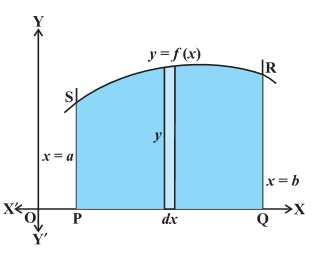
The area under the curve can be assumed to be made up of a large number of vertical, extremely thin strips. Let us take a random strip of height y and width dx as shown in the figure given above whose area is given by dA.
The area dA of the strip can be given as y dx. Also, we know that any point of the curve, y is represented as f(x). This area of the strip is called an elementary area. This strip is located somewhere between x = a and x = b, between the x-axis and the curve. Now, if we need to find the total area bounded by the curve and the x-axis, between x = a and x = b, then it can be considered to be made of an infinite number of such strips, starting from x = a to x = b. In other words, adding the elementary areas between the thin strips in the region PQRSP will give the total area.
Mathematically:

(ii) Going by the same logic, if we want to calculate the area under the curve x = g(y), the y-axis between the lines y = c and y = d, it will be given by:
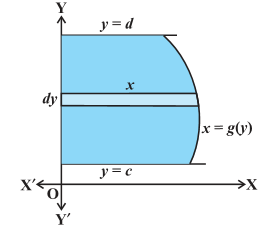

In this case, we need to consider horizontal strips as shown in the figure above.
(iii) If the curve lies below the x-axis, i.e. f(x) <0 then following the same steps, you will get the area under the curve and x-axis between x=a and x=b as a negative value. In such cases, take the absolute value of the area, without the sign, i.e.,  .
.
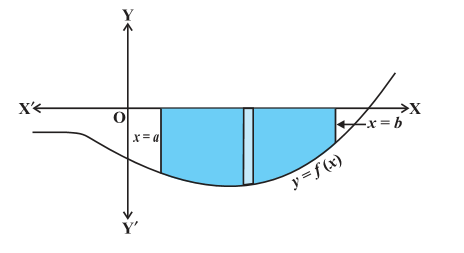
(iv) Another case that is possible is when some portion of the curve may lie above the x-axis and some portion below the x-axis, as shown in the figure,
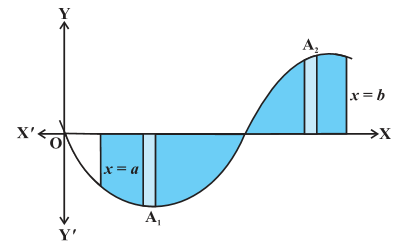
Here A1<0 and A2>0. Hence this is the combination of the first and second cases. Hence the total area will be given as |A1| + A2.
Example: Find the area of the region bounded by the curve y=x2, the x-axis, and the lines x=1 and x=3.
Solution:
Given the boundaries of the area to be found are,
• The curve y = x2
• The x-axis
• x = 1 (a line parallel toy-axis)
• x = 3 (a line parallel toy-axis)
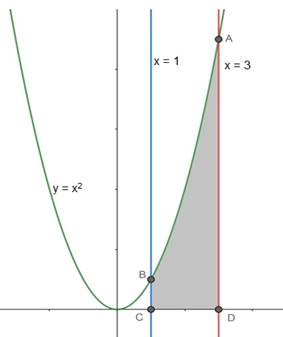
As per the given boundaries,
• The curve y = x2, has only the positive numbers as x has even power, so it is about the y-axis equally distributed on both sides.
• x= 1 and x=3 are parallel toy-axis at 1 and 3 units respectively from the y-axis.
• The four boundaries of the region to be found are,
•Point A, where the curve y = x2 and x=3 meet
•Point B, where the curve y = x2 and x=1 meet
•Point C, where the x-axis and x=1 meet i.e. C(1,0).
•Point D, where the x-axis and x=3 meet i.e. D(3,0).
Area of the required region = Area of ABCD.
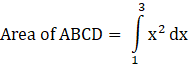
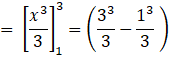
[Using the formula
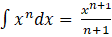 ]
]
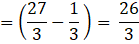
The Area of the required region
Example:
Find the area of the region bounded by the parabola y2=4x, the x-axis, and the lines x=1 and x=4.
Solution:
Given the boundaries of the area to be found are,
• The parabola y2 = 4x
• The x-axis
• x = 1 (a line parallel toy-axis)
• x = 4 (a line parallel toy-axis)
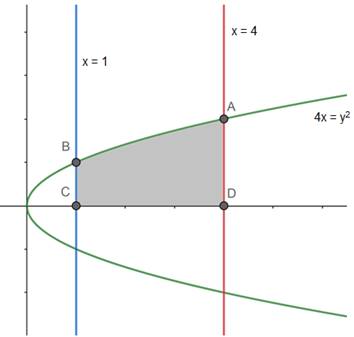
As per the given boundaries,
• The curve y2 =4x, has only the positive numbers as y has even power, so it is about the x-axis equally distributed on both sides.
• x= 1 and x=4 are parallel toy-axis at of 1 and 4 units respectively from the y-axis.
• The four boundaries of the region to be found are,
•Point A, where the curve y2 = 4x and x=4 meet
•Point B, where the curve y2 = 4x and x=1 meet
•Point C, where the x-axis and x=1 meet i.e. C(1,0).
•Point D, where the x-axis and x=4 meet i.e. D(4,0).
Area of the required region = Area of ABCD.
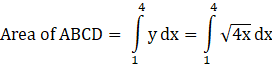
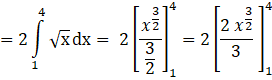
[Using the formula
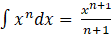 ]
]
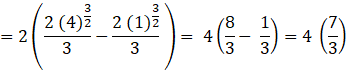

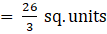
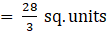
The Area of the required region
Example:
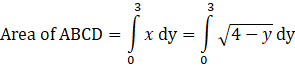
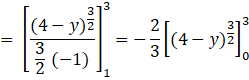
Find the area bounded by the curve y=(4-x2), the y-axis, and the lines y=0,y=3.
Solution:
Given the boundaries of the area to be found are,
• The curve y = 4-x2
• The y-axis
• y = 0 (x-axis)
• y = 3 (a line parallel to the x-axis)
Consider the curve,
y = 4-x2
x2 = 4-y
 —- (1)
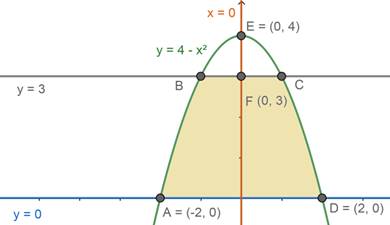
About the area to be found,
• The curve y = 4 – x2, has only the positive numbers as x has even power, so it is about the y-axis equally distributed on both sides.
• From (1) as,  , the curve has its vertex at (0,4) and cannot go beyond y = 4 as the value of x cannot be negative and imaginary.
• y= 0 is the x-axis
• y =3 is parallel to the x-axis which is 3 units away from the x-axis
The four boundaries of the region to be found are,
•Point A, where the x-axis and  meet i.e.
C(-2,0).
•Point B, where the curve  and y=3 meet where x is negative.
•Point C, where the curve  and y=3 meet where x is positive.
•Point D, where the x-axis and  meet i.e. D(2,0).
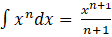
Area of the required region = Area of ABCD.
[Using the formula
 ]
]

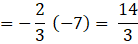
The Area of the required region
Example: Find the area under the curve y = x2 + 2 from x = 1 to x = 2.
Solution:
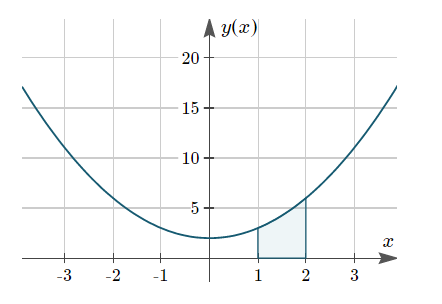
The above graph showing the portion under the curve y = x2 + 2 from x = 1 to x = 2
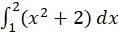
Required area = 
= 
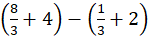
= 
= 
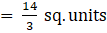
=  units2
Key Points
- The area between curves is the region enclosed by two or more curves on a given interval.
- Finding the area between curves involves using integral calculus.
- The basic approach involves determining the limits of integration and subtracting the functions to find the area.
- Integration for x is used when the curves are defined in terms of x, while integration for y is used when the curves are defined in terms of y.
- The vertical slices method involves integrating for x and treating each vertical slice as a thin rectangle.
- The horizontal slices method involves integrating for y and treating each horizontal slice as a thin rectangle.
- The intersection points between curves are important for breaking the problem into multiple regions and applying the appropriate method to each region.
- Other methods for finding the area between curves include using polar coordinates, where the curves are represented in terms of radius and angle.
- Each method requires careful consideration of the limits of integration and the setup of the integral.
- Practice and solving examples are crucial for gaining proficiency in finding the area between curves using different methods in calculus.