Unit: Infinite Sequence & Series
Chapter: Convergence of Infinite Series
Reference: – Divergence test, Geometric series, Integral test, Comparison test, Limit comparison test, Alternating series test, Absolute convergence, Conditional Convergence, Ratio test, Root test, Taylor series, Radius of convergence, Interval of convergence.
After studying this chapter, you should be able to:
- Introduction to Convergence & Divergence Series.
- Harmonic & P – Series Test.
- Ratio, Root test & Types of series.
- Comparison Test & Taylor Series.
Introduction to Convergence & Divergence Series
- Convergence: A series is said to converge if the sum of its terms approaches a finite value as the number of terms increases. Otherwise, if the sum does not approach a finite value, the series diverges.
- Divergence Test: The divergence test states that if the limit of the terms of a series does not equal zero, then the series diverges. This test is a quick way to determine divergence.
- Geometric Series: A geometric series is a series where each term is multiplied by a common ratio. The geometric series converges if the absolute value of the common ratio is less than 1 and diverges otherwise.
- Integral Test: The integral test allows us to determine the convergence or divergence of a series by comparing it with the convergence or divergence of an improper integral. If the integral converges, the series converges, and vice versa.
- p-Series Test: A p-series is a series of the form Σ(1/n^p), where p is a constant. The p-series converge if p > 1 and diverge if p ≤ 1.
- Comparison Test: The comparison test is used to determine the convergence or divergence of a series by comparing it with a known series. If the known series converges and the given series is greater than or equal to it, then the given series converges. If the known series diverges and the given series is less than or equal to it, then the given series also diverges.
- Limit Comparison Test: The limit comparison test is similar to the comparison test but focuses on the limit of the ratio between the terms of two series. If the limit exists and is finite, and the known series converges, then the given series also converges.
- Alternating Series Test: The alternating series test applies to series whose terms alternate in sign. If the absolute value of the terms decreases as the series progresses and approaches zero, then the alternating series converges.
- Absolute Convergence: A series is said to have absolute convergence if the series of absolute values converge. Absolute convergence guarantees that rearranging the terms of the series will not change its sum.
- Conditional Convergence: A series is conditionally convergent if it converges but the series of absolute values diverges. For conditionally convergent series, rearranging the terms can yield different sums.
- Ratio Test: The ratio test determines the convergence or divergence of a series by examining the limit of the ratio between consecutive terms. If the limit is less than 1, the series converges. If it is greater than 1 or infinite, the series diverges.
- Root Test: The root test is similar to the ratio test, but it examines the limit of the nth root of the absolute value of the terms. If the limit is less than 1, the series converges. If it is greater than 1 or infinite, the series diverges.
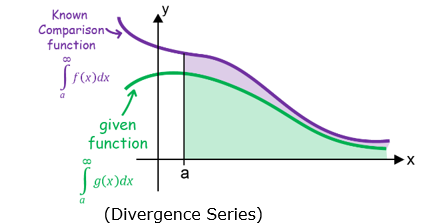
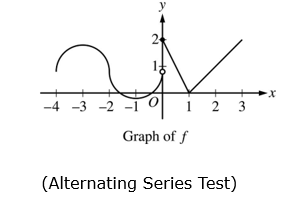
Integral, Comparison & Alternating series Test: –
Integral Test:
- The Integral Test is used to determine the convergence or divergence of a series by comparing it to the convergence or divergence of an integral.
- Suppose you have a series Σ(aₙ) where aₙ ≥ 0 for all n. To apply the Integral Test, you find a function f(x) that is continuous, positive, and decreasing for x ≥ 1, such that f(n) = aₙ for all n.
- Next, you evaluate the improper integral ∫[1, ∞] f(x) dx. If the integral converges, then the series Σ(aₙ) also converges. If the integral diverges, then the series Σ(aₙ) also diverges.
- The Integral Test is useful when the terms of a series resemble a function that can be integrated easily, allowing you to determine convergence or divergence by evaluating the integral.
Comparison Test:
- The Comparison Test is used to determine the convergence or divergence of a series by comparing it with a known series.
- Suppose you have a series Σ(aₙ) and a series Σ(bₙ), where aₙ ≥ 0, bₙ ≥ 0 for all n.
- If you can establish a comparison such that 0 ≤ aₙ ≤ bₙ for all n, and the series Σ(bₙ) converges, then the series Σ(aₙ) also converges. Conversely, if the series Σ(bₙ) diverges, then the series Σ(aₙ) also diverges.
- The Comparison Test allows you to determine the convergence or divergence of a series by comparing it to a known series whose convergence or divergence is already established.
Alternating Series Test:
- The Alternating Series Test is specifically applicable to series whose terms alternate in sign.
- Suppose you have an alternating series Σ((-1)^(n+1) * aₙ), where aₙ > 0 for all n.
- The conditions for the Alternating Series Test are twofold: the terms must decrease in absolute value as n increases (|aₙ₊₁| ≤ |aₙ|), and the limit of aₙ as n approaches infinity must be 0 (lim(n→∞) aₙ = 0).
- If these conditions are satisfied, then the alternating series Σ((-1)n+! * aₙ) converges.
- Note that the Alternating Series Test does not tell you the sum of the series, but rather whether it converges or not.
Absolute & Conditional Convergence
Absolute Convergence:
- Absolute convergence refers to the convergence of a series regardless of the signs of its terms.
- A series Σ(aₙ) is said to converge absolutely if the series of absolute values Σ(|aₙ|) converges.
- If the series Σ(|aₙ|) converges, then the series Σ(aₙ) converges absolutely.
- Absolute convergence implies that rearranging the terms of the series will not change its sum.
- The key advantage of absolute convergence is that it allows for more flexibility in manipulating and rearranging the terms of the series without altering the sum.
- Absolute convergence can be determined using tests such as the Ratio Test, Root Test, or by showing that the series is a combination of absolutely convergent series.
Conditional Convergence:
- Conditional convergence refers to the convergence of a series when the signs of its terms matter.
- A series Σ(aₙ) is said to converge conditionally if the series Σ(aₙ) converges, but the series of absolute values Σ(|aₙ|) diverges.
- In other words, the series Σ(aₙ) does not converge absolutely but still converges when considering the alternating signs.
- The behavior of conditionally convergent series can be more subtle and interesting because rearranging the terms of the series can yield different sums.
- A well-known example of a conditionally convergent series is the alternating harmonic series: 1 – 1/2 + 1/3 – 1/4 + …
- The alternating harmonic series converges, but if you rearrange its terms, you can obtain different sums or even divergent behavior.
- Conditionally convergent series can be analyzed using the Alternating Series Test, which establishes convergence based on the alternating signs and the decreasing magnitude of terms.
Ratio & Root Test
Ratio Test:
- The Ratio Test is a convergence test used to determine the convergence or divergence of a series.
- Consider a series Σ(aₙ) with non-zero terms.
- To apply the Ratio Test, you compute the limit as n approaches infinity of the absolute value of the ratio of consecutive terms: lim(n→∞) |(aₙ₊₁ / aₙ)|.
- If the limit is less than 1, the series Σ(aₙ) converges absolutely.
- If the limit is greater than 1 or infinite, the series Σ(aₙ) diverges.
- If the limit is exactly equal to 1, the Ratio Test is inconclusive, and other tests or methods need to be applied.
- The Ratio Test is particularly useful for series with terms that involve powers, exponentials, or factorials.
Root Test:
- The Root Test is another convergence test used to determine the convergence or divergence of a series.
- Consider a series Σ(aₙ) with non-zero terms.
- To apply the Root Test, you compute the limit as n approaches infinity of the nth root of the absolute value of the terms: lim(n→∞) (|aₙ|)^(1/n).
- If the limit is less than 1, the series Σ(aₙ) converges absolutely.
- If the limit is greater than 1 or infinite, the series Σ(aₙ) diverges.
- If the limit is exactly equal to 1, the Root Test is inconclusive, and other tests or methods need to be applied.
- The Root Test is particularly useful for series with terms that involve powers, exponentials, or factorials.
- The Root Test can handle situations where the terms of a series involve nth powers, nth roots, or combinations of these operations.
Radius & Interval of Convergence
The radius of Convergence:
- The Radius of Convergence is a property of a power series, which is an infinite series of the form Σ(aₙ * (x – c)^n), where aₙ are the coefficients and c is a constant.
- The Radius of Convergence represents the interval centered at point c within which the power series converges.
- The Radius of Convergence is denoted by R and can take on different values: R = 0, R = ∞, or a positive real number R > 0.
- If R = 0, it means the power series converges only at the center point c and nowhere else.
- If R = ∞, it means the power series converges for all real values of x.
- If R > 0, it means the power series converges for values of x within an interval centered at c, and the radius of that interval is R.
- The Radius of Convergence can be determined using the Ratio Test or the Root Test, which involves computing the limit as n approaches infinity.
The interval of Convergence:
- The Interval of Convergence is the range of values for which a power series converges.
- Given a power series Σ(aₙ * (x – c)n) with a known Radius of Convergence R, the Interval of Convergence consists of all values of x that satisfy |x – c| < R.
- The Interval of Convergence can be open, closed, or a combination of both, depending on the specific power series.
- To determine whether the endpoints of the interval are included, you need to perform additional tests at those points.
- At the endpoints of the Interval of Convergence, the power series may converge or diverge, or the behavior may vary based on the specific power series.
- If the power series converges at an endpoint, the convergence may be inclusive (included) or exclusive (excluded), depending on the convergence behavior at that point.
- The Interval of Convergence is important as it tells us the specific range of x-values for which the power series converges and provides insights into the behavior of the function represented by the power series.
Example: – Determine the convergence or divergence of the series Σ(3n / n!).
Solution:
To determine the convergence or divergence of the given series, we can apply the Ratio Test.
Applying the Ratio Test:
We evaluate the limit as n approaches infinity of the absolute value of the ratio of consecutive terms:
lim(n→∞) |(3n+1 / (n+1)!) / (3n / n!)|
= lim(n→∞) |3n+1 / (n+1)!| * |n! / 3n|
We simplify this expression:
= lim(n→∞) |3 / (n+1)|
Taking the limit as n approaches infinity, we find:
Lim(n→∞) |3 / (n+1)| = 0
Since the limit is less than 1, by the Ratio Test, the series Σ(3n / n!) converges.
Therefore, we conclude that the series Σ(3n / n!) converges.
Key Points
- Convergence refers to the sum of a series approaching a finite value as the number of terms increases, while divergence indicates the sum does not approach a finite value.
- The divergence test is a quick way to determine divergence: if the limit of the terms of a series does not equal zero, the series diverges.
- The integral test compares the convergence or divergence of a series with the convergence or divergence of an integral.
- The p-series test is a special case of the integral test, used for series of the form Σ(1/np), where p is a constant.
- The comparison test compares the convergence or divergence of a given series with the convergence or divergence of a known series.
- The limit comparison test is similar to the comparison test but involves taking the limit of the ratio between the terms of two series.
- The alternating series test is used for series whose terms alternate in sign, checking convergence based on the decreasing magnitude of terms.
- Absolute convergence refers to the convergence of a series regardless of the signs of its terms.
- Conditional convergence refers to the convergence of a series when the signs of its terms matter.
- The ratio test determines convergence or divergence by evaluating the limit of the ratio of consecutive terms.
- The root test determines convergence or divergence by evaluating the limit of the nth root of the absolute value of the terms.
- Taylor series is an expansion of a function into an infinite sum of terms, useful for approximating functions.