Unit: Congruency
Chapter: Congruence in Lines and Angles
Reference: – Basic Angle Relationships, Parallel Lines and Transversals, Perpendicular Lines and Angle Congruence, Triangle Angle Properties, Angle Congruence Theorems & Proofs, Applications & Problem-Solving
After studying this chapter, you should be able to understand:
- Geometry: – Lines & Angles
- Basic Angle Relationships & Parallel Lines and Transversals
- Perpendicular Lines and Angle Congruence
- Triangle Angle Properties & Angle Congruence Theorems & Proofs
Geometry: Lines and Angles
Theorems:
Axiom 1– If a ray stands on a line, then the sum of two adjacent angles so formed is 180°.
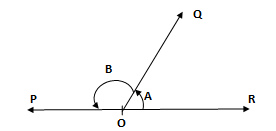
As we can see that PR is a straight line, thus angle formed on a straight line is 180°.
Therefore, ∠A + ∠B = 180°, thus the sum of adjacent angles is equal to 180°.
Also, when the sum of two adjacent angles is 180°, then they are called a linear pair of angles.
Axiom 2- If the sum of two adjacent angles is 180°, then the non-common arms of the angles form a line.
- The two axioms above together are called the Linear Pair Axiom.
Theorems related to Lines and Angles
Theorem 1– If two lines intersect each other, then the vertically opposite angles are equal.
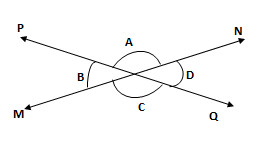
Proof- ∠A & ∠C and ∠B & ∠D are vertically opposite angles.
As we can see, MN is a straight line and ∠A & ∠B are adjacent angles on it,
∠A + ∠B = 180° …. (a) (Axiom 1)
Similarly, PQ is also a straight line and ∠A & ∠D are adjacent angles on it, so
∠A + ∠D = 180° …. (b) (Axiom 1)
Equating (a) & (b), we can say that ∠B = ∠D.
Similarly, we can proof this theorem for ∠A & ∠C.
Transversal Line
A line which intersects two or more lines at distinct points is called a transversal line.
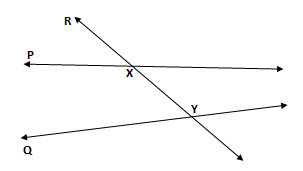
Line R intersects lines P and Q at points X and Y respectively. Therefore, line R is a transversal for lines P and Q.
Here, we can observe that four angles are formed at each of the points X and Y.
Let us name them, ∠1, ∠2, ∠3 … ∠7 & ∠8.
Nomenclature of angles related to transversal line.
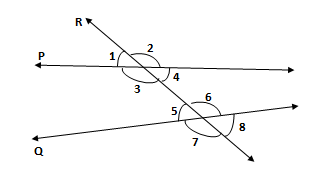
- ∠ 1, ∠ 2, ∠ 7 and ∠ 8 are called exterior angles and ∠ 3, ∠ 4, ∠ 5 and ∠ 6 are called interior angles.
- Corresponding angles–
- ∠ 1 and ∠ 5
- ∠ 2 and ∠ 6
- ∠ 4 and ∠ 8
- ∠ 3 and ∠ 7
- Alternate interior angles-
- ∠ 4 and ∠ 5
- ∠ 3 and ∠ 6
- Alternate exterior angles-
- ∠ 1 and ∠ 8
- ∠ 2 and ∠ 7
- Consecutive interior angles-
- ∠ 4 and ∠ 6
- ∠ 3 and ∠ 5
Relationship between angles
Axiom 3– If a transversal line intersects two parallel lines, then each pair of corresponding angles is equal.
Therefore,
-
- ∠ 1 = ∠ 5
- ∠ 2 = ∠ 6
- ∠ 4 = ∠ 8
- ∠ 3 = ∠ 7
Also,
Axiom 4- If a transversal line intersects two lines such that a pair of corresponding angles is equal, then the two lines are parallel to each other.
Theorem 2- If a transversal intersects two parallel lines, then each pair of alternate interior angles is equal.
Proof- As we know ∠QXY = ∠AXP……. (Vertically Opposite angles)
Also, ∠AXP = ∠XYR….. (Axiom 3, Corresponding angles)
Equating both, we can conclude that,
∠QXY = ∠XYR
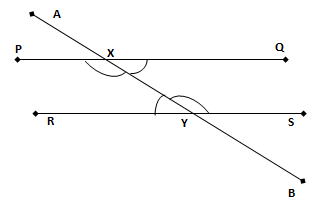
Similarly, we can prove this for,
∠PXY = ∠XYS
Converse, of Theorem 2 is also true.
Therefore,
Theorem 3- If a transversal intersects two lines such that a pair of alternate interior angles is equal, then the two lines is parallel.
Theorem 4- If a transversal intersects two parallel lines, then the consecutive interior angles are supplementary.
So, ∠QXY + ∠XYS = 180° and ∠PXY + ∠XYR = 180°
Converse, of Theorem 4 is also true, so,
Theorem 5- If a transversal intersects two lines such that a pair of interior angles on the same side of the transversal is supplementary, then the two lines is parallel.
Lines Parallel to Same Lines
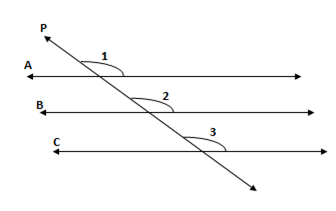
Given, Line A∥ B and A∥
 C, where line P is the transversal line.
So as, A∥ B, ∠1= ∠2….. (Corresponding angles)
Also, A∥ C, ∠1= ∠3….. (Corresponding angles)
Thus, we can say that ∠2 = ∠3
Now as ∠2 = ∠3, we can say that line B ∥ C.
Theorem 6– Lines which are parallel to the same line are parallel to each other.
- Congruent Angles – Two angles are congruent if they have the same measure.
- Angle Addition Postulate – If a point lies inside an angle, the sum of the two smaller angles equals the measure of the larger angle.
- Complementary Angles – Two angles are complementary if the sum of their measures is 90°.
- Supplementary Angles – Two angles are supplementary if the sum of their measures is 180°.
- Vertical Angles – When two lines intersect, the opposite (vertical) angles formed are always congruent.
- Parallel Lines and Transversals – When a transversal intersects two parallel lines, special angle relationships are created, including corresponding, alternate interior, alternate exterior, and consecutive interior angles.
- Perpendicular Lines – Two lines are perpendicular if they intersect at a 90° angle.
- Perpendicular Bisector Theorem – A point on the perpendicular bisector of a segment is equidistant from the segment’s endpoints.
- Right Angles Congruence Theorem – All right angles are congruent, meaning they have the same measure of 90°.
- Triangle Sum Theorem – The sum of the interior angles of any triangle is always 180°.
- Exterior Angle Theorem – The measure of an exterior angle of a triangle is equal to the sum of the two non-adjacent interior angles.
- Congruent Supplements Theorem – If two angles are supplementary to the same angle, then they are congruent.
- Congruent Complements Theorem – If two angles are complementary to the same angle, then they are congruent.
- Geometric Proofs – A logical sequence of statements and reasons used to justify geometric relationships and congruence.