Unit: Congruency
Chapter: Angle Sum Property
Reference: – Triangle Angle Sum Theorem, Exterior Angle Theorem, Interior Angles of a Polygon, Exterior Angles of a Polygon, Base Angles Theorem (Isosceles Triangle Theorem), Equilateral Triangle Angle Property, Angle Properties of Right Triangles, Angles in Special Quadrilaterals
After studying this chapter, you should be able to understand:
- Triangle Angle Sum Theorem & Exterior Angle Theorem
- Interior Angles of a Polygon & Exterior Angles of a Polygon
- Base Angles Theorem (Isosceles Triangle Theorem)
- Angle Properties of Right Triangles & Angles in Special Quadrilateral
Geometry: Lines and Angles
Angle Sum Property of Triangle
Theorem 7– The sum of the angles of a triangle is 180°.
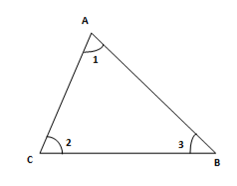
Using the axioms and theorems we have studied in the previous lesson; we can prove that the sum of all the angles of a triangle is 180°.
Consider ∆ABC with angles ∠1, ∠2 & ∠3 as shown in the figure.
To proof ∠1 + ∠2 + ∠3 = 180°
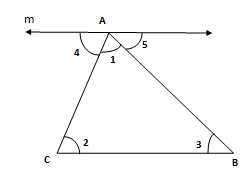
We’ll draw line m parallel to BC.
Now as m ∥ BC, ∠5 = ∠3 and ∠4 = ∠2 –> (Alternate interior angle)
Also, ∠1, ∠4 & ∠5 lie on a straight line, so ∠1 + ∠4 + ∠5= 180°
Equating both, ∠1 + ∠2 + ∠3 = 180°
Exterior Angle of a Triangle
∠4 is known as the exterior angle of a triangle.
Theorem 8- If a side of a triangle is extended, then the exterior angle so formed is equal to the sum of the two interior angles, that are opposite to the vertex of exterior angle.
Proof- 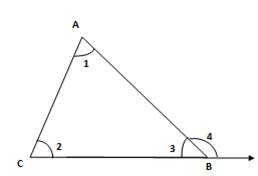
As ∠3 and ∠4 lie on a same line, so
∠3 + ∠4= 180°……… (1)
Also, ∠1 + ∠2 + ∠3 = 180°……….. (2)
Equating both we get,
∠4 = ∠1 + ∠3
Triangle Angle Sum Theorem – The sum of the interior angles of any triangle is always 180°, regardless of the type of triangle. This property is fundamental to all triangles and is used in solving for unknown angles.
Exterior Angle Theorem – The measure of an exterior angle of a triangle is equal to the sum of the two non-adjacent interior angles. This theorem helps determine missing angle measures when one exterior angle is given.
Exterior Angles of a Polygon – The sum of the exterior angles of any convex polygon, taken one per vertex, is always 360°, regardless of the number of sides. This property holds true because the exterior angles form a full rotation around the polygon.
Base Angles Theorem (Isosceles Triangle Theorem) – In an isosceles triangle, the angles opposite the two congruent sides are also congruent. This property is used to determine unknown angles when two sides of a triangle are equal in length.
Equilateral Triangle Angle Property – An equilateral triangle has all three sides and all three angles congruent. Since the sum of the angles in a triangle is 180°, each angle in an equilateral triangle measure exactly 60°.
Angle Properties of Right Triangles – A right triangle contains one 90° angle. The sum of the remaining two angles must be 90°, since the total sum of all three angles in any triangle is always 180°.
Triangle Inequality Theorem and Angle Relationships – In any triangle, the largest angle is always opposite the longest side, and the smallest angle is always opposite the shortest side. This property helps in comparing angle measures when only the side lengths are given.
Angles in Special Quadrilaterals – The sum of the interior angles of a quadrilateral is always 360°. Specific quadrilaterals, such as parallelograms, rectangles, rhombuses, and trapezoids, have additional angle properties based on their symmetries and side lengths.
Using Algebra to Solve for Unknown Angles – Unknown angles in geometric figures can be determined using algebraic equations based on the angle sum properties of triangles and polygons. This involves forming and solving equations using known angle relationships.