Unit: Congruency
Chapter: Line and Angle Congruency in Isosceles Triangles
Reference: – Base Angles Theorem, Converse of the Base Angles Theorem, , Perpendicular Bisector of the Base, Equilateral Triangle as a Special Isosceles Triangle, Exterior Angles in Isosceles Triangles, Congruence of Isosceles Triangles
After studying this chapter, you should be able to understand:
- Base Angles Theorem & Converse of the Base Angles Theorem
- Vertex Angle of an Isosceles Triangle & Theorems
- Perpendicular Bisector of the Base
- Exterior Angles in Isosceles Triangles & Congruence of Isosceles Triangles
Definition of an Isosceles Triangle – An isosceles triangle is a triangle that has at least two congruent sides. The angles opposite these congruent sides are also congruent, making the triangle symmetrical along its altitude.
Base Angles Theorem – In an isosceles triangle, the angles opposite the two congruent sides, called the base angles, are always equal in measure. This property ensures that any isosceles triangle has at least two congruent angles.
Converse of the Base Angles Theorem – If two angles in a triangle are congruent, then the sides opposite to these angles are also congruent. This theorem is used to prove that a given triangle is isosceles when two angles are known to be equal.
Vertex Angle of an Isosceles Triangle – The angle formed at the intersection of the two congruent sides is called the vertex angle. This angle is distinct from the two base angles and helps determine the symmetry of the triangle.
Isosceles Triangle Theorem Proofs – Logical justifications based on congruence postulates such as Side-Angle-Side (SAS) and Angle-Side-Angle (ASA) are used to prove that an isosceles triangle has congruent base angles and equal sides. These proofs establish the fundamental properties of isosceles triangles.
Perpendicular Bisector of the Base – In an isosceles triangle, the perpendicular bisector of the base passes through the vertex, dividing the triangle into two congruent right triangles. This bisector also acts as the altitude, angle bisector, and median, confirming the triangle’s symmetry.
Equilateral Triangle as a Special Isosceles Triangle – An equilateral triangle is a specific type of isosceles triangle where all three sides and all three angles are congruent. Since each interior angle of an equilateral triangle measures 60°, it satisfies the properties of both equilateral and isosceles triangles.
Exterior Angles in Isosceles Triangles – The exterior angle of an isosceles triangle is supplementary to the adjacent interior angle. According to the Exterior Angle Theorem, the measure of an exterior angle is equal to the sum of the two non-adjacent interior angles, allowing for the determination of unknown angles in the triangle.
Congruence of Isosceles Triangles – Two isosceles triangles are congruent if they satisfy one of the standard triangle congruence criteria: Side-Side-Side (SSS), Side-Angle-Side (SAS), Angle-Side-Angle (ASA), or Angle-Angle-Side (AAS). These criteria help establish the equivalence of triangles in geometric proofs.
Algebraic Applications in Isosceles Triangle Congruency – Algebraic expressions and equations are used to determine unknown side lengths and angle measures in isosceles triangles. By setting up equations based on the given properties, values can be found using algebraic manipulation.
Geometry: Triangles
Properties of Congruent triangles
- Reflexive Property of Congruent Triangle: Every triangle is congruent to itself.
Therefore, ∆ABC ≅ ∆ABC
- Commutative or Symmetric property of Congruent Triangles
if ∆ABC ≅ ∆DEF then it also means ∆DEF ≅ ∆ABC. - Transitive Property of Congruent Triangles
If ∆ABC ≅ ∆DEF and ∆DEF ≅ ∆LKM then ∆ABC ≅ ∆LKM
Properties of Isosceles Triangles
Theorem 4- The angles opposite to the equal sides of an isosceles triangle are equal.
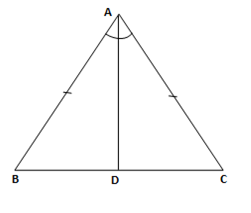
We are given an isosceles triangle ABC in which AB = AC.
Let us draw the bisector of ∠ A and let D be the point of intersection of this bisector of ∠ A and BC.
In ∆BAD and ∆CAD,
AB = AC (Given)
∠ BAD = ∠ CAD (Angle Bisector)
AD = AD (Common)
So, ∆BAD ≅ ∆CAD (By SAS rule).
Therefore, ∠ABD = ∠ACD, because they are corresponding angles of congruent triangles.
Hence Proved!
The converse of this theorem is also true, therefore,
Theorem 5- The sides opposite to equal angles of a triangle are equal.
Inequalities in Triangles
Based on the theorem 4, we can draw additional inferences as explained below in next three theorems
Theorem 6- If two sides of a triangle are unequal, the angle opposite to the longer side is larger (or greater).
Theorem 7– In any triangle, the side opposite to the larger (greater) angle is longer than the side opposite to the smaller angle.
Theorem 8– The sum of any two sides of a triangle is greater than the third side.
Five-point conclusion summarizing the Line and Angle Congruency in Isosceles Triangles chapter:
- Symmetry and Congruency – An isosceles triangle maintains symmetry due to its congruent sides and angles, making it a fundamental shape in geometric proofs and constructions.
- Base Angles and Side Relationships – The Base Angles Theorem and its converse establish that in an isosceles triangle, equal sides correspond to equal angles, reinforcing the triangle’s balanced structure.
- Role of Perpendicular Bisector – The perpendicular bisector of the base of an isosceles triangle serves multiple roles as the altitude, median, and angle bisector, ensuring equal division and symmetry.
- Equilateral Triangle Connection – An equilateral triangle is a special case of an isosceles triangle where all sides and angles are congruent, demonstrating the broad applicability of isosceles triangle properties.
- Geometric and Algebraic Applications – The principles of isosceles triangle congruency are widely used in geometric proofs, coordinate geometry, and algebraic problem-solving, making them essential for understanding advanced geometric concepts.