Unit: Congruency
Chapter: Congruency in Parallelograms
Reference: – Opposite Sides Theorem, Opposite Angles Theorem, Consecutive Angles Theorem, Diagonals of a Parallelogram, Parallelogram Area Formula, Rhombus as a Special Parallelogram, Rectangle as a Special Parallelogram, Square as a Special Parallelogram, Using Congruence to Prove Properties
After studying this chapter, you should be able to understand:
- Opposites Sides & Angles Theorem
- Consecutive Angles Theorem & Diagonals of a Parallelogram
- Rhombus & Rectangle as a Special Parallelogram
- Using Congruence to Prove Properties
Geometry: Quadrilaterals
Understanding Congruency in Quadrilaterals
Definition of a Parallelogram – A parallelogram is a quadrilateral in which both pairs of opposite sides are parallel to each other. This geometric property leads to several congruency relations between sides and angles.
Opposite Sides Theorem – In a parallelogram, opposite sides are congruent. This means that the side lengths of the parallelogram are equal in pairs, with one pair of opposite sides being congruent to each other. This property holds true for any parallelogram.
Opposite Angles Theorem – In a parallelogram, opposite angles are congruent. This implies that the two angles on opposite sides of the parallelogram are equal in measure, further supporting the geometric symmetry of parallelograms.
Consecutive Angles Theorem – In a parallelogram, consecutive (or adjacent) angles are supplementary. This means the sum of the measures of two adjacent angles is always 180°, and this property helps in determining unknown angles within the parallelogram.
Diagonals of a Parallelogram – The diagonals of a parallelogram bisect each other, meaning they intersect at their midpoints, dividing each diagonal into two equal segments. This property is crucial for solving problems involving the diagonals and proving other geometric relations in parallelograms.
Parallelogram Area Formula – The area of a parallelogram can be calculated using the formula Area = base × height, where the base is the length of one side, and the height is the perpendicular distance from the base to the opposite side. This formula is used to find the area of any parallelogram.
Rhombus as a Special Parallelogram – A rhombus is a special type of parallelogram where all four sides are congruent. In addition to the properties of a parallelogram, a rhombus has diagonals that are perpendicular to each other and bisect each other at right angles.
Rectangle as a Special Parallelogram – A rectangle is a type of parallelogram where all angles are 90°. Like all parallelograms, opposite sides are congruent and parallel, but the defining property of a rectangle is that its angles are right angles.
Square as a Special Parallelogram – A square is a special parallelogram that combines the properties of both a rhombus and a rectangle. In a square, all sides are congruent, and all angles are 90°. Its diagonals are congruent, perpendicular, and bisect each other at right angles.
Using Congruence to Prove Properties – The properties of parallelograms can be proven using congruence criteria like Side-Side-Side (SSS), Side-Angle-Side (SAS), Angle-Side-Angle (ASA), and Angle-Angle-Side (AAS). These criteria allow for formal geometric proofs to demonstrate congruence between parts of the parallelogram and to solve problems involving its properties.
Congruent Diagonal Theorem
Theorem 4- The diagonals of a rectangle are congruent to each other.
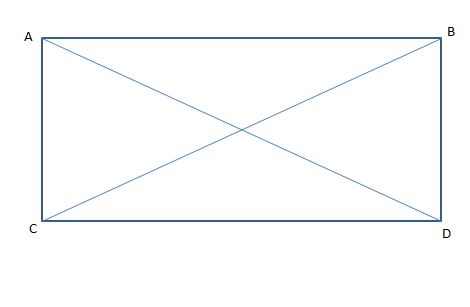
Prove a theorem that = A rectangle is a parallelogram with only right angles. Thus, all the rules of parallelograms apply to rectangles as well.
To prove this theorem, we will need to show that ∆ADC ≅ ∆BCD because that guarantees that AD ≅
 BC.
BC.
All angles on a rectangle are 90o, which means ∠ ACD ≅
ACD ≅ ∠
∠ BDC. Opposite sides of a parallelogram are equal, so AC ≅
 BD. By the Reflexive Property, CD ≅
 DC. Therefore, by the SAS triangle congruency criteria, ∆ADC ≅
 ∆BCD and thus AD ≅
 BC.
BC.
Five-point conclusion summarizing the Congruency in Parallelograms chapter in HS Geometry:
- Symmetry and Congruence – Parallelograms exhibit inherent symmetry, with congruent opposite sides and angles, making them fundamental shapes in geometry with consistent properties.
- Special Parallelograms – Specific types of parallelograms, such as rhombuses, rectangles, and squares, have unique properties that extend the basic characteristics of parallelograms, such as equal sides, right angles, and perpendicular diagonals.
- Angle Relationships – The relationships between opposite and consecutive angles in parallelograms help in understanding their geometric properties and allow for solving various geometric problems.
- Diagonals and Area Calculation – The diagonals of parallelograms bisect each other, and their properties, along with the area formula, are crucial for analysing and solving problems involving parallelograms.
- Proof and Application – Parallelogram properties can be proven using congruence postulates, and these proofs are essential for further exploration of congruence, geometric relationships, and real-world applications.