Unit: Right Triangles
Chapter: Special Triangles and Ratios
Reference: – Definition of Special Right Triangles, Derivation of Special Triangle Ratios, Applications of Special Triangle Ratios in Geometry, Using Special Triangles in Coordinate Geometry, Angle-Based Trigonometric Relationships, Comparing Special Triangles to General Right Triangles, Geometric Constructions Using Special Right Triangles
After studying this chapter, you should be able to understand:
- Definition of Special Right Triangles & Its Derivation
- Applications of Special Triangle Ratios in Geometry
- Angle-Based Trigonometric Relationships
- Comparing Special Triangles to General Right Triangles
Definition of Special Right Triangles – Special right triangles are unique types of right triangles with fixed angle measures that create consistent side length relationships. These triangles provide a standardized method for solving geometric problems involving right angles without requiring additional calculations or trigonometric functions.
Properties of a 45°-45°-90° Triangle – This type of right triangle is formed when a square is divided along one of its diagonals, resulting in two congruent right triangles. Since two of its angles are equal, the triangle exhibits symmetry, meaning that its two non-hypotenuse sides are always equal in length. The hypotenuse follows a fixed proportional relationship with the legs, maintaining a predictable structure regardless of the triangle's scale.
Properties of a 30°-60°-90° Triangle – This triangle is derived by dividing an equilateral triangle into two equal halves, creating a right triangle with three distinct angle measures. The three sides of the triangle maintain a proportional relationship, where the shortest side is always opposite the smallest angle, and the longest side corresponds to the right angle's hypotenuse. This fixed proportion allows for consistent side length determination in various applications.
Derivation of Special Triangle Ratios – The proportional relationships in special right triangles originate from fundamental geometric principles. In a 45°-45°-90° triangle, the equality of the two non-hypotenuse sides results from its isosceles nature. In a 30°-60°-90° triangle, the division of an equilateral triangle establishes the fixed side relationships. These derivations demonstrate how geometric properties naturally lead to predictable and consistent patterns.
Applications of Special Triangle Ratios in Geometry – Special right triangles frequently appear in geometric structures such as squares, equilateral triangles, and hexagons. Their pre-determined side length relationships enable efficient problem-solving without the need for complex calculations. They are particularly useful in determining unknown measurements in regular polygons and tessellations.
Using Special Triangles in Coordinate Geometry – Special right triangles play a crucial role in coordinate geometry, where they assist in determining distances between points, constructing perpendicular lines, and identifying midpoints. Their structured properties simplify geometric analysis and allow for precise calculations when working within a coordinate plane.
Angle-Based Trigonometric Relationships – The consistent proportional relationships in special right triangles create predictable trigonometric values for their angles. These values provide a foundational understanding of how angle size influences side length ratios. This predictability is especially useful in trigonometric problem-solving and graphical representations of angles in a coordinate system.
Comparing Special Triangles to General Right Triangles – While general right triangles require trigonometric functions to determine unknown side lengths, special right triangles allow for direct side length determination using their fixed ratios. This distinction makes them highly practical in mathematical problem-solving and geometric proofs, as they eliminate the need for additional calculations.
Geometric Constructions Using Special Right Triangles – Special right triangles are commonly used in geometric constructions to create precise angles, perpendicular bisectors, and symmetrical patterns. Their structured properties ensure that geometric figures are formed with accuracy, making them essential tools in architectural and mathematical designs.
Real-World Applications of Special Right Triangles – The practical use of special right triangles extends to various fields, including architecture, engineering, physics, and design. They help in constructing stable structures, determining slopes, and designing mechanical systems. Their predictable side relationships make them valuable in creating efficient solutions for real-world problems that involve right-angled geometry.
Trigonometry: Introduction to Trigonometry
Trigonometric Ratios of Special Angles
- Trigonometry Ratios Of 45°

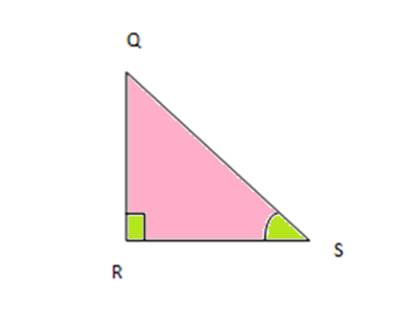
Let  be an isosceles triangle with
 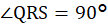 and sides QR = RS = x.
 …….. (By Pythagoras Theorem,
 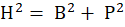 )
)


Now,
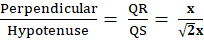
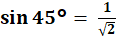
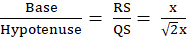
Sin  =
= 
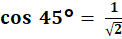
Cos  =
= 
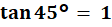
tan S = 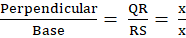
Cot S = 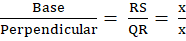

Sec S = 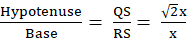
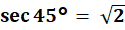
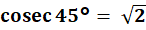
Cosec S = 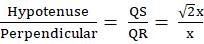
- Trigonometric Ratio Of 60° And 30°
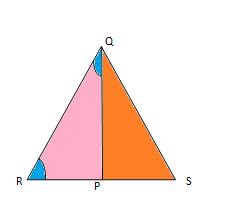 Let
Let  be an equilateral triangle with each side = 2x. QP is perpendicular bisector of RS.
RP = 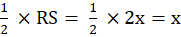
We know that each angle of an equilateral triangle is 60° , therefore,
 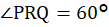 ,
,

By applying Pythagoras Theorem,




Trigonometric Ratio Of 60°
In  with QP =
  , RP = x and QR = x
Sin R = 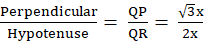
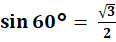
Cos R = 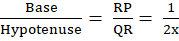
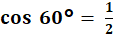
tan R = 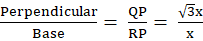
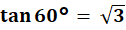
Cot R = 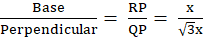
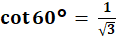
Sec R = 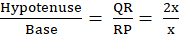
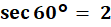
Cosec R = 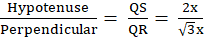
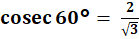
Trigonometric Ratios Of 30°
In 
Sin Q =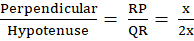
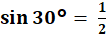
Cos Q = 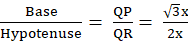
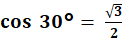
tan Q = 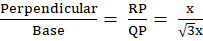
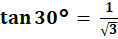
Cot Q = 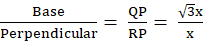
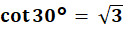
Sec Q = 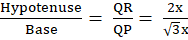
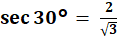
Cosec Q = 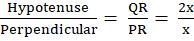
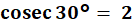
Trigonometric Ratios Of 0
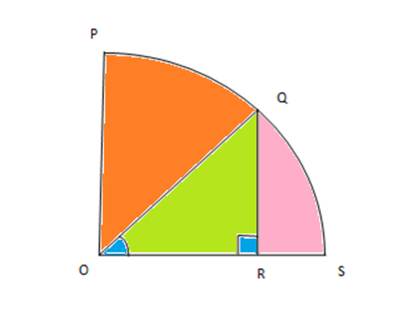
Let  be a right-angled triangle inscribed in an arc POS on x-axis and y-axis.
So, OQ = n, OR = x and QR= y and 
Trigonometric Ratios Of 
When  , Q coincides with S so that x = n and y = 0 (on both axes)
Sin O =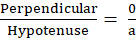

Cos O = 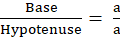
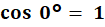
tan O = 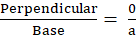

Cot O = 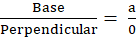

Sec O = 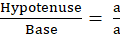
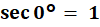
Cosec O = 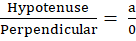

Trigonometric Ratios Of 90°
 , Q coincides with P so that x=0 and y = a.
Sin O =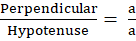
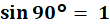
Cos O = 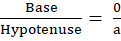
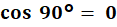
Tan O = 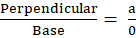

Cot O = 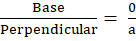

Sec O = 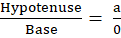

Cosec O = 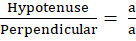
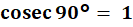
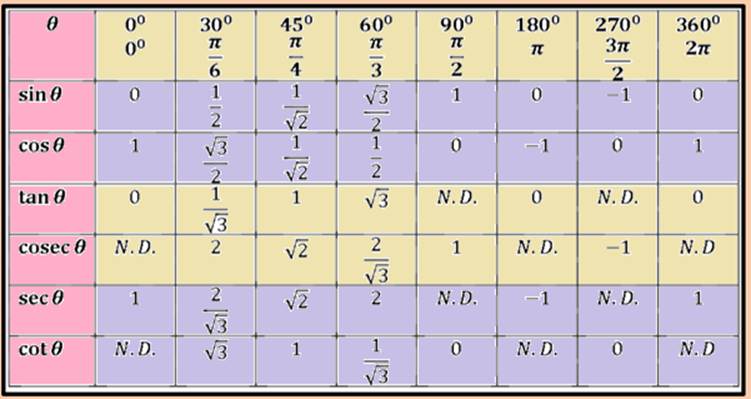
Table of Special Angles and their values:
Have a predefined table of Sine and Cosine and Tangent values of angles, for some special angles helps a lot. And it also gives a good idea of the range that a specific measure will fall into.
For example, looking at the table below, we can say that the range of the Sine value goes from (+1 to -1) and it starts from “0” when the angle is “0”.
Likewise, the cosine value goes from +1 to -1.
And Tangent values go from 0 to √3, and also contains some non-defined values.
Once we know above, we can use above information in calculating various properties of sine and cosine waveform as well.
A table of values for the special angles is included below: –
Trigonometric Ratios of Complementary Angles:
If the sum of two angles is one right angle or 90°, then one angle is said to be complementary of the other. Thus, 25° and 65°; θ° and (90 – θ)° are complementary to each other.
Suppose a rotating line rotates about O in the anti-clockwise sense and starting from its initial position.
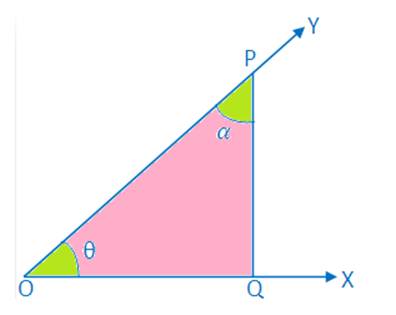
 traces out angle ∠XOY = θ, where θ is acute.
Take a point P on  and draw
  perpendicular to OX. Let, ∠OPQ =α
 . Then, we have,
 + θ = 90°
or,  = 90° – θ.
Therefore, θ and  are complementary to each other.
Now, by the definition of trigonometric ratio,
Sin θ =  ………. (i)
Cos θ = ; ………. (ii)
tan θ = ; ……. (iii)
And sin  =
= ; ………. (iv)
cos  =
= ………. (v)
tan  =
= ….… (vi)
From (i) and (iv) we have,
Sin  = cos θ
Or, sin (90° – θ) = cos θ;
From (ii) and (v) we have,
Cos  = sin θ
Or, cos (90° – θ) = sin θ;
From (iii) and (vi) we have,
And tan  = 1/tan θ
Or, tan (90° – θ) = cot θ.
Similarly, cosec (90° – θ) = sec θ;
Sec (90° – θ) = cosec θ
and cot (90° – θ) = tan θ.
Therefore,
Sine of any angle = cosine of its complementary angle;
Cosine of any angle = sine of its complementary angle;
Tangent of any angle = cotangent of its complementary angle.
Corollary:
Complementary Angles: Two angles are said to be complementary if their sum is 90°. Thus θ and (90° – θ) are complementary angles.
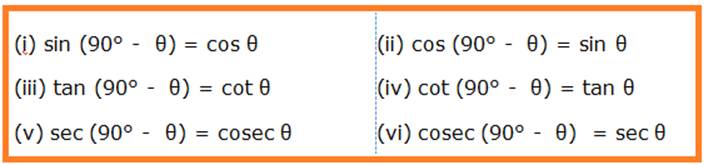
We know there are six trigonometrically ratios in trigonometry. The above explanation will help us to find the trigonometrically ratios of complementary angles