Unit: Right Triangles
Chapter: Law of Cosines
Reference: – Fundamental Concept of the Law of Cosines, Application of the Law of Cosines in Non-Right Triangles, Solving Triangles with Given Two Sides and an Included Angle (SAS Case), Solving Triangles with Three Known Sides (SSS Case), Comparison Between the Law of Cosines and the Law of Sines, Proof and Derivation of the Law of Cosines, Understanding the Relationship Between Angles and Side Lengths, Use of the Law of Cosines in Real-World Applications
After studying this chapter, you should be able to understand:
- Fundamental Concept of the Law of Cosines & Application of the Law of Cosines in Non-Right Triangles
- Solving Triangles with Given Two Sides and an Included Angle (SAS & SSS Case)
- Use of the Law of Cosines in Real-World Applications
- Understanding the Relationship Between Angles and Side Lengths
Concept of the Law of Cosines
The Law of Cosines establishes a mathematical relationship between the lengths of the sides of a triangle and the cosine of one of its angles. It is particularly useful for solving triangles that do not have a right angle, providing a way to determine missing measurements when certain conditions are known.
Application in Non-Right Triangles
Unlike other trigonometric principles that primarily apply to right-angled triangles, the Law of Cosines extends these concepts to oblique (non-right) triangles. It enables the determination of missing sides or angles in cases where the traditional Pythagorean Theorem cannot be applied.
Determining a Missing Side When Two Sides and an Included Angle are Known (SAS Case)
In a triangle where two side lengths are given along with the angle between them, the Law of Cosines provides a method to calculate the length of the third side. This scenario frequently appears in real-world applications such as land surveying and navigation.
Determining a Missing Angle When All Three Sides are Known (SSS Case)
If all three side lengths of a triangle are known, the Law of Cosines allows for the determination of one or more unknown angles. This is particularly useful when angles are not directly measurable, such as in mechanical and architectural designs.
Comparison with the Law of Sines
Both the Law of Cosines and the Law of Sines are fundamental in solving triangles. While the Law of Sines is used when an angle-side ratio is available, the Law of Cosines is applied when such a ratio is not present. Understanding the differences helps in choosing the most effective approach for solving a given problem.
Geometric Justification and Theoretical Proof
The Law of Cosines can be derived using geometric constructions by breaking a given triangle into right-angled components. This process helps in understanding how the relationship between sides and angles emerges from fundamental trigonometric principles.
Understanding the Connection Between Angles and Side Lengths
In any triangle, the length of a side is influenced by the angle opposite to it. A larger angle corresponds to a longer side, while a smaller angle corresponds to a shorter side. The Law of Cosines provides a systematic way to quantify this relationship, making it a powerful tool in triangle analysis.
Practical Applications in Real-World Scenarios
The Law of Cosines is extensively used in fields such as engineering, astronomy, physics, and navigation. It is applied in determining distances between objects, calculating structural loads, and analyzing motion in physics, among other practical uses.
Solving Word Problems Using the Law of Cosines
Many real-life problems involving triangular configurations can be addressed using the Law of Cosines. These include determining unknown distances in topographical surveys, solving for angles in construction projects, and computing travel routes in navigation.
Recognizing Its Limitations and When to Use Alternative Methods
While the Law of Cosines is a powerful mathematical tool, it is not always the most efficient approach. In some cases, the Law of Sines or other geometric principles might provide a simpler solution. Understanding its limitations ensures that the best method is selected for each problem.
Defining the Law of Cosines
In the past, when we have had a triangle only defined by two sides and the included angle, we would start by calculating the third side. However, this was only when that included angle was 90o, and we used the Pythagorean Theorem.
The Law of Cosines can be considered an extension or a generalization of the Pythagorean Theorem. For triangle ∆ABC with sides a, b, and c opposite the angles with the same letter, the formula is:

Putting the Laws Together
You can now solve the angle measures and side measures of just about any unique triangle possible. Here are some key situations in which you can use either the Law of Sines or Cosines, as summarized in the table below
Table: Solution techniques on identifying the remaining dimensions of a triangle.
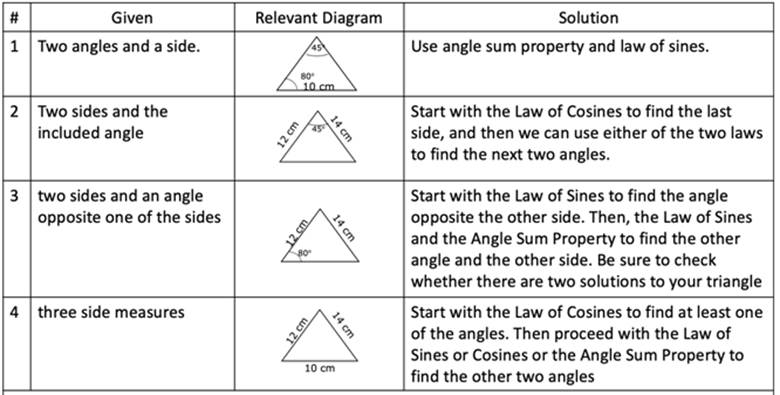
In addition to the above table, here’s a list of scenarios in which you can’t find any more sides or angle measures except perhaps with the Angle Sum Property:
- We have less than three sides and no angles. The triangle two sides form depends on either the third side or the angle between those two sides.
- We only have angles. There is an infinite number of similar triangles that all have different side measures but all with the same angle measures. If you have two angle measures, you can find the third with the Angle Sum Property, but that is all.
- We have one angle and one side. If they are opposite, you have a good idea what the angle-to-opposite-side ratios are going to be, but it doesn’t give you any information that can help you add more angle and side measures to the figure.
Essential for Solving Non-Right Triangles
The Law of Cosines extends trigonometric principles beyond right-angled triangles, making it an indispensable tool for solving oblique triangles where the Pythagorean Theorem cannot be applied.
Versatile in Determining Missing Sides and Angles
Whether given two sides and the included angle (SAS) or all three sides (SSS), this law allows for the precise calculation of unknown values, making it highly useful in various geometric and real-world applications.
Bridges Trigonometry and Geometry
By incorporating cosine values into side-length calculations, the Law of Cosines provides a fundamental connection between trigonometric functions and geometric properties, reinforcing the mathematical relationship between angles and distances.
Widely Applicable in Real-World Problems
Used in fields such as engineering, physics, astronomy, and navigation, the Law of Cosines helps in distance calculations, structural analysis, and trajectory predictions, demonstrating its practical significance beyond theoretical mathematics.
Complementary to the Law of Sines
While powerful on its own, the Law of Cosines is best utilized alongside the Law of Sines to provide a complete set of tools for solving all types of triangles, ensuring flexibility and accuracy in problem-solving.