Unit: Circles
Chapter: Basic Concepts
Reference: – Definition of a Circle, Radius and Diameter, Area of a Circle, Chord of a Circle, Secant and Tangent Lines, Arc of a Circle, Central Angle, Inscribed Angle, Concentric Circles
After studying this chapter, you should be able to understand:
- Definition of Circle & Types
- Area & Chord of a Circle
- Secant and Tangent Lines & Arc of a Circle
- Inscribed Angle & Concentric Circles
Definition of a Circle – A circle is a set of points in a plane that are equidistant from a fixed point called the centre. This fixed distance is known as the radius of the circle. The circle is a basic geometric figure where every point on the curve maintains an equal distance from the centre. The circle is a two-dimensional figure, and its symmetry is one of its defining properties.
Radius and Diameter – The radius of a circle is the constant distance from the centre of the circle to any point on its circumference. It is a key measurement used to define the size of the circle. The diameter is the longest chord of the circle, passing through the centre, and it is twice the length of the radius. The diameter can be calculated by multiplying the radius by 2: – d=2r.
Circumference of a Circle – The circumference is the total distance around the circle. It represents the boundary of the circle. The formula for calculating the circumference of a circle is C=2πr, where r is the radius of the circle. The constant π (pi) is an irrational number approximately equal to 3.14159. The circumference gives insight into the scale of the circle in terms of its boundary length.
Area of a Circle – The area of a circle represents the total space enclosed within its boundary. It is calculated using the formula r is the radius of the circle. The area of a circle is directly proportional to the square of its radius, meaning as the radius increases, the area grows exponentially.
Chord of a Circle – A chord is a line segment whose endpoints lie on the circumference of the circle. The chord does not necessarily pass through the centre of the circle. The longest possible chord is the diameter, which divides the circle into two equal parts. Chords play an important role in defining the relationship between different parts of a circle, such as determining the lengths of arcs.
Secant and Tangent Lines – A secant is a straight line that intersects the circle at two distinct points. It "cuts" the circle, and its two points of intersection are important in geometric analysis. A tangent is a straight line that touches the circle at exactly one point. This point is called the point of tangency. A tangent never intersects the circle, and the line is perpendicular to the radius of the circle at the point of contact.
Arc of a Circle – An arc is a portion of the circumference of a circle, defined by two points on the circle. The length of an arc is proportional to the central angle subtended by it. For instance, a full circle (360 degrees) has a circumference, and a fraction of that circumference corresponds to the central angle.
Central Angle – A central angle is an angle whose vertex is at the centre of the circle and whose sides are formed by two radii of the circle. The central angle subtends an arc on the circle, and the measure of the central angle directly corresponds to the proportion of the circle’s circumference that the arc represents. For example, a central angle of 90° subtends a quarter of the circle, and its arc will be one-fourth of the total circumference.
Inscribed Angle – An inscribed angle is an angle formed by two chords in the circle that share a common endpoint, which is on the circumference of the circle. The vertex of the inscribed angle lies on the circle itself. The measure of an inscribed angle is always half the measure of the central angle that subtends the same arc. For example, if a central angle measures 80°, the corresponding inscribed angle will measure 40°.
Concentric Circles – Concentric circles are two or more circles that share the same centre but have different radii. The circles do not intersect each other and are nested within each other. These circles have the same central point but different sizes. Concentric circles often appear in designs, patterns, and certain physical phenomena where multiple layers of circles are involved.
Geometry, Circle
Basic Concepts and Introduction
The collection of all the points in a plane which are at a fixed distance from a fixed point in the plane is called a circle.
The fixed point is called the centre of the circle and the fixed distance is called the radius of the circle.
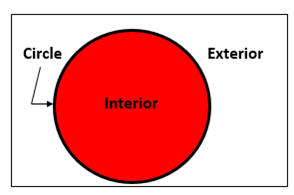
A circle divides the plane on which it lies into three parts. They are-
- Inside the circle, which is also called the interior of the circle
- The circumference
- Outside the circle, which is also called the exterior of the circle
Chord of a Circle
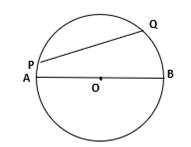
Let’s take two points, P and Q on a circle, the line segment formed by joining these two points PQ is known as the chord of the circle.
And a chord that passes through the centre of the circle is called the diameter of the circle.
Therefor you can say that, the diameter is the longest chord and all diameters of a same circle, have the same length, which is equal to the twice of the radius.
Thus, D = 2R. (Where D = Diameter and R = Radius)
Arc of a Circle
A section of the circumference of a circle between the two points on a circumference is called an arc. The longer one is called the major arc and the shorter one is called the minor arc. As shown in the diagram below
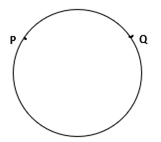
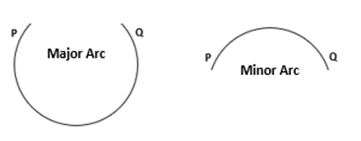
When P and Q are the ends of a diameter, then both arcs are equal, and each arc is then called as a semicircle.
The length of the complete circle is called its circumference, and it’s equal to 2πR. This is because π is defined as the ratio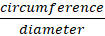 , and the diameter is simply 2R.
The region between a chord and either of its arcs is called a segment of the circular region.
There are two types of segments,
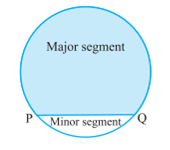
- Major segment
- Minor segment
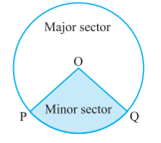
The other way to define the segments is “sectors”. Therefore, we also have minor sector and major sector corresponding to their respective arcs.
The area of the complete circle can be determined using the same rules for a regular polygon. For a regular polygon, area = ½ × perimeter × distance from centre to any side. Applying it to circles, we find this:
Area = ½ × 2πR × R
Area = πR2
This is indeed the area for a circle that you have probably learned and seen many times before.
Five-point conclusion summarizing the Basic Concepts of Circles in HS Geometry:
- Foundational Geometric Figure – The circle is a fundamental geometric shape characterized by its constant radius and centre, making it central to various geometric principles and theorems in geometry.
- Key Measurements – The primary measurements of a circle—radius, diameter, circumference, and area—are crucial for understanding its size and relationship with other geometric shapes. These measurements allow for accurate calculations and problem-solving in geometry.
- Chords, Secants, and Tangents – Chords, secants, and tangents are critical elements in circle geometry. Chords connect points on the circle, secants intersect it at two points, and tangents touch the circle at only one point, each having unique geometric properties and relationships with the circle's centre.
- Angles and Arcs – Central and inscribed angles play a vital role in circle geometry. The central angle directly affects the size of the corresponding arc, while inscribed angles are always half the measure of their central counterparts, making these relationships crucial for circle-related proofs and calculations.
- Real-World Applications – Understanding circles and their properties extends beyond geometry into real-world contexts such as architecture, engineering, astronomy, and design, where circles are used to model natural shapes and structures, calculate distances, and solve problems involving rotational symmetry.