Unit: Circles
Chapter: Theorems, Circles
Reference: – Angle at the Centre Theorem, Inscribed Angle Theorem, Angle Between a Tangent and a Chord, Theorem of Tangents from an External Point, Cyclic Quadrilateral Theorem, Power of a Point Theorem, Chord-Chord Intersection Theorem, Secant-Secant Theorem, Secant-Tangent Theorem, Arc Length and Sector Area Theorem
After studying this chapter, you should be able to understand:
- Angle at the Centre Theorem & Inscribed Angle Theorem
- Angle Between a Tangent and a Chord
- Theorem of Tangents from an External Point
- Cyclic Quadrilateral Theorem & Power of a Point Theorem
- Arc Length and Sector Area Theorem
Angle at the Centre Theorem – This theorem states that the angle subtended by an arc at the Centre of a circle is exactly twice the angle subtended by the same arc at any point on the circle's circumference. In other words, if an angle is formed at the Centre by two radii, and another angle is formed at a point on the circle by the same two radii, the central angle will always be double the inscribed angle.
Inscribed Angle Theorem – According to this theorem, the measure of an inscribed angle (an angle whose vertex is on the circle and whose sides are formed by two chords) is half the measure of the central angle that subtends the same arc. This theorem provides a relationship between central and inscribed angles and is fundamental in understanding the properties of angles in a circle.
Angle Between a Tangent and a Chord – This theorem states that the angle between a tangent to a circle and a chord drawn to the point of tangency is equal to the angle subtended by the chord in the alternate segment of the circle. This property is useful in solving problems involving tangents and chords in circles, as it connects the angle at the point of tangency to the circle’s interior angles.
Theorem of Tangents from an External Point – This theorem asserts that if two tangents are drawn from an external point to a circle, then the lengths of these tangents are equal. This is a key property when dealing with tangents from an external point and has applications in geometric constructions and proofs.
Cyclic Quadrilateral Theorem – A cyclic quadrilateral is a quadrilateral where all four vertices lie on a circle. The theorem states that the sum of the opposite angles of a cyclic quadrilateral is always 180°. This theorem is useful in finding angle relationships in cyclic quadrilaterals and is often applied in solving problems involving cyclic polygons.
Power of a Point Theorem – This theorem defines the relationship between a point and a circle. It states that for any point outside or inside a circle, the power of the point is the square of the distance from the point to the Centre of the circle minus the square of the radius of the circle. This power is a constant for any line drawn through the point and the circle. The power of a point is a fundamental concept in circle geometry, often used in solving more complex problems.
Chord-Chord Intersection Theorem – This theorem states that when two chords intersect inside a circle, the product of the lengths of the segments of one chord is equal to the product of the lengths of the segments of the other chord. This theorem is a specific case of the more general power of a point theorem and is helpful in solving problems involving intersecting chords in a circle.
Secant-Secant Theorem – This theorem states that if two secants are drawn from an external point to a circle, the product of the length of the external segment of the first secant and the length of the whole secant is equal to the product of the length of the external segment of the second secant and the length of the whole secant.
Secant-Tangent Theorem – The secant-tangent theorem states that if a tangent and a secant intersect at an external point, the square of the length of the tangent segment is equal to the product of the lengths of the external segment of the secant and the whole secant. Mathematically,
This relationship helps to find unknown lengths involving secants and tangents.
Arc Length and Sector Area Theorem – The arc length theorem states that the length of an arc of a circle is proportional to the measure of the central angle that subtends the arc.
Geometry: Circle
Theorems
Theorem 1- Equal chords of a circle subtend equal angles at the centre.
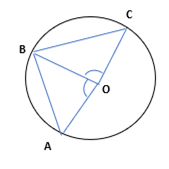
Proof- OA = OC = OB (Radii of a circle)
AB = BC (Given)
Therefore, ∆ AOB ≅ ∆ COB (SSS rule)
This gives ∠ AOB = ∠ COB
The converse of this theorem is also true.
Therefore,
Theorem 2– If the angles subtended by the chords of a circle at the centre are equal, then the chords is equal.
Perpendicular from the Centre to a Chord
Theorem 3– The line drawn through the centre of a circle to bisect a chord is perpendicular to the chord.
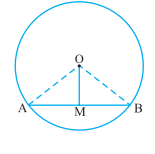
Proof- OA = OB (Radius of the circle)
AM = BM (Given)
OM = OM (Common)
OA = OB (Radius)
Therefore, ∆OAM ≅ ∆OBM (SSS Congruence)
Thus ∠OMA = ∠OMB
Also, ∠OMA + ∠OMB = 180° (Both angles lie on a straight line)
Therefore, ∠OMA = ∠OMB = 90°
Also, the converse of this theorem is also true.
Theorem 4-The perpendicular from the centre of a circle to a chord bisects the chord.
Circle through Three Points
Theorem 5– There is one and only one circle passing through three given non-collinear points.
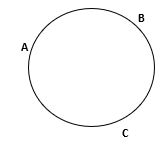
We have already learnt that there is only one unique line passing through two points. For a circle, we require three points (non-colinear points).
Equal Chords and Their Distances from the Centre
Theorem 6– Equal chords of a circle (or of congruent circles) are at equidistant from the centre (or centres).
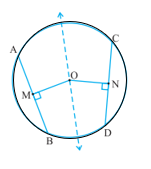
Also, the converse of this theorem is also true.
Theorem 7– Chords equidistant from the centre of a circle are equal in length.
Important points-
- Distance of a line from “a point” is equal to the perpendicular distance from “that specific point” to the line.
- A circle can have infinitely many chords.
Angle Subtended by an Arc of a Circle
If two chords of a circle are equal, then their corresponding arcs are congruent and conversely, if two arcs are congruent, then their corresponding chords are equal.
Also, congruent arcs (or equal arcs) of a circle subtend equal angles at the centre.
Theorem 8– The angle subtended by an arc at the centre is twice of the angle subtended by it at any point on the remaining part of the circle
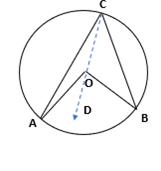
Proof- In triangle OCB,
∠DOB = ∠OCB + ∠OBC (Exterior angle property)
Also, OC = OB (Radii of a circle)
Therefore,
∠OCB = ∠ OBC
This gives
∠DOB = 2 ∠ OCB
Similarly, in triangle OCA
∠DOA = 2 ∠ OCA
Thus,
∠DOB + ∠DOA = 2(∠ OCA + ∠ OCB)
∠AOB = 2 ∠ACB
Above, leads us to the definitions of inscribed and central angles. An inscribed angle is an angle formed by two chords with one shared endpoint, and a central angle is one with a vertex at the centre. Thus, Theorem 8 can be rewritten as “A central angle is always double of the inscribed angle with the same intercepted arc.”
Theorem 9– Inscribed angles in the same segment of a circle are equal.
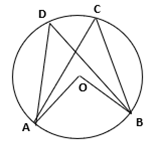
Means, ∠ADB = ∠ACB
Inscribed angle formed by a semicircle is a right angle.
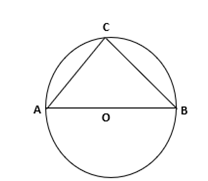
Proof- ∠AOB = 2 ∠ACB (Theorem 8)
As, ∠AOB = 180° (Angle on a straight line)
Therefore,
∠ACB= 90°
Theorem 10–If a line segment joining two points subtends equal angles at two other points lying on the same side of the line containing the line segment, the four points lie on a circle (i.e. they are concyclic)
Cyclic Quadrilaterals
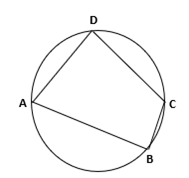
A quadrilateral ABCD is called cyclic if all the four vertices of it lie on the circumference of the same circle
Theorem 11–The sum of either pair of opposite angles of a cyclic quadrilateral is 180°.
Also, the converse of this theorem is also true.
Theorem 12–If the sum of a pair of opposite angles of a quadrilateral is 180°, the quadrilateral is cyclic.
We will start by taking the radius that connects each point on the quadrilateral to the centre of the circle:
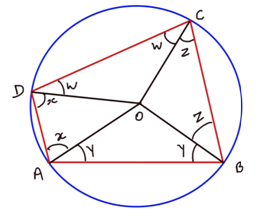
We have created four triangles from the quadrilateral, ∆AOD, ∆DOC, ∆BOC, and ∆AOB. Each one is an isosceles triangle because two of its sides are radii. As we have learned in the triangles properties chapter, in an isosceles triangle, the angles opposite the congruent sides are also congruent, so referring above diagram:
We know that from previous grades that all angles of a quadrilateral add up to 360o, which leads us to:
 DAB +
DAB +  BCD +
BCD +  ADC +
ADC +  CBA. = 360o
We can replace above angles with the angles formed by a combination of angles from the isosceles triangles –
(w + x) + (x + y) + (y + z) + (w + z) = 360o
2w + 2x + 2y + 2z = 360o
w + x + y + z = 180o
By the theorem,  DAB +
DAB +  BCD = 180o and
  ADC +
ADC +  CBA = 180o. Let’s see if this holds up using the above equation:
 DAB +
DAB +  BCD = 180o
(x + y) + (w + z) = 180o
w + x + y + z = 180o
180o = 180o+
 ADC +
ADC +  CBA = 180o
(w + x) + (y + z) = 180o
w + x + y + z = 180o
180o = 180o
Therefore, the sum of both pair of opposite angles in a cyclic quadrilateral is 180o.
Five-point conclusion summarizing the Theorems of Circles in HS Geometry:
- Fundamental Relationships – The theorems of circles establish key relationships between various elements such as angles, chords, tangents, secants, and arcs, providing essential tools for analysing and solving geometric problems involving circles.
- Angle and Arc Interplay – Theorems like the Angle at the Centre, Inscribed Angle, and Tangent-Chord Angle highlight the interplay between angles and arcs, helping us understand how central and inscribed angles correlate with arc lengths, crucial for circle-related geometric proofs.
- Tangents and Secants – The theorems involving tangents and secants, such as the Power of a Point, Secant-Tangent, and Tangents from an External Point, help establish relationships between external points and their intersections with the circle, facilitating the calculation of distances and lengths in circle geometry.
- Cyclic Quadrilaterals and Power of a Point – The properties of cyclic quadrilaterals and the Power of a Point theorem deepen our understanding of the relationship between the circle and other geometric figures, expanding the scope of geometric reasoning beyond the circle itself.
- Real-World Applications – The theorems of circles are not only crucial in abstract geometric proofs but also in real-world applications such as architecture, engineering, and navigation, where circular shapes and their properties are used in designing structures, calculating distances, and creating efficient systems.