Unit: Conics
Chapter: The Ellipse Formula
Reference: – Definition of an Ellipse, Standard Equation of an Ellipse, Major and Minor Axes, Foci and Their Role in Ellipses, Center of an Ellipse, Eccentricity of an Ellipse, Horizontal vs. Vertical Orientation, Graphing an Ellipse, Applications of Ellipses, Transformations of Ellipses
After studying this chapter, you should be able to understand:
- Definition of an Ellipse
- Standard Equation of an Ellipse, Major and Minor Axes
- Foci and Their Role in Ellipses, Center of an Ellipse
- Horizontal vs. Vertical Orientation
- Transformations of Ellipses
Definition of an Ellipse
An ellipse is a symmetrical, closed curve formed by a set of points in a plane where the sum of the distances to two fixed points, called foci, remains constant. This fundamental property distinguishes it from other geometric shapes and is key to its mathematical representation.
Standard Equation of an Ellipse
The equation of an ellipse represents its structure in coordinate geometry, describing its overall shape, orientation, and position in relation to its axes and center. It provides a way to analyze and manipulate the ellipse using algebraic methods.
Major and Minor Axes
The major axis is the longest line segment that passes through the center and foci of the ellipse, while the minor axis is the shortest line segment that is perpendicular to the major axis. These two axes define the overall proportions and orientation of the ellipse in space.
Foci and Their Role in Ellipses
The foci are two fixed points inside the ellipse that determine its shape and properties. The sum of the distances from any point on the ellipse to both foci is always the same, which governs the overall structure of the ellipse and distinguishes it from a circle.
Center of an Ellipse
The center of an ellipse is the midpoint of both the major and minor axes. It acts as the reference point for determining the position of the ellipse within the coordinate plane and helps in defining its equation and geometric characteristics.
Eccentricity of an Ellipse
Eccentricity is a numerical measure that describes the shape of an ellipse, specifically how elongated or circular it is. It depends on the distance between the foci and the length of the major axis. An ellipse with higher eccentricity appears more stretched, whereas lower eccentricity makes it look closer to a circle.
Horizontal vs. Vertical Orientation
The orientation of an ellipse depends on the direction of its major axis. If the major axis is aligned horizontally, the ellipse is stretched along the x-direction, whereas if the major axis is vertical, it is stretched along the y-direction. This distinction affects the way the ellipse is analyzed and represented.
Graphing an Ellipse
Graphing an ellipse involves identifying key features such as the center, foci, vertices, and axes. By locating these points and understanding their relationships, an accurate graphical representation of the ellipse can be achieved, aiding in visualization and problem-solving.
Applications of Ellipses
Ellipses have extensive real-world applications, including planetary motion, satellite orbits, architecture, and optical systems. Their unique geometric properties make them valuable in physics, engineering, and astronomy, demonstrating their significance beyond theoretical study.
Transformations of Ellipses
An ellipse can undergo geometric transformations such as translations, which shift its position, and dilations, which change its size. These transformations alter the appearance and placement of the ellipse while preserving its fundamental properties, allowing for versatile applications in geometry and real-world modeling.
The Ellipse Formula
An ellipse is simply a stretched circle. Most of its important properties are more relevant in algebra, but since it is a geometric figure, and this is the unit on the intersection between geometry and algebra, now’s a good time to introduce ourselves to them.
In this lesson, we will learn about the basic elements of an ellipse. Just as a circle is a special type of ellipse, in this lesson we will also learn that the ellipse formula is simply a more general form of the circle formula.
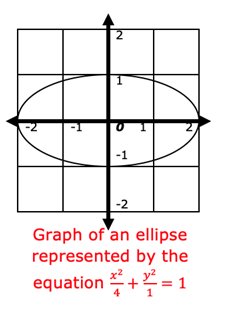
Elements of an Ellipse
There are plenty of interesting elements to an ellipse that you will learn in more detail in later grades. For now, we will learn the parts of an ellipse that we need to know to graph an ellipse and understand the equation.
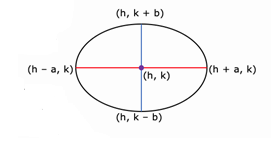
Just like with a circle, an ellipse has a center (h, k). Instead of being defined by a radius, however, an ellipse is defined by its major axis and its minor axis.
- Its major axis, the red line in the picture, has length 2a, and is the longest possible line segment running from one end of the ellipse to the opposite end.
- The minor axis, the blue line in the picture, has length 2b, and is the shortest possible line segment running from one end of the ellipse to the opposite end.No matter which axis is horizontal and which is vertical, the major axis has length 2a and the minor axis is 2b.
The points where the major axis touch the ellipse are called the vertices (singular form is “vertex”). When the major axis is horizontal, these vertices are (h ± a, k). When the major axis is vertical, these vertices are (h, k ± a).
The points where the minor axis touch the ellipse are called the co-vertices (singular form is “co-vertex”). When the minor axis is vertical, these co-vertices are (h, k ± b). When the minor axis is horizontal, these co-vertices are (h ± b, k).
The Formula
Now that we have established the definition of all the different variables of an ellipse, we can delve into the ellipse’s formula:
Horizontal Major Axis: 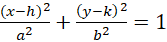
Vertical Major Axis: 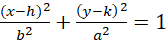
For graphing, don’t worry too much about which is “a” and which is “b”; the square of half of the length of the horizontal axis always goes under the x term and the square of half of the length of the vertical axis always goes under the y term. The reason we use variables referring to which is the major axis and which is the minor axis rather than which is horizontal and which is vertical will be more apparent when we learn more about ellipses in later grades.
For a circle, a = b = r. Therefore, if you put the information for a circle into the ellipse formula, you get:
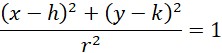
If you multiply both sides by r2, you will get the circle formula, indicating the circle is simply a special type of ellipse in which the major and minor axes are equal.
Fundamental Geometric Shape – The ellipse is a crucial geometric figure defined by a constant sum of distances from any point on the curve to two fixed foci, distinguishing it from circles and other conic sections.
Key Structural Elements – Understanding the major and minor axes, center, foci, and eccentricity helps in visualizing and analyzing ellipses, providing a deeper insight into their unique properties.
Graphical Representation – The equation of an ellipse allows for accurate plotting in the coordinate plane, making it easier to study transformations, orientations, and relationships between various components.
Real-World Applications – The properties of ellipses have widespread applications in astronomy, physics, engineering, and architecture, showcasing their importance beyond theoretical geometry.
Foundation for Advanced Studies – Mastery of ellipses and their equations lays the groundwork for deeper exploration in conic sections, calculus, and applied sciences, helping students build problem-solving skills for higher-level mathematical concepts.